Contents
You know that feeling when you're listening to a sales call recording and you catch something brilliant your rep said that closed the deal?
Or worse, you hear them fumble an objection you know they've been trained on five times?
That feeling is exactly what led to the rise of conversation intelligence. And if you're not using it yet, by the time you finish reading this, you will be.
So, What Actually Is Conversation Intelligence?
Forget the buzzwords for a second.
At its core, a conversation intelligence platform records your customer conversations, calls, meetings, video chats, whatever and then analyzes them to pull out the insights that actually matter.
Think of it like having a coach sitting in on every single customer interaction your team has.
Taking notes, spotting patterns, and flagging the stuff you'd otherwise miss because, let's be honest, who has time to listen to 47 sales calls a week?
It's not just transcription, though that's part of it. The real magic is what happens after.
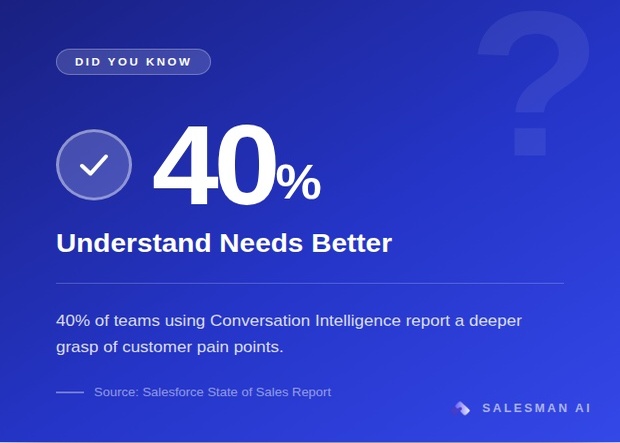
The AI looks at what's being said, how it's being said, what questions prospects ask, which objections keep coming up, talk-to-listen ratios, sentiment, competitive mentions, all of it.
Why Conversation Intelligence Matters Right Now
Here's the uncomfortable truth: most of what happens in your customer conversations is invisible to you.
Your rep closes a deal. Great! But why? Was it the pricing? The specific pain point they touched on? The customer story they told? You probably don't know.
And if you don't know why deals close, you can't replicate it.
Meanwhile, think about what gets missed in your sales calls every week:
- Competitors getting mentioned, but no one tracking it
- The same objections coming up again and again
- Coaching moments that never happen
- Subtle deal signals that everyone overlooks
A new objection starts popping up across 30% of your demos. By the time it bubbles up to management through normal channels, you've lost two weeks of deals you could have won.
Conversation intelligence closes that gap, automatically, in real time.
For sales leaders, it's like finally being able to see what's actually happening on the front lines, instead of just looking at the leaderboard at the end of the quarter.
For reps, the value is just as real. Instead of vague feedback like "you need to do better discovery," they get specific, timestamped moments from their actual calls.
How a Conversation intelligence software Works
The mechanics are straightforward, even if the technology underneath is sophisticated.
Most conversation intelligence softwares integrate with your existing tech stack in hours, not weeks and from there, the process is essentially automatic.
So what really happens from the moment a call starts to the insights you get later?
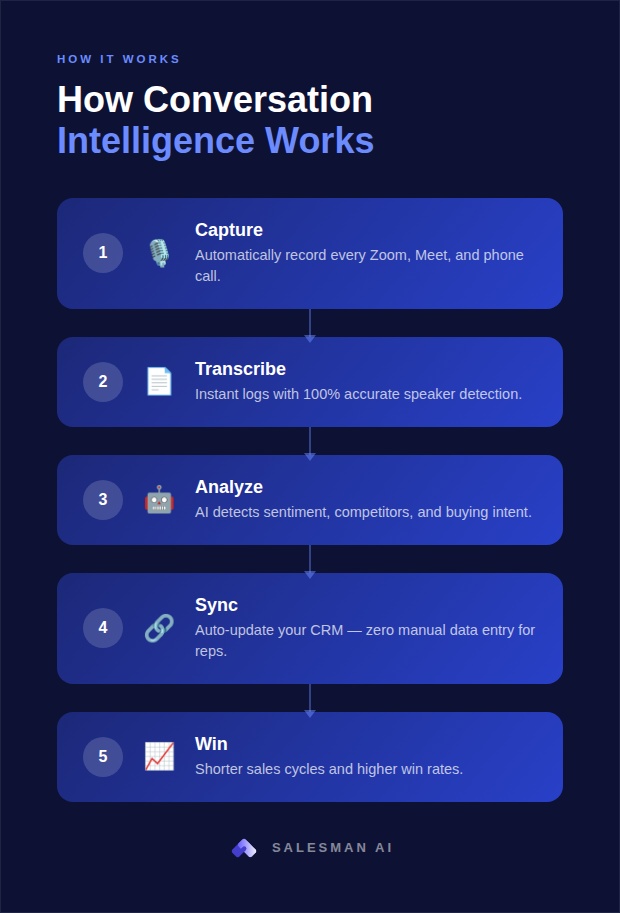
Data Capture
The platform integrates with your communication tools like, Zoom, Google Meet, Microsoft Teams, your phone system and automatically records every conversation.
Transcription
Speech recognition converts spoken words into text in real time, creating a fully searchable record of everything that was said (and by whom).
AI Analysis
NLP (natural language processing and machine learning take over here. The platform identifies key moments, measures sentiment, flags competitor mentions, and tracks behavioral signals like talk-to-listen ratio and question frequency.
Actionable Insights
The software surfaces patterns, recurring objections, pricing discussions, at-risk customer signals and packages them into dashboards your team can actually act on.
CRM Integration
Most platforms sync directly with your CRMs, automatically logging call summaries, action items, and deal signals without reps lifting a finger. That means cleaner pipeline data and less time on admin.
What Kind of Data Gets Analyzed?
The data these platforms surface is honestly kind of wild when you see it all together.
Beyond the obvious like, what was said, when, by whom, it goes much deeper:
| Data Type | What It Tells You |
| Speech-to-text transcriptions | A searchable record of every conversation |
| Sentiment analysis | Whether the prospect is engaged, skeptical, or frustrated |
| Talk-to-listen ratio | Whether your rep is listening or steamrolling |
| Keywords & competitor mentions | Pricing discussions, feature comparisons, competitive flags |
| Objections & pain points | What's blocking deals across your entire pipeline |
| Customer intent signals | Buying language vs. stall language |
| Action items | Commitments made during the call, flagged for follow-up |
Wait, Isn't This the Same as AI Chatbots?
No, and this trips people up constantly. The distinction is simple:
Conversation intelligence analyzes human-to-human conversations. It sits in the background, listening and learning. It doesn't replace you in the conversations, it observes and reports back.
Conversational AI (chatbots, voice assistants, automated schedulers) actually has the conversation instead of a human.
You might use both a chatbot handles inbound qualification, while conversation intelligence analyzes what happens when your reps take over. But they're solving completely different problems.
⚠️ Worth Noting
Conversation intelligence ≠ call tracking. Call tracking tells you which campaigns drive phone calls. Conversation intelligence tells you what happened on those calls.
How Sales Teams Actually Use Conversation Intelligence
Here's what it looks like when it's actually working.
Coaching gets specific
A rep comes out of a demo feeling good. Two weeks later, the deal goes cold.
With conversation intelligence, the manager already knows why. The rep talked for 14 straight minutes without asking a question, and pricing came up but never got properly addressed.
The coaching conversation stops being “what happened?” and starts being “here’s the exact moment, here’s the fix.”
But here’s the real challenge:
Even after coaching, many reps still struggle to apply what they’ve learned in live conversations.
Because in high-pressure moments, sales isn’t just about knowing the right thing to say. It’s about having the confidence to say it.
As Brian Tracy famously said,
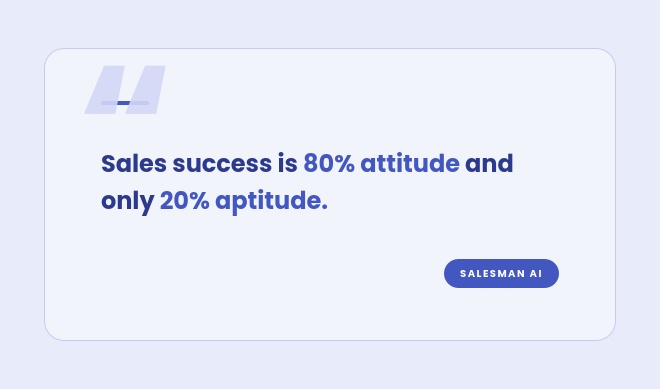
Conversation intelligence plays a powerful role here. When reps know they have real-time guidance, proven talk tracks, and data-backed coaching behind them, they walk into every call with more confidence.
One rep's best call becomes everyone's playbook
Every team has that one rep who just handles objections differently.
CI tells you exactly what they're doing, maybe it's a specific question they ask, or a story they tell at the right moment.
You clip it, share it, and suddenly the whole team is doing it. What used to live in one person's head becomes a good playbook.
Deal risk surfaces before it's too late
A deal has been sitting in "late stage" for three weeks. The rep says it's fine, just slow.
But CI tells a different story, the champion's engagement dropped off after the last call, a competitor got mentioned twice with no real response from the rep, and the last three emails went unanswered.
Catching that signal two weeks earlier is the difference between saving the deal and writing it off.
Conversation intelligence doesn't wait for the rep to update the CRM. It reads what's actually happening.
Real intel straight from the frontlines
Your marketing team updates the competitive battlecard twice a year.
Your reps are hearing about competitors on calls every single week.
There's always been a gap between what's actually being said in deals and what the company officially knows about the competition.
Conversation intelligence closes that gap automatically. Every time a competitor is mentioned, how it came up, what the prospect said, how the rep responded, gets captured and surfaced. Over time you start to see patterns.
Over time, conversation intelligence helps teams build better playbooks, stronger coaching programs, and deeper visibility into what really drives revenue. But insight alone isn’t enough.
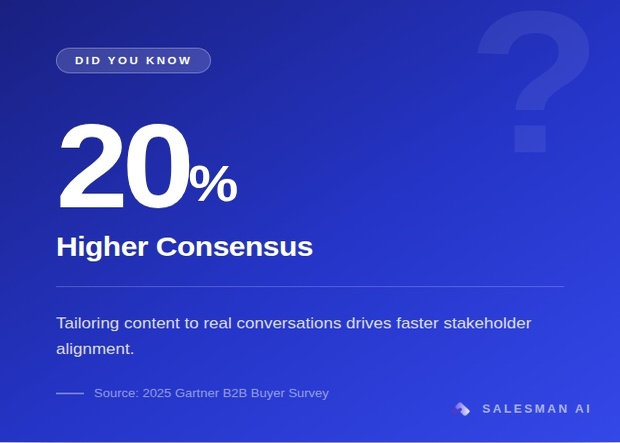
As David Sandler famously said,
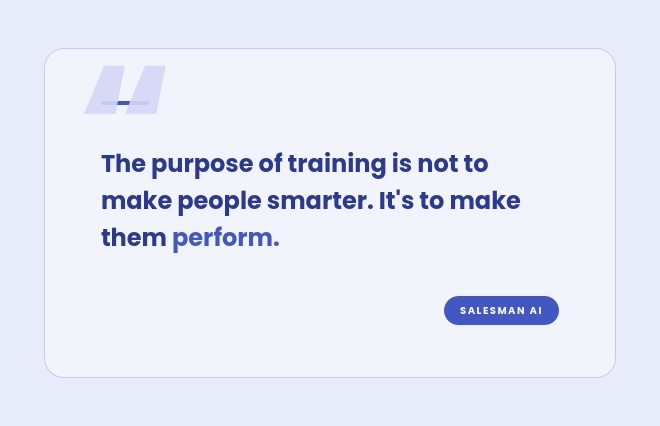
That’s where the next evolution of conversation intelligence begins.
The Evolution of Conversation Intelligence Software
But even with all this visibility into your customer conversations, there’s still a deeper challenge most sales leaders run into.
Why do some reps improve immediately after coaching, while others struggle to apply the same insights in live conversations?
Here’s something worth sitting with.
Two reps on your team get the same call recording, the same coaching session, and the same battlecard. One walks into the next demo and handles every objection cleanly. The other freezes the moment a prospect goes off-script.
Why?
It’s not about who prepared more. It’s about who can use what they know in real time, under pressure, mid-conversation, while the prospect is still talking.
That’s the gap conversation intelligence software is built to close. And that gap has a name: Reflex Intelligence (RQ).
Conversation intelligence gives your team the insights. But RQ determines whether they can act on those insights in the moment, not in the debrief, not on the next call, but right now, when it actually matters.
And that’s why modern conversation intelligence softwares are shifting from passive analysis to real-time guidance, coaching, and execution support, a shift you can already see in platforms like Salesman Ai and Gong.
What Salesman AI Offers as a Conversation intelligence software
Understanding conversation intelligence is one thing. Having a platform that actually delivers on the promise is another.
Salesman AI is built end-to-end around your revenue team's workflow, from the minute before a call starts to the moment a deal closes.
Pre-Call Notes
Walk into every conversation prepared.
Salesman AI generates automatic briefing notes before each call, context on the prospect, deal history, open questions, and suggested talking points, so your reps are never starting from scratch.
On-Call Assistance
Real-time prompts and guidance delivered during live calls.
When an objection surfaces or a competitor gets mentioned, your rep gets the right response cue right when they need it, not in the debrief an hour later.
Post-Call Analysis
Every call automatically analyzed and summarized after it ends.
Key moments, objections raised, sentiment shifts, action items, and next steps, all logged without your rep lifting a finger.
Deal Forecasting
Forecast accuracy built on what's actually being said in deals, not just what reps self-report.
Salesman AI reads conversation signals to give you a real-time, ground-truth view of pipeline health.
Deal Mapping
Visualize the full landscape of every deal, stakeholders, objections, decision timelines, risks, mapped directly from your conversations.
Know exactly where each deal stands and what it needs to move forward.
AI Roleplay
Practice makes pipeline.
Reps can run realistic sales scenarios with Salesman AI's roleplay feature, handling tough objections, practising discovery, or rehearsing a demo, before they're ever in a live deal.
AI Deal Chatbot
Ask anything about any deal and get an instant, accurate answer.
Which stakeholders have we spoken to on the Acme account? What objections came up in last week's demo? Where does this deal stand right now?
Salesman AI's chatbot has read every call, every summary, and every note, so you get nuanced, deal-specific answers in seconds.
The Salesman AI Difference
Most tools cover one part of the conversation, the recording, or the coaching, or the forecasting.
Salesman AI connects the entire journey: before the call, during the call, after the call, and across every deal in your pipeline.
The Bottom Line
You're already having thousands of conversations with your market every week.
Right now, most of what you could learn from them evaporates the second the call ends.
A conversation intelligence software captures all of it, every objection, competitor mention, feature request, and signal that a deal is heating up or cooling down.
The question isn't really whether you should use conversation intelligence. It's how fast you can implement it, how deeply you can embed it into your team's workflows, and how quickly you can act on what it tells you.
The insights are already there in your conversations. You're just not capturing them yet.
Want to try Salesman AI?