Contents
You've heard the name. You've probably sat through the demo. And at some point, someone on your team has asked: "So how much does Gong actually cost?"
And then came the silence. Followed by: "We'll need to get you in touch with our sales team."
Gong keeps its pricing off its website intentionally. And if you're evaluating revenue intelligence platforms in 2026, that alone should make you pause.
Because here's the thing: when a vendor makes you fight for a number, the number is usually the problem.
So we did the digging. In this article, we've broken down exactly what Gong pricing looks like based on customer reports and market analysis, and we've stacked it up against what Salesman AI offers at a fraction of the price and with complete transparency.
Let's get into it.
How Much Does Gong Actually Cost in 2026?
Gong pricing isn't a single number. It's a stack of fees that builds up quickly once you're in the buying process. Here's what you're actually signing up for:
1. The Platform Fee
This is Gong's baseline "access fee." Think of it as the cover charge before you even start paying per user.
Starts at $5,000/year for small teams
Can climb to $50,000/year for larger organizations, depending on data storage volume
What's included in this fee:
Unlimited data storage
Calendar, phone, email, and video integrations
Manager and employee training
Basic onboarding and CSM support
Data export
This is just the foundation. Your per-user costs are on top of this and that's where Gong pricing starts to sting for smaller teams.
2. Gong Pricing Per User
On top of the platform fee, every recorded user costs extra. This is where small and mid-sized teams feel the pressure the most. The Gong pricing per user tiers break down like this:
| Team Size | Per User / Year |
| Up to 49 users | $1,600 |
| 50–99 users | $1,520 |
| 100–249 users | $1,440 |
| 250+ users | $1,360 |
There's no monthly billing option. You pay annually, upfront, before you've had a chance to fully test whether the platform actually fits your workflow.
For a small team already watching headcount costs, Gong pricing per user at $1,600 is a significant line item before you've even proven ROI.
3. The Professional Services Fee
Here's a line item that catches a lot of buyers off guard.
In addition to the platform fee, most teams are expected to pay a $7,500 professional services fee for onboarding, implementation, and training. This is separate from the platform fee. It's not optional if you want a proper setup.
This fee often goes unmentioned until you're already deep in the sales conversation — which is a pattern you'll notice throughout the Gong pricing experience.
4. Add-Ons
Gong's core package covers the basics, but advanced features — including custom integrations, premium analytics, and priority support — are typically negotiated separately during the sales process. Pricing isn't disclosed until you're deep in the conversation.
This is especially relevant if you're evaluating Gong Engage pricing specifically. Gong Engage is Gong's sales engagement layer, designed to manage outbound sequences, calls, and email cadences in one place.
But Gong Engage pricing is handled entirely through a separate negotiation, layered on top of everything else. If you're expecting a bundled, all-in-one price for Gong Engage, you won't find one — at least not without going through a full sales process to get there.
What Does Gong Pricing Look Like in Real Numbers?
Here's how Gong software pricing stacks up across different team sizes:
Small Team: 10 Users
| Line Item | Cost |
| Platform fee | $5,000 |
| Per-user cost (10 × $1,600) | $16,000 |
| Professional services | $7,500 |
| Estimated Total | $28,500/year |
That's nearly $30,000 a year for a 10-person team, before any add-ons, before multi-year contract negotiations, and before you've confirmed it's even the right tool. For small teams evaluating Gong software pricing, this upfront commitment is a hard pill to swallow.
Mid-Sized Team: 50 Users
| Line Item | Cost |
| Platform fee | $5,000 |
| Per-user cost (50 × $1,520) | $76,000 |
| Professional services | $7,500 |
| Estimated Total | $88,500/year |
Enterprise Team: 100 Users
| Line Item | Cost |
| Platform fee | $5,000 |
| Per-user cost (100 × $1,440) | $144,000 |
| Professional services | $7,500 |
| Estimated Total | $156,500/year |
At that scale, Gong software pricing starts to look less like a software subscription and more like a second headcount budget.
So What Does Gong Actually Do?
To be fair to Gong: it's a capable platform. For large sales organizations that need deep call analysis and pipeline visibility, Gong AI pricing reflects a genuinely comprehensive toolset, particularly in the post-call space.
Core features include:
Call and meeting recording across email, phone, and video
Deal boards and pipeline tracking
Sales coaching tools for managers
Activity-based forecasting
Basic AI call scoring
Conversation intelligence with topic and sentiment tracking
Revenue forecasting based on deal activity
CRM sync and activity logging
But here's the honest limitation: Gong is fundamentally a post-call tool. It records what happened. It analyses what was said. It helps managers review calls after the fact and surfaces trends from historical data. That's genuinely useful, but it only solves part of the problem.
It doesn't prepare your reps before they get on a call. It doesn't help them in the moment when a tough objection lands or a competitor gets mentioned. By the time Gong's insights reach your team, the conversation is already over and the opportunity to change its outcome has passed.
For small teams that can't afford to leave those moments to chance, a post-call intelligence tool is better than nothing, but it's not the same as having AI working with your reps across the entire sales cycle.
The Gong Pricing Problem Nobody Talks About
Here's what the pricing structure tells you about the buying experience as a whole:
- No trial. You can't test Gong before you buy. You have to commit to a multi-year contract before you've seen it work in your actual environment, with your actual team, on your actual deals.
- No month-to-month option. Everything is billed annually. There's no way to start small and scale up as you see results.
- Multi-year contracts are the norm. Most Gong deals are structured as multi-year commitments, which means if your team, budget, or strategy changes, you're still on the hook.
- Pricing opacity is by design. The fact that you have to go through a full sales process to get a number isn't a product limitation. It's a negotiation strategy. And the people on the other side of that negotiation do it every day.
- Implementation takes time. Even after you've paid, getting Gong fully configured and adopted across your team takes weeks — sometimes months. That's opportunity cost that doesn't show up in the pricing sheet.
- The cost of Gong Engage pricing adds up fast. If you want Gong's full engagement suite on top of the conversation intelligence layer, you're looking at additional negotiation, additional contract terms, and an additional price that's never disclosed upfront. Gong Engage pricing compounds what's already an expensive decision.
- You're paying enterprise prices for post-call coverage only. At $28,500/year for a 10-person team, you're getting analysis of conversations that have already ended, not intelligence that helps your reps win the ones happening right now.
For small teams specifically, the combination of these factors creates a buying experience that's designed to get you to commit before you've fully evaluated whether the ROI is real.
Is Gong Pricing Worth It for Small Teams in 2026?
Let's be direct: for most small teams in 2026, Gong pricing doesn't make sense.
Here's why:
- At $28,500/year for just 10 users, you're committing serious budget before you've run a single live test in your environment.
- You have no monthly option and no trial to de-risk that commitment.
- You're locking into a multi-year deal when your team's needs, your headcount, and the sales technology landscape are all likely to shift.
- You're paying Gong AI pricing that's calibrated for large enterprise organizations, not lean, growth-stage teams that need to move fast and prove ROI quickly.
- And critically, you're getting a tool that only activates after the call is over, leaving the pre-call preparation and in-call execution entirely on your reps.
The teams that get genuine value from Gong are typically larger organizations with dedicated sales ops or RevOps functions, established coaching cultures, and enough deal volume to make conversation intelligence insights statistically meaningful.
For a 10-person team, you often don't have the infrastructure to act on what Gong surfaces, which means you're paying enterprise-tier prices for post-call insights you can't fully operationalize.
Salesman AI: Pre-Call, On-Call, and Post-Call Intelligence for Small Teams
Salesman AI is built for revenue teams who want AI working across the entire sales cycle, not just reviewing what happened after the call ends.
Where Gong activates post-call, Salesman AI is with your reps before they dial, while they're in the conversation, and after they hang up. And where Gong makes you wait for a sales call to get pricing, Salesman AI puts it on the table from day one.
Here's how the three stages break down:
Before the Call: AI Rehearsal
Salesman AI's AI Rehearsal feature lets reps practice before they're ever in a live deal. They can run through tough objection scenarios, discovery conversations, and demo situations with AI playing the prospect, complete with realistic pushback, curveball questions, and competitive mentions.
For small teams where formal sales coaching time is limited, this is transformative. Repetition builds reflex. By the time a rep gets on a real call, they've already heard the hard questions and rehearsed the right responses. Gong has no equivalent to this, it can only analyze calls that have already happened, not help reps prepare for the ones ahead.
During the Call: AI Ghost
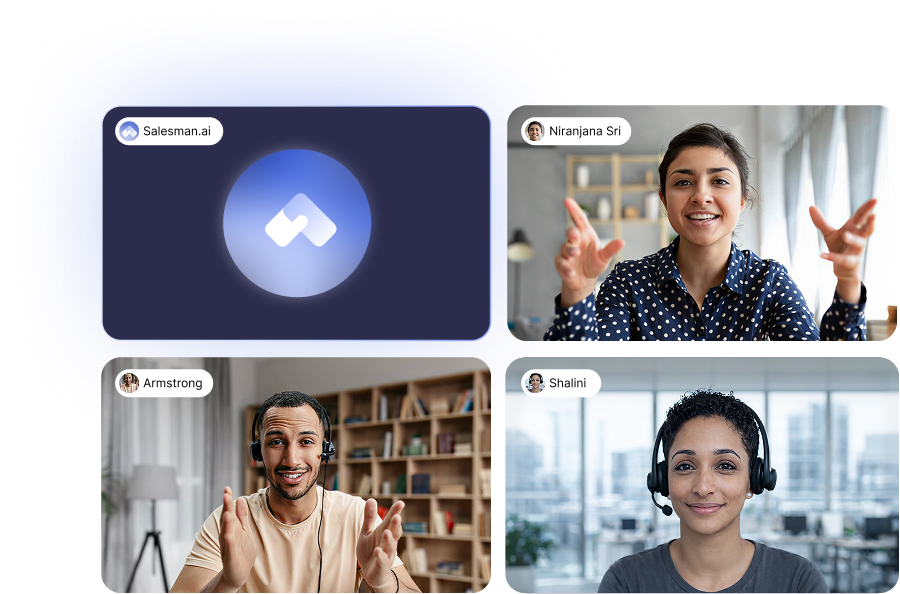
AI Ghost is Salesman AI's real-time guidance engine, live prompts delivered during the call itself.
When an objection surfaces, a competitor gets mentioned, or a buying signal appears, your rep gets the right response in the moment. Not in the debrief an hour later. Not in a manager review the following week. Right now, while the conversation is still alive and the outcome is still in play.
This is the kind of feature that simply doesn't exist in Gong's model. Gong records and analyses. AI Ghost actively participate, invisibly, in making every call better as it happens.
After the Call: Focus Framework Report
Post-call, Salesman AI generates a Focus Framework Report, an automatic, structured analysis of every conversation. Objections raised, sentiment shifts, key moments, action items, deal risks, and next steps are all captured and organized without a rep touching anything.
This is where Gong competes directly, and it does post-call analysis well. But the Focus Framework Report goes further: it doesn't just tell you what happened, it tells you what to do next and how to frame the follow-up. It's built for deal momentum, not just record-keeping.
Combined with deal forecasting based on what's actually being said in conversations, not what reps self-report into the CRM and a full AI Deal Chatbot that can answer any question about any deal instantly, Salesman AI gives small teams a complete revenue intelligence picture that Gong simply wasn't designed to deliver.
The Honest Comparison
Gong is a capable post-call tool. For large enterprise organizations with the budget and operational maturity to support it, it delivers real value in the analysis and coaching layer.
But it only covers one third of the sales cycle.
| Feature | Gong | Salesman AI |
| Pricing transparency | No, requires sales call | Yes, listed upfront |
| Free trial | No | Yes |
| Monthly billing | No, annual only | Available |
| Pre-call AI rehearsal | No | AI Rehearsal |
| Real-time on-call guidance | No | AI Ghost |
| Post-call analysis | Yes | Focus Framework Report |
| Deal forecasting | Yes | Yes |
| AI deal chatbot | No | Yes |
| Full-cycle coverage | Post-call only | Pre, on, and post-call |
| Suitable for small teams | Expensive at this tier | Built for this |
Gong tells you what happened. Salesman AI helps you prepare, perform, and execute — across every conversation, at every stage.
The Bottom Line
Gong is a serious platform. For large enterprise sales organizations with the budget and the operational maturity to support it, it can deliver real value in the post-call analysis space. The Gong AI pricing reflects a product that has genuinely invested in its technology, and for the right buyer — one with the deal volume, RevOps headcount, and coaching infrastructure to act on post-call insights, it pays off.
But for everyone else, two problems compound each other in 2026.
The first is the price. Nearly $30,000 a year for a 10-person team. No trial. No monthly option. Multi-year lock-in. Gong software pricing you have to negotiate just to see. Gong Engage pricing on top of that if you want the full suite. A professional services fee that most buyers don't see coming.
The second is the coverage gap. Even if you could afford it, you'd be paying enterprise rates for a tool that only activates after the call is over. Your reps would still walk into calls underprepared, handle objections on instinct, and miss the moments that actually decide deals.
Salesman AI closes both gaps. Transparent pricing, full-cycle coverage — AI Rehearsal before the call, AI Ghost during it, and the Focus Framework Report after — and a platform built for teams that need to move fast and prove ROI without writing a blank check.
If you want to see what that looks like for your team, you don't need to book three discovery calls to find out what it costs. You can just start.