Contents
Here is a reality check nobody says out loud on the Monday forecast call: most of the numbers on the report are not accurate data. This is exactly the problem a revenue intelligence platform is built to solve.
A deal is marked "commit" because the rep feels good about the relationship. Another sits in "pipeline" because nobody wants to be the one to remove it. And CRM notes? Usually written in a rush between calls, missing the exact moment a buyer's tone shifted or procurement suddenly got looped in.
Sales teams generate more data than ever, yet the most important questions still feel like guesses:
- Is this deal actually going to close?
- Which rep needs help right now?
- What is making deals slip in Q3?
According to Salesforce, sales reps spend less than one-third of their time actively selling. Gartner predicts AI will influence the majority of B2B sales interactions by 2028, meaning the window to build a data-driven sales motion is now.
To help you choose the right revenue intelligence software, this guide breaks down the top five options appearing in real sales stacks this year, features, pricing, honest pros and cons, and best use cases.
TL;DR
- Gong = Best for enterprise coaching
- Clari = Best for forecasting
- Sybill = Best for admin automation
- Salesman AI = Best for end-to-end rep execution
- Backstory = Best for CRM hygiene
What is the Best Revenue Intelligence Platform?
A revenue intelligence platform is AI-driven software that automatically captures and analyzes your sales conversations, emails, and pipeline activity, giving reps and leaders a real-time picture of deal health, without manual CRM updates.
For enterprise teams, Gong and Clari are the market leaders. For growing teams wanting affordable AI coaching, Salesman AI and Sybill are faster to implement. For RevOps teams focused on CRM hygiene, Backstory is the specialist pick.
Revenue Intelligence Platforms Compared at a Glance
| Platform | Best For | Starting Price |
| Gong | Enterprise Coaching | Custom |
| Clari + Salesloft | Forecasting & Execution | Custom |
| Sybill | Admin Automation | $49/user/month |
| Salesman AI | End-to-End Rep Support | $19/user/month |
| Backstory | RevOps Data Layer | Custom |
What to Look for in a Revenue Intelligence Platform
Before evaluating individual platforms, it helps to understand how revenue intelligence platforms help drive sales across real-world workflows. Instead of checking arbitrary boxes on a vendor website, look for these five specific things.
1. Conversation Intelligence Depth
Does the tool actually understand what is happening in a call, or does it just transcribe words? There is a massive difference between "we detected the word 'pricing'" and "the buyer showed hesitation around budget three times in this call."
2. Action Over Post-Mortem Analysis
Too many revenue intelligence tools give you a beautiful post-mortem on a deal that already died. The best ones surface the right insight while the deal is still alive and saveable.
3. True Rep Adoption
The fanciest platform in the world fails if reps find workarounds to avoid logging into it. Tools that reduce manual data entry always win here because they give time back to the rep.
4. Direct CRM Hygiene
Look closely at how revenue intelligence tools streamline sales processes by automatically injecting conversation insights directly back into your CRM fields rather than making reps copy-paste summaries.
5. Pricing Transparency
Some sales forecasting software providers are famously opaque about what things cost. Keep this in mind when mapping out your true total cost of ownership.
Two Questions for Your Next Vendor Call
Push past the standard sales pitch and ask these:

"Does your platform natively write data back to our specific CRM objects, or does it only suggest updates that my reps still have to click and approve?"
"Can you show me the exact rep-facing dashboard, and explain how it prevents tool fatigue for an AE who already uses five other applications?"
How Revenue Intelligence Addresses the Ebbinghaus Forgetting Curve
Psychologists have long proved that humans forget roughly 50–60% of new information within one hour of learning it.
In a high-intensity sales environment, an AE finishes a grueling discovery call, immediately closes their laptop to grab a coffee, and by the time they sit down to update Salesforce, more than half of the crucial psychological nuances of that call are gone forever.
It is not because your reps are lazy, it is a physiological limitation. That is the exact gap a modern revenue intelligence platform is built to close. The right tools do not just show you what happened; they tell you what it means and what to do next.
Top 5 Revenue Intelligence Platforms: Full Comparison
1. Gong
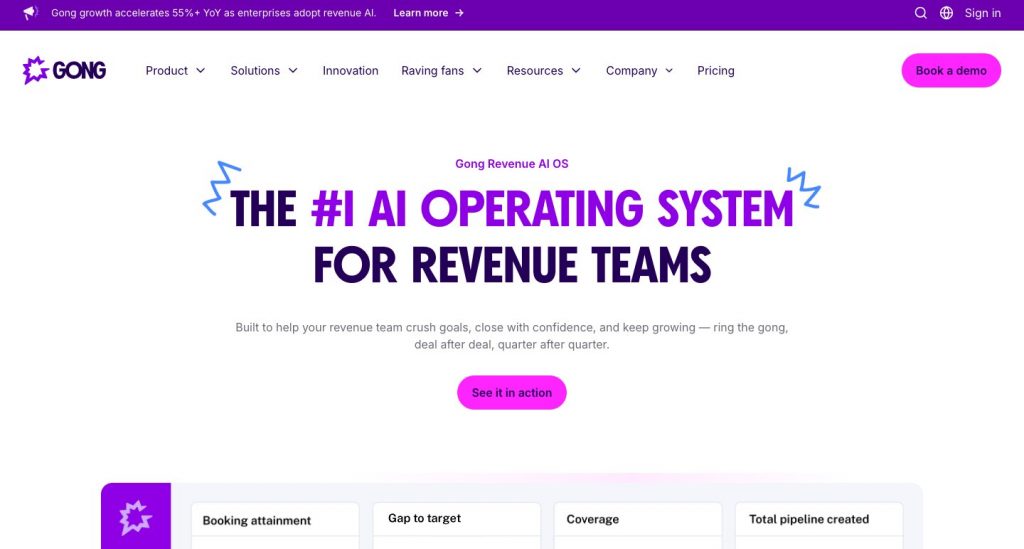
Best for: Large enterprise sales teams with a dedicated RevOps function and budget to match.
Pricing: Custom enterprise tiers; user reports put it north of $100K/year for mid-size teams.
Gong basically invented the mainstream conversation intelligence category. If you work in B2B SaaS, you have probably had a manager say, "Let me pull this up in Gong." That brand recognition is real and earned.
What It Does Well
Gong gives managers an incredibly powerful lens into how reps sell. Talk-to-listen ratios, competitor mentions, discovery questions that land, and deals where buyer engagement has gone cold, it is all there. For sales leaders who want deep, data-backed coaching conversations, Gong is hard to beat.
The "Observer Effect" Backlash
Borrowing a concept from physics, the Observer Effect states that the mere act of observing a phenomenon changes how it behaves. When legacy platforms arrived, leadership often used them as surveillance tools, managers used recorded calls to play "gotcha" games.
The industry is experiencing a significant backlash against this approach to conversation intelligence. When reps know they are being monitored solely for compliance, they play it safe, stick rigidly to scripts, and lose their natural closing instincts. Gong is pushing back with expanded AI "Assistant" tools, but its underlying legacy architecture still feels built for manager observation rather than day-to-day rep execution.
The Verdict: Skip Gong if you are a lean team, lack a dedicated RevOps person, or your reps are already stretched thin on admin work. It is great for enterprise teams with a mature sales process and a coaching culture.
2. Clari + Salesloft
Best for: Revenue leaders and CROs who need strict pipeline visibility, forecasting confidence, and execution across the revenue operations function.
Pricing: Enterprise pricing, custom quotes only.
Following their merger, Clari and Salesloft have solidified their position as a dominant force in enterprise revenue orchestration. By combining Clari's forecasting engine with Salesloft's frontline execution tool, they aim to bridge the gap between back-office reporting and front-line action.
What It Does Well
The combined platform excels at aggregating massive data pipelines. It pulls signals from across your stack, emails, meetings, CRM activity and surfaces a real-time picture of which deals are moving and which are stalling. For a VP of Sales running weekly forecast calls, it makes those conversations much sharper.
The Frankenstack User Experience Problem
While the headlines call it a revenue AI powerhouse, the reality on the ground is a classic integration tax. Clari and Salesloft come from two entirely different legacy database architectures. Right now, frontline AEs still live in the Salesloft UI to run their cadences, while leadership inspects the data inside the Clari UI.
A recent study by Clari Labs found that 87% of enterprises missed revenue targets despite record AI investments, precisely because their data lacked real-time context. Managing integration decisions across multiple legacy schemas means your internal RevOps admin burden may actually increase during their multi-year unification roadmap.
The Verdict: Skip Clari + Salesloft if you are a nimble team that wants a lightweight, single-interface tool to help reps execute deals faster day-to-day. It is built for larger enterprise organizations requiring deep, board-level forecasting accountability and global scale.
3. Sybill
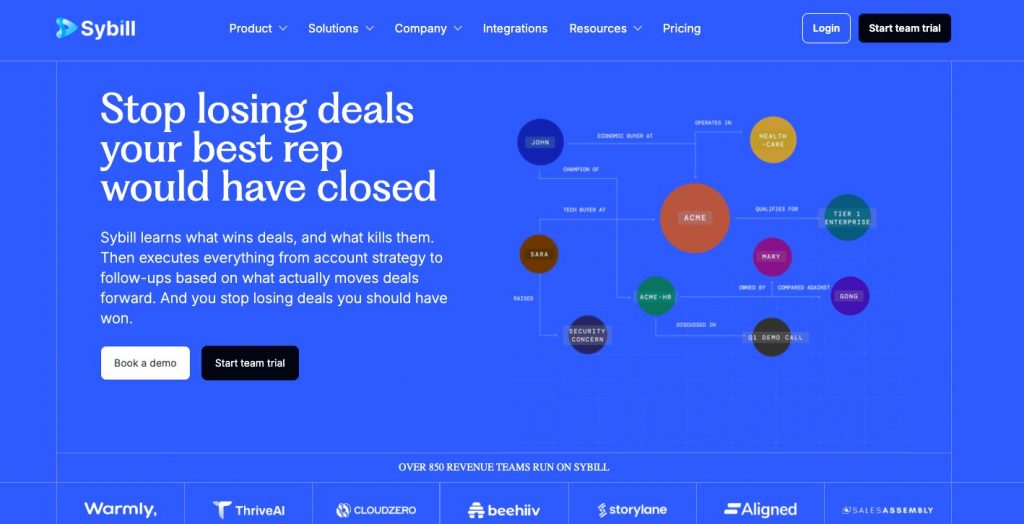
Best for: Sales reps and AEs who want AI to handle the admin work so they can focus on selling.
Pricing: Starts around $49/user/month with a free trial available.
Sybill is not a household name the way Gong or Clari is. But when you ask reps which sales intelligence platform actually makes their day easier, it comes up constantly. The core insight behind Sybill is simple: while most tools are built for leadership surveillance, Sybill is heavily weighted toward rep productivity.
What It Does Well
Sybill is a masterclass in how revenue intelligence platforms reduce manual data entry. Within minutes of a call ending, it automatically generates a structured summary — capturing the exact context needed to combat the Ebbinghaus Forgetting Curve — and writes that data directly back into your CRM fields.
It drafts a follow-up email in your exact tone, creates tasks from the conversation, and gives you a pre-meeting brief before your next call so you are not scrambling through notes.
The Honest Gaps
Sybill's macro-reporting and analytics layer is not as deep as Gong's. If your VP needs to compare 12 months of talk-track trends across 80 reps, Gong has more raw horsepower. As a newer platform, its integrations ecosystem is also smaller.
The Verdict: Skip Sybill if you are a massive enterprise team that needs a sophisticated coaching and analytics observation layer above all else. It is ideal for growing teams where manual admin is eating up selling time.
4. Salesman AI
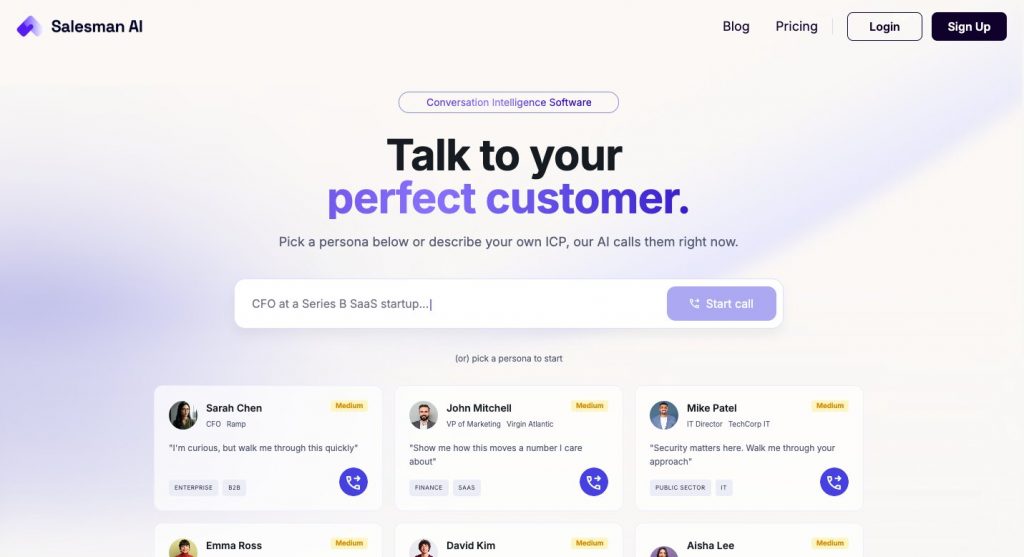
Best for: Sales reps and AEs who want one unified system handling everything, before the call, during it, and after it ends.
Pricing: Starts around $19/user/month with a free trial available.
The Hidden Trend: AI Copilot Fatigue
The average enterprise sales stack now features five or six different AI micro-features bolted onto separate tools. The email tool has a writer, the dialer has a summarizer, the CRM has a forecasting predictor. Reps are spending more time managing their various AI assistants than talking to prospects. Salesman AI stands out because it targets this fragmentation directly, treating the rep as the primary user at every single stage of a deal under one unified workflow.
The product is tightly structured around three distinct moments that matter most in any deal:
Before the call: Salesman AI generates pre-call notes built on the DISC framework. It also features AI Rehearsal, essentially AI roleplay, which builds an exact clone of your prospect so you can practice objection handling and test your pitch before the real call. Learn more about how AI sales coaching works in practice.
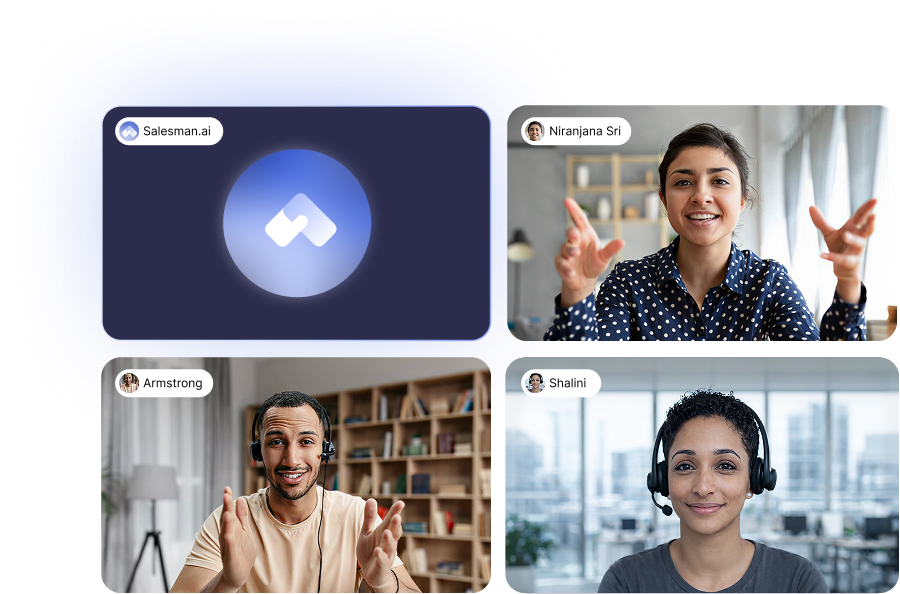
On the call: It runs live nudges that act like a GPS for your sales conversation. While you are talking, it surfaces the right prompt at the right moment to keep you on track toward closing.
After the call: Its FOCUS framework kicks in. It captures 100% of the conversation context and in under three minutes, your follow-up is written, your CRM is updated via CRM automation, and your winning strategy is built.
The Honest Gaps
As a newer platform, Salesman AI's integrations ecosystem and macro-level analytics layer are not as mature as Gong or Clari. If your VP needs enterprise-wide forecasting rollups across hundreds of reps, you will want to pair it with a dedicated tool for that layer.
The Verdict: Skip Salesman AI if you are primarily solving for executive-level pipeline visibility or large-scale sales forecasting. It is built for individual reps who want to walk into every call prepared, get coached live, and automate their post-call flow.
5. Backstory (Formerly People.ai)
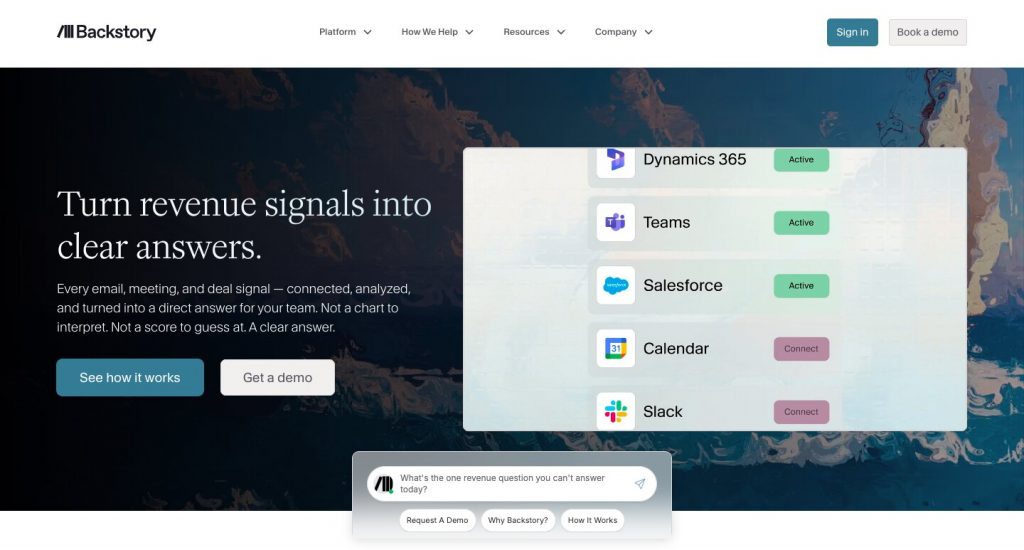
Best for: RevOps teams that need clean CRM data and want to deliver revenue context directly into modern AI workflows.
Pricing: Enterprise pricing, demo required.
In April 2026, People.ai officially rebranded as Backstory, shifting away from traditional data-capturing dashboards to become what they call a "Revenue Answers Platform." The tool solves a very specific, painful enterprise problem: your CRM data is incomplete because reps simply do not have time to log interactions.
The Concept: Illuminating the "Dark Pipeline"
Most traditional platforms look at your pipeline as a clean, linear progression — Discovery → Demo → Proposal. But the modern B2B buying journey looks like a spiderweb. Buyers discuss your product in private Slack communities, read un-trackable peer reviews, and consult internal champions before talking to a rep.
This is the Dark Pipeline.
Backstory acts as a digital detective to combat this. It automatically captures sales activities across email, calendar, and Slack and syncs them to the CRM, revealing the hidden buying team's true alignment. Backstory has also integrated Model Context Protocol (MCP), meaning instead of logging into a dashboard, a CRO or rep can open their preferred AI assistant and ask plain-language questions like "What's the backstory on the Acme Corp deal?" and get an instant, data-grounded deal intelligence assessment.
The Honest Limitation
While Backstory excels at structural revenue reasoning and data plumbing, it is not a native conversation intelligence tool. It infers buyer sentiment and deal risk signals from activity and text data, but it lacks the deep, granular audio-visual coaching analytics found in platforms like Gong.
The Verdict: Skip Backstory if your primary goal is to review rep talk-tracks for granular coaching. It is built for enterprise RevOps leaders who want flawless CRM hygiene and a headless, AI-ready data layer.
How to Choose a Revenue Intelligence Platform
Stop reading feature matrices for a second. Three simple questions will clear up the right path forward.
1. Who is the primary user, reps or managers?
- Reps who want end-to-end deal support → Salesman AI
- Reps who primarily need post-call admin handled → Sybill
- Managers and leaders → Gong for coaching, Clari for pipeline forecasting
2. What problem keeps you up at night?
- "My forecast is always wrong." → Clari
- "My reps spend too much time on admin." → Sybill or Salesman AI
- "My reps are going into calls unprepared." → Salesman AI
- "I can't coach effectively." → Gong
- "My CRM data is garbage." → Backstory
3. What is your team size and RevOps maturity?
- Under 20 reps, no dedicated RevOps → Salesman AI or Sybill
- 20–100 reps with a RevOps function → Assess Gong or Clari; layer Salesman AI for rep-level execution
- 100+ reps, full enterprise RevOps team → Gong + Clari, with Backstory as the automated data layer underneath
Red Flags to Watch For When Evaluating Vendors
🚩 The demo focuses entirely on the manager view. If you spend an entire demo looking at executive dashboards but never see what a rep's actual workflow looks like post-call, ask to see it. That is where adoption is won or lost.
🚩 They cannot tell you the average time-to-value. Vague answers here are a major warning sign. AI-native solutions should deliver value within days. Enterprise platforms like Gong or Clari can take 4–8 weeks, but they should be upfront about it.
🚩 The AI outputs feel generic. If an AI-generated follow-up email looks like a basic mail-merge with a chatbot wrapper, the underlying intelligence is thin. It should reflect the nuanced points discussed on the actual call.
🚩 The vendor resists a structured trial. Focus on 10–15 reps testing one specific workflow for 2–3 weeks. If a vendor pushes immediately for an annual commitment instead of a pilot, walk away.
What Revenue Intelligence Will Look Like in 12 Months
- Intelligence turns into automation. The current wave acts on insights automatically — updating CRMs, drafting emails, and generating task flows without manual intervention.
- Pre-call intelligence takes center stage. The next frontier is what happens before the call — preparation, AI roleplay, and building rep confidence before stepping into the room.
- AI search replaces static dashboards. Reps are increasingly asking natural language questions about their deals rather than digging through pipeline visibility dashboards.
- Platform consolidation accelerates. Running separate point solutions for calls, forecasting, and engagement creates data silos and tool fatigue. The Clari and Salesloft merger proves that tech stack consolidation is now a boardroom mandate.
FAQs
A revenue intelligence platform is an AI-driven software category that automatically captures and analyzes data across sales conversations, email threads, and pipeline activity to give leadership and reps an accurate, real-time look at deal health and forecasting predictability.
Conversation intelligence focuses specifically on recording, transcribing, and analyzing meetings. Revenue intelligence is much broader, it takes that conversational data and connects it directly with pipeline progression, email engagement, CRM automation, and financial forecasting models.
Revenue intelligence tools are software platforms that use AI to capture, analyze, and act on data generated across the sales cycle, including call recordings, email threads, CRM logs, and pipeline signals, to help teams forecast accurately and close more deals.
By replacing manual CRM updates and gut-feel pipeline reviews with automatically captured activity data and AI-driven deal health scores, revenue intelligence platforms give sales leaders a far more accurate and real-time picture of which deals will close and which will slip.
A CRM is a system of record, it stores data that reps manually enter. A revenue intelligence platform is a system of insight, it automatically captures activity data, analyzes it for signals, and surfaces recommendations on top of your CRM rather than replacing it.
For startups and small teams, Salesman AI and Sybill offer the lowest implementation overhead, transparent per-user pricing, and fast time-to-value, typically within days of connecting your calendar. Both are built with the rep experience as the priority.
For enterprise teams with a dedicated RevOps function and a genuine coaching culture, yes. For teams under 50 reps without a RevOps owner to manage the platform, the cost-to-value ratio is harder to justify. Newer sales intelligence platforms like Salesman AI deliver a comparable rep-level experience at a fraction of the price.
Not necessarily. If your biggest roadblock is outbound pipeline generation and sequence organization, a sales engagement platform is your starting point. If your issue is pipeline visibility and forecasting accuracy, look toward a purpose-built revenue intelligence tool.
AI-native tools like Salesman AI and Sybill generally have the lowest implementation overhead, reps can connect their calendars and see value within days. Enterprise deployments like Gong or Clari typically require 4–8 weeks.
Most platforms cover one part of the deal cycle. Salesman AI covers all three: pre-call preparation with DISC-based briefings and AI Rehearsal, live in-call coaching nudges, and fully automated post-call execution through the FOCUS framework.