
Contents
Sales closing has a bad reputation, and frankly it earned one.
For years, sales training taught reps to memorise clever lines. As a result, buyers learned to spot the trick coming a mile off.
But a close is not a trick. Instead, it is simply the moment you ask someone to decide. So the only real skill is knowing which question to ask, and when to ask it.
Below you will find ten sales closing techniques that still work. For each one, there is a short script, the situation it suits, and the mistake that ruins it.
"There is no magic to closing. There are no magic phrases." — Alice Heiman, sales strategist
TL;DR - the 10 sales closing techniques at a glance
If you only read one part of this page, read this table.
| # | Technique | Use it when | Risk if you rush it |
|---|---|---|---|
| 01 | Assumptive Close | The buyer is asking how onboarding works | Sounds pushy if they have not decided |
| 02 | Summary Close | The deal is long and has many parts | Turns into a pitch if you overstuff it |
| 03 | Alternative Close | They are weighing up two packages | Three options create fresh doubt |
| 04 | Question Close | Something is blocking the deal quietly | Feels like a trap at signature stage |
| 05 | Takeaway Close | They keep asking for extras | Backfires if the extra costs you nothing |
| 06 | Urgency Close | A genuine deadline exists | A fake deadline kills trust for good |
| 07 | Soft Close | You cannot read the room yet | It tests interest, so something must follow |
| 08 | Objection Close | One clear blocker is left | A second objection means you were not close |
| 09 | Ben Franklin Close | An analytical buyer keeps circling | Feels rigged if you fill both columns |
| 10 | Sharp Angle Close | They ask you for a discount or freebie | Damaging if you cannot deliver it |
What is a sales closing technique?
A sales closing technique is a specific way of asking a buyer to commit.
Some techniques ask outright. Others test the water first. Meanwhile, a few remove something to see how badly the buyer wants it.
However, they all do the same job. Each one turns a friendly chat into a clear decision.
Of course, no single technique works everywhere. So the real skill is matching the close to the buyer sitting in front of you.
Why deals stall in the first place
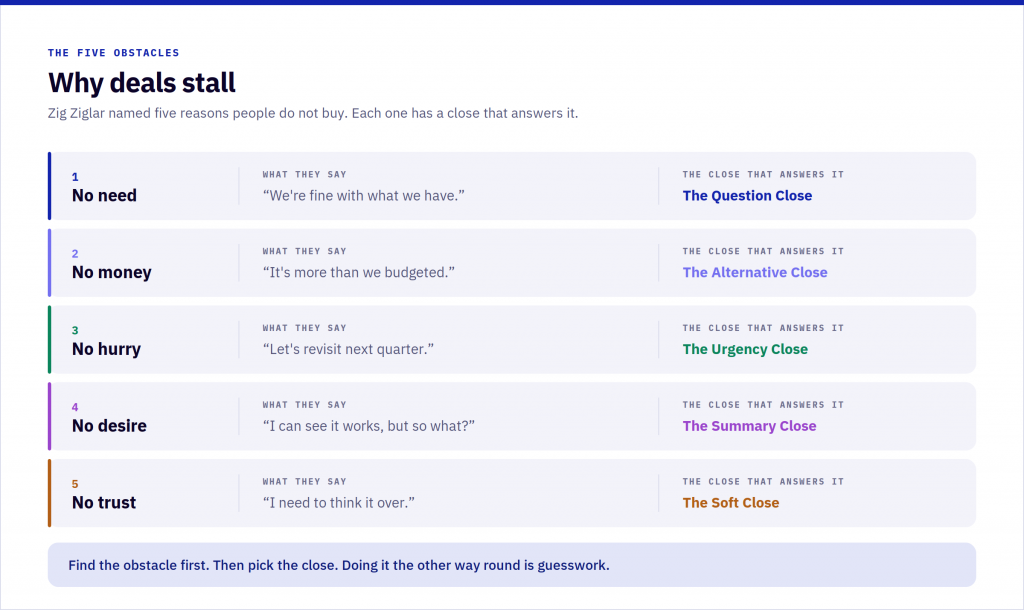
Before you pick a close, work out what is actually stopping the buyer. Zig Ziglar summed it up decades ago, and it still holds.
"Every sale has five obstacles: no need, no money, no hurry, no desire, no trust." — Zig Ziglar, author of Secrets of Closing the Sale
Because of that, closing starts well before you ask for the order. First you name the obstacle. Then you choose the close that answers it.
The 10 sales closing techniques
Each technique below follows the same shape. First the idea, then a real conversation, and finally the moment to avoid it.
1. The Assumptive Close
What it is: You talk as though the buyer has already agreed, so the conversation shifts to logistics rather than permission.
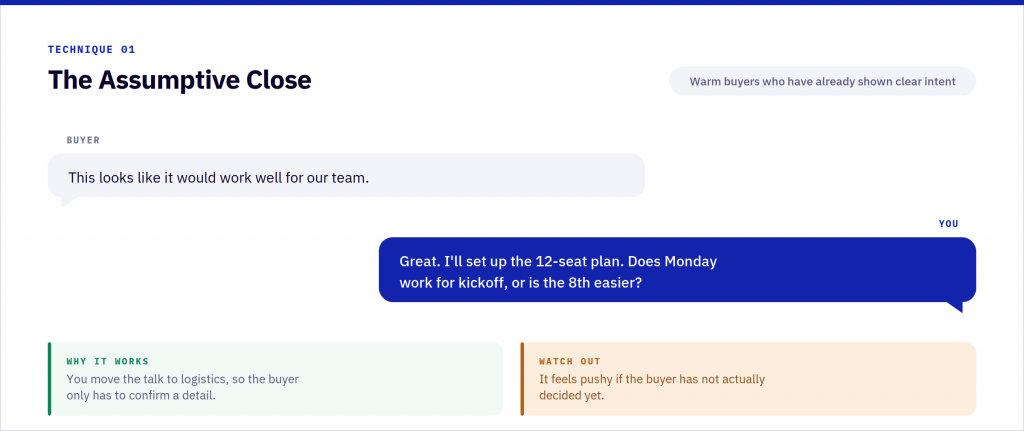
Why it works: Small decisions feel easier than big ones. So "Monday or the 8th?" lands more softly than "do you want to buy?"
When to avoid it: Skip it unless the buyer has shown real intent. Otherwise you will have to backtrack, and that costs you credibility.
2. The Summary Close
What it is: You replay everything the buyer is getting, in their words, just before you ask for the decision.
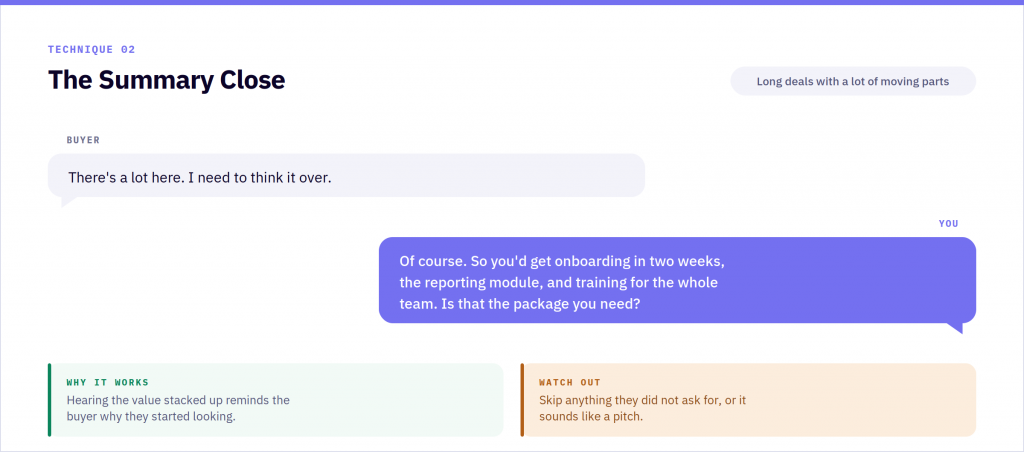
Why it works: Long deals blur. Hearing the value stacked up again reminds the buyer why they started looking in the first place.
When to avoid it: Never list things they did not ask for. Otherwise the recap turns into a pitch, and the moment slips away.
3. The Alternative Close
What it is: Rather than asking yes or no, you offer two options. Either answer moves the deal forward.
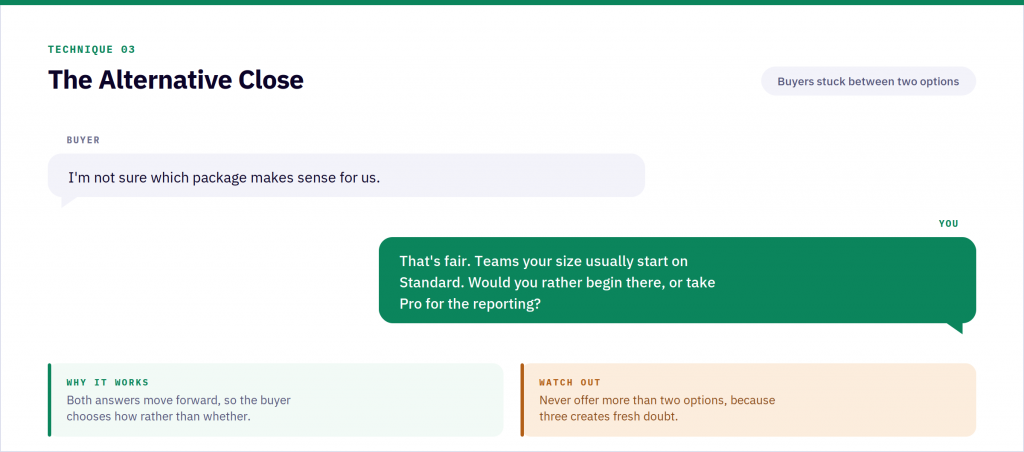
Why it works: The buyer stops deciding whether to buy. Instead, they start deciding how to buy, which is a much smaller step.
When to avoid it: Offer two choices, never three. Because a third option reopens the whole decision, buyers often retreat to thinking it over.
4. The Question Close
What it is: You ask a direct question designed to surface whatever is quietly blocking the deal.
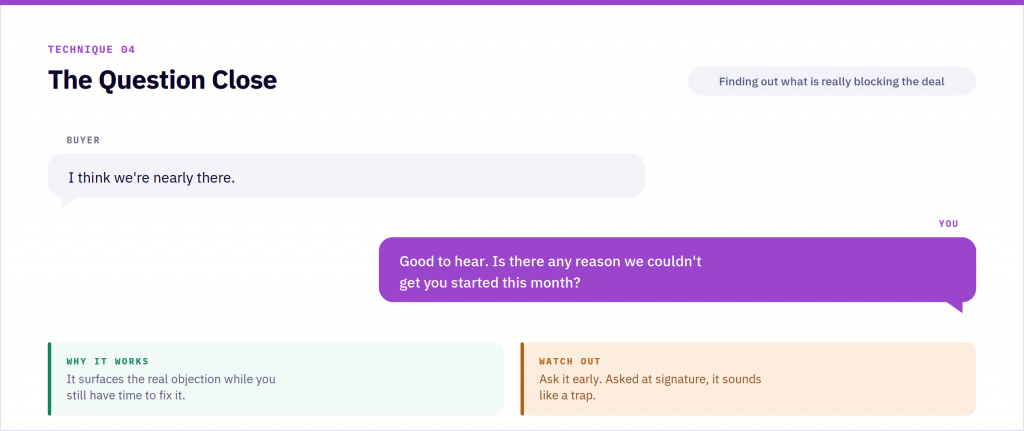
Why it works: Silent objections kill more deals than loud ones. So asking early gives you time to fix the problem.
When to avoid it: Ask it mid-cycle, not at signature. At the last minute, the same question sounds like a trap.
5. The Takeaway Close
What it is: When a buyer asks for more, you offer it. Meanwhile, something else has to come out to keep the budget straight.
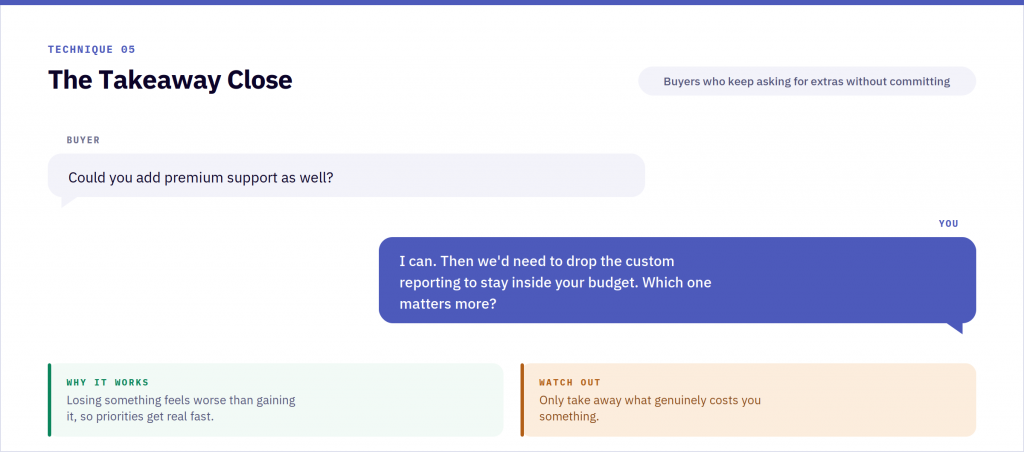
Why it works: Losing something stings more than gaining it. As a result, priorities become clear very quickly.
When to avoid it: Only remove things that genuinely cost you money. If the extra is free, the trade is obviously fake.
6. The Urgency Close
What it is: You point to a real deadline, then explain plainly what happens if the buyer misses it.
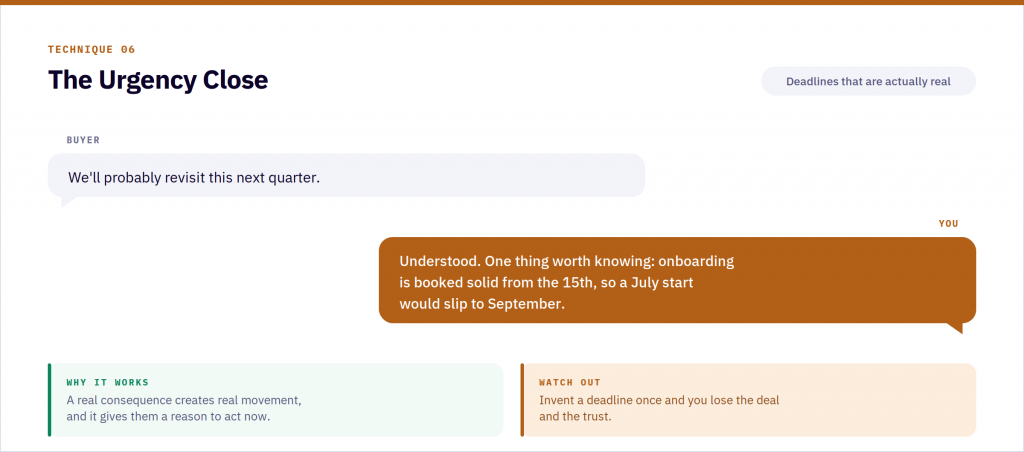
Why it works: Real consequences create real movement. Because the deadline is genuine, the buyer can check it and still trust you.
When to avoid it: Never invent a deadline. Once a buyer catches you, you lose the deal and the relationship together.
7. The Soft Close
What it is: Also called a trial close, this is a low-pressure question that measures interest without asking for a signature.
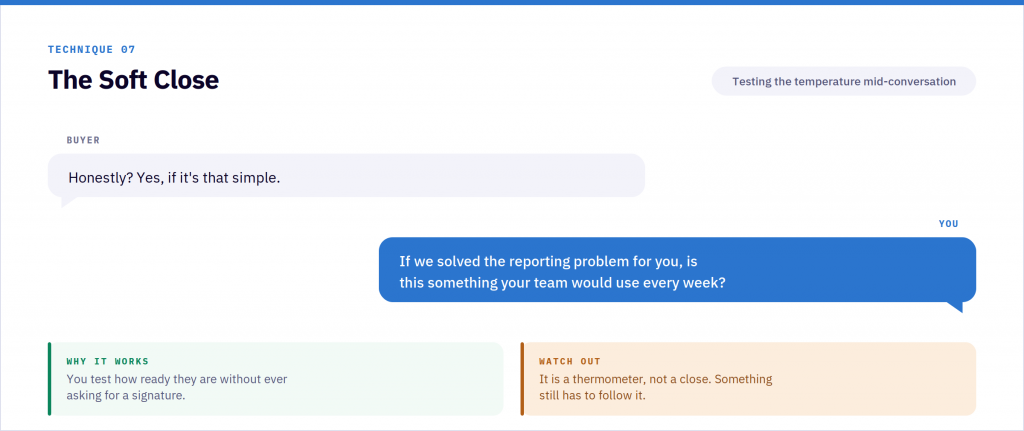
Why it works: You learn where you stand before committing to a bigger ask. Consequently, you avoid closing far too early.
When to avoid it: Treat it as a thermometer rather than a close. Something firmer still has to follow it.
8. The Objection Close
What it is: You isolate the final blocker, then confirm that solving it clears the path completely.
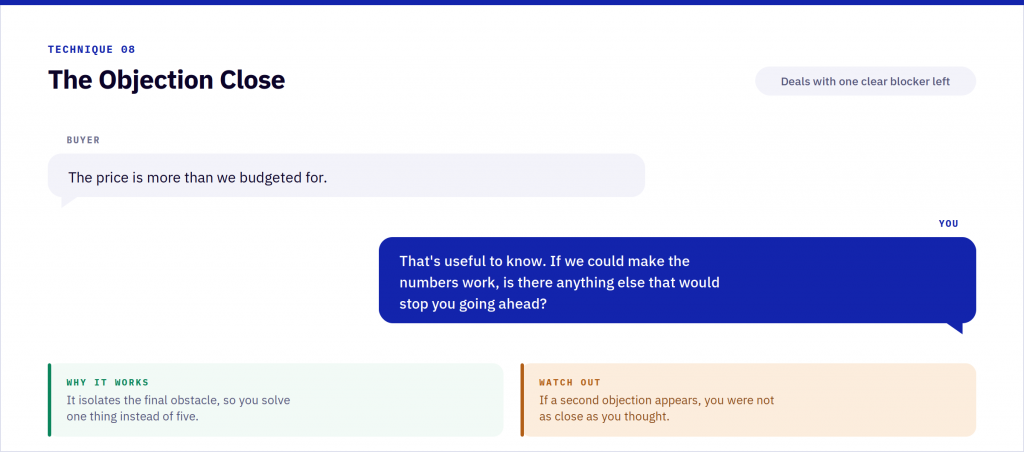
Why it works: You end up solving one problem instead of five. Brian Tracy framed objections as useful rather than hostile.
"Treat objections as requests for further information." — Brian Tracy, author of The Psychology of Selling
When to avoid it: If a second objection appears immediately, you were further away than you thought. So go back to discovery.
9. The Ben Franklin Close
What it is: You write the reasons to go ahead on one side and the reasons to wait on the other.
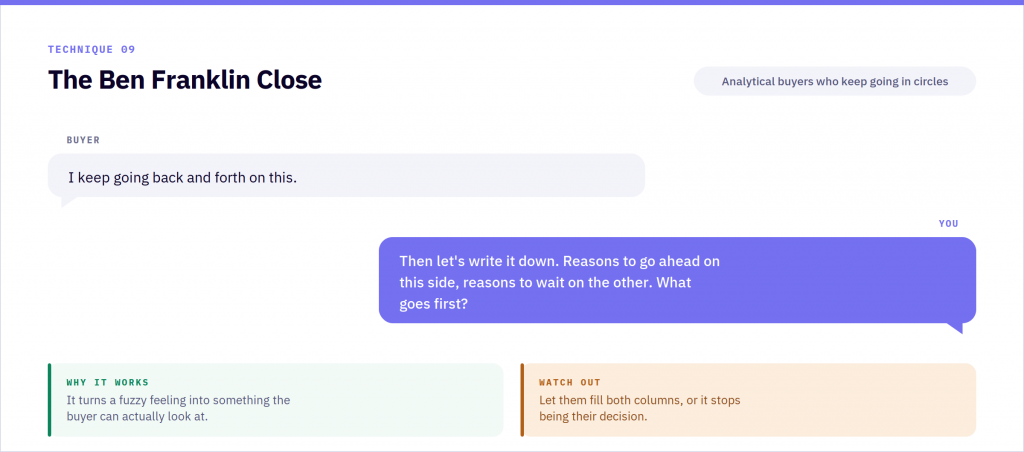
Why it works: A vague worry shrinks once it is written down. Analytical buyers especially like seeing the trade-off laid out.
When to avoid it: Let the buyer fill both columns themselves. Otherwise it stops feeling like their decision.
10. The Sharp Angle Close
What it is: When a buyer asks for a concession, you trade it directly for a commitment.
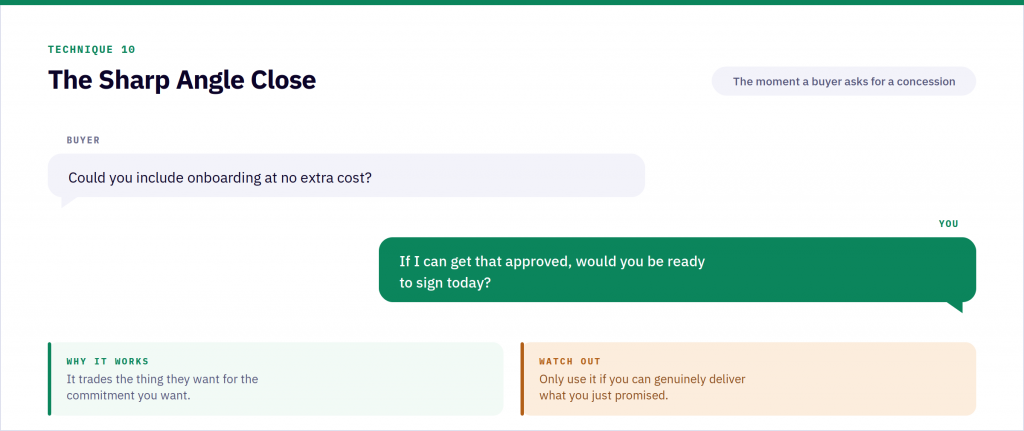
Why it works: The buyer has just told you exactly what they value. Therefore you can exchange it for the decision you need.
When to avoid it: Only use it when you can actually deliver. Promising something you cannot approve destroys the deal later.
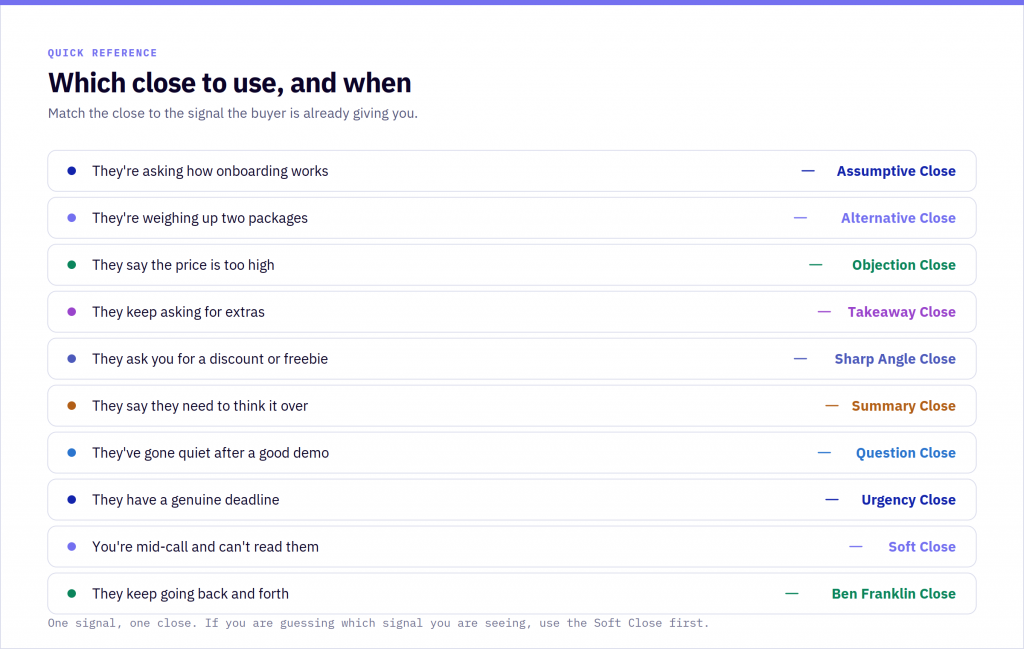
Which closing technique should you use?
Match the close to the signal the buyer is already giving you. Below is the shortcut version.
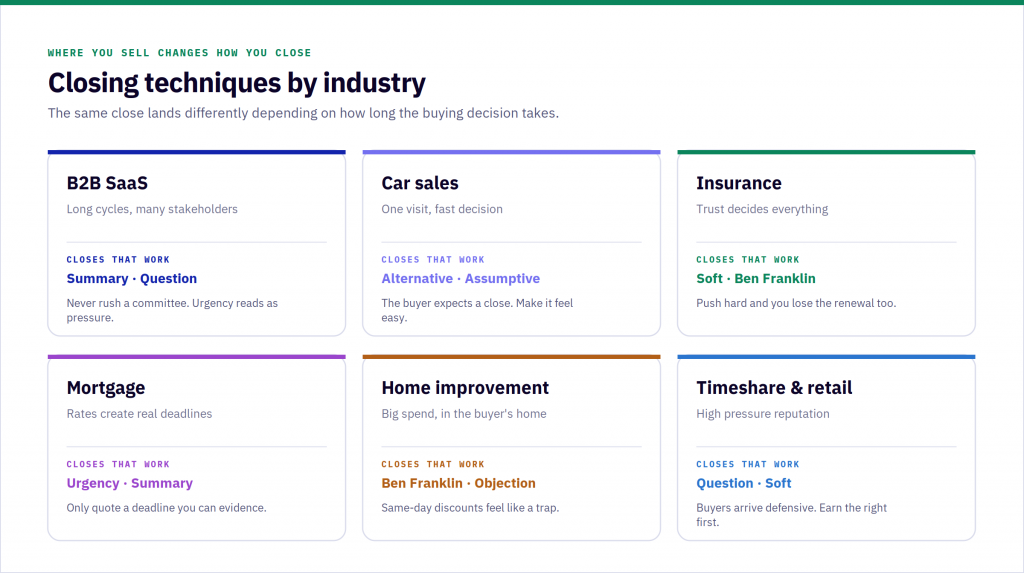
Closing techniques by industry
Where you sell changes how you close. For instance, urgency works in mortgages because rates genuinely move. Meanwhile, the same line in B2B software sounds like pressure.
4 signs your buyer is ready to close
Closing too early annoys people. However, closing too late loses deals to whoever asked first. Watch for these four signals.
1. They switch from "if" to "when". Once a buyer says "when we roll this out", they have already pictured owning it.
2. They ask about implementation. Questions about onboarding, training or contracts mean the decision has quietly moved on.
3. They bring somebody new in. Buyers rarely waste a colleague's time. So a new face usually signals real intent.
4. They start negotiating details. Talk of payment terms or start dates means they are past the question of whether.
5 closing mistakes that cost deals
1. Closing before you have earned it. If you have not found a real problem yet, no technique will save the conversation.
2. Talking past the yes. Once the buyer agrees, stop selling. Otherwise you hand them fresh reasons to reconsider.
3. Treating an objection as a rejection. Usually an objection means they are still interested. Therefore it deserves a question, not a defence.
4. Using pressure instead of clarity. Pressure closes one deal. Meanwhile, clarity closes the next three as well.
5. Never asking at all. Plenty of good conversations end politely and go nowhere, simply because nobody asked for a decision.
"Customers don't care at all whether you close the deal or not." — Aaron Ross, co-author of Predictable Revenue
The part almost nobody practises
Here is the awkward truth. Most reps read a list like this, nod along, and then never say a word of it out loud until a real deal is on the line.
Because of that, the first attempt usually goes badly. The wording comes out clumsy. The timing feels off. Meanwhile, a live opportunity pays for the rehearsal.
So practise somewhere cheap instead. You could role play with a colleague, record yourself on your phone, or rehearse against an AI version of your buyer.
We build one of those at Salesman AI, which lets you run the actual meeting before you walk into it. Still, the tool matters far less than the habit itself.
The rule of thumb: say the words out loud before a buyer ever hears them. Otherwise your customer becomes your practice partner.
Frequently asked questions
What are sales closing techniques?
Sales closing techniques are specific ways of asking a buyer to commit to a purchase. Some ask outright, while others test interest first or trade a concession for a decision. In practice, the best rep picks the technique that matches the obstacle in front of them.
What are the best closing techniques in sales?
The most reliable sales closing techniques are the assumptive close, the summary close, the alternative close, the question close and the soft close. Because these five suit most everyday situations, they are the ones worth learning first. The takeaway, urgency, objection, Ben Franklin and sharp angle closes then cover the harder cases.
What are the 5 sales closing techniques every rep should know?
If you only learn five, learn the soft close, the question close, the summary close, the alternative close and the objection close. Together they let you test interest, find the blocker, rebuild the value, offer a choice and clear the final hurdle. Consequently, they cover the vast majority of real conversations.
What is the most effective sales closing technique?
No single technique wins every time, so the most effective one is whichever answers the buyer's actual obstacle. For example, the summary close works when value has faded, while the objection close works when one clear blocker remains. Diagnosis matters far more than delivery.
What closing techniques work best in car sales?
Car sales usually happen in one visit, so the alternative close and the assumptive close work best. Buyers already expect a decision that day, and offering a straight choice between two vehicles or two finance options keeps things moving. However, heavy pressure still backfires, because reviews and referrals follow the sale.
What closing techniques work in insurance sales?
Insurance closing depends on trust, so the soft close and the Ben Franklin close tend to work best. Both let the buyer reason their way to a decision instead of feeling pushed. Since renewals matter more than the first sale, a hard close is usually a false economy.
What are B2B sales closing techniques?
B2B closing techniques suit long cycles and buying committees, so the summary close and the question close do most of the work. Deals stall quietly in B2B, which means surfacing hidden objections early matters more than any clever line. Urgency should only appear when the deadline is genuinely real.
How do you close a sale without being pushy?
Ask a question rather than making a statement, and give the buyer a genuine way to say no. Soft closes and question closes both do this well. Above all, close only after you have found a real problem, because asking too early is what actually feels pushy.
What is a trial close in sales?
A trial close is a low-pressure question that measures how ready a buyer is, without asking for the order. For instance, you might ask how the team would use the product if one specific problem were solved. It tells you whether to keep building value or move towards a decision.
Is "always be closing" still good advice?
Not really, at least not in its original form. Always be closing came from an era of one-call selling, whereas most deals today involve several people and several conversations. A better version is always be clarifying, because moving the decision forward beats pushing for a signature every time.
Final word
Closing is not a personality trait. Instead, it is a small set of questions you learn to ask at the right moment.
So start with two techniques rather than ten. Use the soft close to read the room, then use the question close to find whatever is stuck.
After that, add one more each month. Practise it out loud until the words stop feeling borrowed and start sounding like you.
"Make a customer, not a sale." — Katherine Barchetti, retailer