Contents
There are many reasons to choose sales reporting software in 2026, but simply picking the cleanest-looking chart isn't enough.
Account executives need reporting that ties together activity, conversations, pipeline movement, and next steps.
Where the bulk of an organisation's key sales data resides will determine the tool they require. For example, if the data resides within their CRM, they may need pipeline reporting.
On the other hand, if it exists within buyer conversations, conversation intelligence will likely be their primary requirement.
Leadership will also want to know what to expect from future revenue. As such, forecasting and revenue intelligence become more critical.
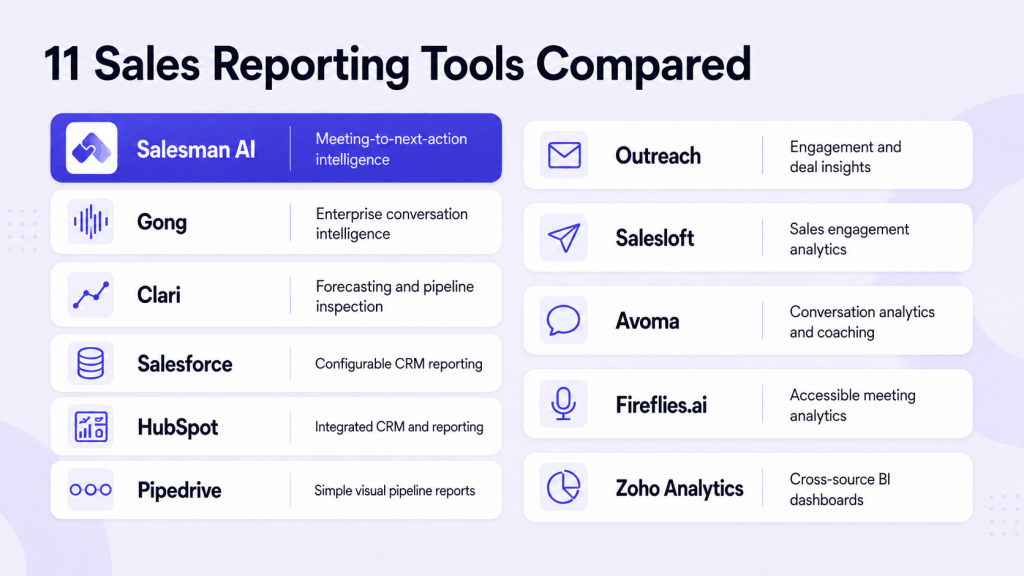
Below, we compare 11 of the leading sales reporting tools used by account executives, the strengths and weaknesses of each, and when to use them.
TL;DR: The best sales reporting tools for account executives
The best sales reporting software depends on whether your team needs meeting intelligence, CRM reporting, engagement analytics or forecasting.
| Tool | Best for | Main reporting strength | Public pricing status |
|---|---|---|---|
| Salesman AI | AEs who want meeting insights they can act on | Connected pre-call, rehearsal and post-call intelligence | Starts at $29/month |
| Gong | Enterprise conversation intelligence | Call analysis and revenue insights | Custom pricing |
| Clari | Enterprise forecasting and pipeline inspection | Revenue analytics and predictive forecasting | Custom pricing |
| Salesforce Sales Cloud | Teams already running sales in Salesforce | CRM reporting, dashboards and pipeline analytics | Starts at $25/user/month |
| HubSpot Sales Hub | Growing teams wanting CRM and reporting together | Activity, pipeline, revenue and forecasting reports | Tiered pricing |
| Pipedrive | Small and midsize sales teams | Easy custom pipeline reports and dashboards | Starts at $14/user/month annually |
| Outreach | Teams combining engagement and deal execution | Activity, deal risk and pipeline insights | Custom pricing |
| Salesloft | Sales engagement teams | Seller activity and outcome analytics | Custom pricing |
| Avoma | Teams wanting meeting analytics and coaching | Call scoring, topic tracking and performance trends | Add-ons from $29/user/month annually |
| Fireflies.ai | Teams starting with meeting analytics | Talk time, topics and conversation trends | Conversation Intelligence on Business and Enterprise |
| Zoho Analytics | Teams combining sales data from several systems | Cross-source BI dashboards and sales analytics | Starts at $24/month annually |
Pricing changes frequently. Confirm current plan limits and contract requirements with each vendor before buying.
What is sales reporting software?
Sales reporting software tracks sales-related information, including activities, pipeline and conversations. It gives teams historical context about what occurred and where current deals stand.
This helps them determine which items require additional focus.
Traditional sales reporting contains lagging indicators, including revenue, quota attainment and closed-won deals.
In contrast, modern sales analytics tools include both traditional and leading indicators.
Examples include meeting activity, stage movement, buyer engagement, objection patterns, completed follow-ups and overall deal risk.
A useful report helps an account executive determine the appropriate course of action. It should answer questions such as:
- Which deals need attention today?
- What changed after the last buyer conversation?
- Which next steps were agreed?
- Where is the deal losing momentum?
- Which activities are producing meaningful progression?
- What should I do differently in my next meeting?
Types of sales reporting tools
The category includes several different product types.
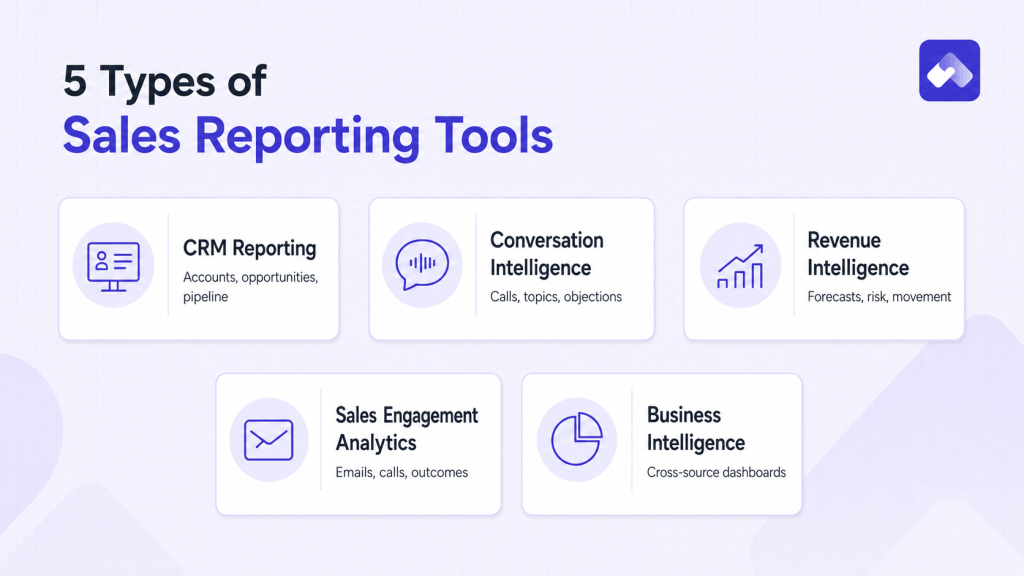
CRM reporting tools
CRM platforms such as Salesforce, HubSpot and Pipedrive report on accounts, contacts, activities, opportunities, stages and revenue. They function most effectively when your CRM is complete and frequently updated.
Conversation intelligence platforms
Tools such as Gong, Avoma and Fireflies.ai convert calls and meetings into searchable data. They report on topics, speaking patterns, questions, objections, action items and potential coaching signals.
Revenue intelligence platforms
Platforms such as Clari combine CRM data and revenue signals. This allows for better pipeline inspection, forecasting and risk detection. Their main users tend to be revenue leaders, managers and operations teams. However, the insights can also benefit individual representatives.
Sales engagement analytics
Tools such as Outreach and Salesloft link reporting directly to a team's prospecting and follow-up activities. They help teams identify how calls, emails, tasks and engagement patterns correlate with pipeline outcomes.
Business intelligence tools
Business intelligence tools such as Zoho Analytics collect data from multiple systems. While BI tools provide a high degree of flexibility, someone must develop the underlying model, integrate the systems and define which metrics are important.
How we evaluated the best sales reporting software
The priorities in this list reflect the day-to-day requirements of an account executive and not the quantity of chart displays available. We have reviewed each solution utilizing six criteria to evaluate their effectiveness:
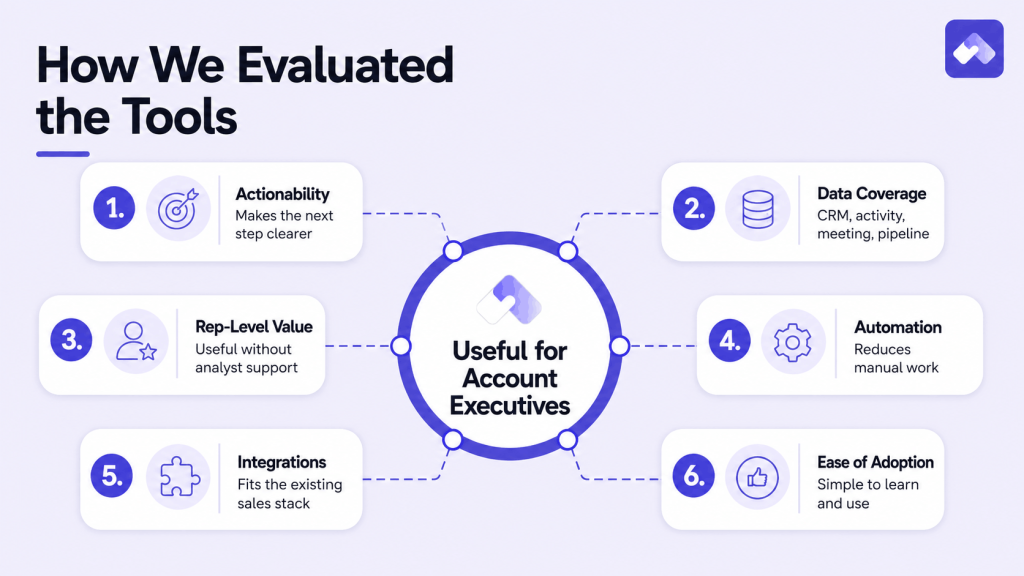
- Actionability: Is the next action clear based on the reporting?
- Data coverage: Does the reporting use CRM, activity, meeting, pipeline or revenue data?
- Rep-level usefulness: Can an AE use the insight without waiting for a manager or analyst?
- Automation: Does the reporting eliminate manual note-taking, data entry and report building?
- Integration: Can it integrate with existing sales systems?
- Ease of adoption: What configuration, governance and training are required?
Comparison of the 11 best sales reporting software options
The following sales reporting software options cover different parts of an account executive's workflow.
| Tool | Category | Best for | Standout capability | Main limitation |
|---|---|---|---|---|
| Salesman AI | Rep-first meeting intelligence | Individual AEs and lean B2B teams | Connects preparation, rehearsal and post-call reporting | Not a full BI or enterprise forecasting suite |
| Gong | Conversation and revenue intelligence | Larger revenue teams | Deep analysis of customer interactions | Pricing is not public; can be more platform than a small team needs |
| Clari | Revenue intelligence | Enterprise forecasting teams | Centralized pipeline and forecast visibility | Designed primarily for coordinated revenue operations |
| Salesforce | CRM and sales analytics | Complex Salesforce environments | Highly configurable opportunity and pipeline reporting | Configuration and administration can become complex |
| HubSpot | CRM and sales analytics | Growing teams wanting an integrated platform | Accessible dashboards across sales activity and pipeline | Advanced reporting depends on the plan |
| Pipedrive | CRM and pipeline reporting | SMB and mid-market teams | Simple, visual pipeline reports | Less suitable for advanced enterprise analytics |
| Outreach | Revenue orchestration | Teams already using Outreach for execution | Connects engagement, deal insights and recommendations | Custom pricing and broader implementation scope |
| Salesloft | Revenue orchestration | Engagement-heavy sales teams | Connects seller activity with outcomes | Reporting value is strongest when workflows run in Salesloft |
| Avoma | Conversation intelligence | Teams focused on coaching and meetings | Custom scorecards, topic tracking and trend analytics | Intelligence capabilities may require paid add-ons |
| Fireflies.ai | AI meeting assistant | Cost-conscious teams | Accessible conversation analytics from recorded meetings | Full analytics is limited to higher plans |
| Zoho Analytics | Business intelligence | Teams with data across multiple tools | Blended dashboards and AI-assisted analysis | Requires more setup than a rep-first sales tool |
1. Salesman AI: Best for turning every meeting into the next action

Salesman AI serves as a sales copilot for reps throughout every part of their meetings. Unlike systems that treat preparation, practice and reporting as completely different functions, Salesman AI ties all three together. It keeps the buyer, meeting and opportunity information connected throughout the process.
Pre-Call Notes provide the AE with a concise summary of buyer priorities, possible objections, DISC-based communication clues, useful questions and the meeting goal prior to each call.
AI Sales Role Play allows the rep to simulate a conversation with a customer clone. They can practise discovery, demos, objection handling and follow-ups.
Meeting Reports will take the conversation from the meeting and create notes, next steps and FOCUS based analysis of the meeting.
The system also supports rep development by tying those insights in the Meeting Report to the rep's own development.
Additionally, AI Helper allows the rep to ask about deal issues, objections, follow-ups or coaching ideas using call notes.
Key features
- Two-minute, DISC-based pre-call notes
- AI Rehearsal using the same buyer and opportunity context
- Meeting reports with notes, next steps and FOCUS analysis
- AI Helper for deal questions, objections and follow-ups
- Connected context before and after the meeting
Best for
Account executives who want reporting to improve the next buyer interaction, not merely document the previous one.
Limitations
Salesman AI is not a general-purpose BI platform or an enterprise forecasting replacement. Teams that primarily need board-level revenue dashboards or complex cross-functional data modelling will still need a CRM, revenue platform or BI tool.
Pricing
The Business plan starts at $29 per month with 2,000 monthly AI credits. Credits can be used across rehearsals, meeting reports and AI Helper messages.
Verdict
Choose Salesman AI when the sales reporting software gap sits between the meeting and the next action. It is particularly relevant for AEs who want preparation, practice and post-call insight to reinforce one another.
2. Gong: Best for enterprise conversation intelligence
Gong records and examines a company's customer communications, including calls, meeting notes and emails. Its conversation analysis turns those unstructured communications into structured data. The data is searchable by topic, conversation style, customer need or key deal points.
For AEs, Gong can provide greater usefulness for reviewing their calls and help identify significant portions of a customer’s dialogue. For managers and revenue leaders, the greater value will be in identifying patterns within the group and relating conversation activity to an organization’s pipeline.
Key features
- Meeting capture and transcription
- Conversation search and analysis
- Talk-pattern and topic insights
- Action items and customer signals
- Revenue and pipeline visibility across interactions
Best for
Established revenue organizations that need conversation intelligence at scale.
Limitations
Gong does not publish standard pricing. The platform's breadth, deployment and cost may be difficult to justify for an individual AE or a small team that only needs lightweight meeting reporting.
Pricing
Custom pricing.
Verdict
Gong is a strong option when customer conversations are a strategic source of revenue data and the organization has the process and budget to use the insight across teams.
3. Clari: Best for enterprise forecasting and pipeline inspection

Clari provides an integrated, real-time view of sales and CRM data across a company's revenue stream. It combines that information in actionable dashboards and predictive models. This helps companies understand pipeline movement, future trends and forecasting risks.
Clari has value when multiple parties have roles within the overall revenue generation process. A Sales AE uses Clari to see where deals stand with respect to moving through the process and to understand what forecasted results they expect from those deals. Managers, RevOps teams and executive leadership will typically be using Clari for the broader level of reporting.
Key features
- Revenue dashboards and visualizations
- Pipeline movement analysis
- Predictive forecasting
- Trend and risk detection
- Centralized revenue data
Best for
Enterprise revenue teams that need disciplined forecasting and a shared view of pipeline health.
Limitations
Clari may be excessive for small teams or individual reps seeking straightforward activity and meeting reports. Its value depends on clean CRM data and consistent revenue processes.
Pricing
Custom pricing.
Verdict
Choose Clari when forecast confidence and pipeline inspection matter more than lightweight rep-level reporting.
4. Salesforce Sales Cloud: Best for configurable CRM reporting

Salesforce Sales Cloud provides reporting across leads, accounts, contacts, activities, opportunities and pipeline. Its dashboards track win rate, average deal size, days to close and deal-stage progress.
The biggest advantage to using Sales Cloud from Salesforce is its ability to be flexible. The majority of sales departments already live in Salesforce. Therefore, reporting will be able to utilize opportunity data that is already being used by your team.
However, this flexibility comes with an administration cost. A useful dashboard depends on the objects and fields included, access permissions and how consistently users enter information.
Key features
- Opportunity and pipeline dashboards
- Sales activity reporting
- Forecasting on supported plans
- Custom reports and workflows
- Advanced pipeline and deal insights on higher editions
Best for
Teams already committed to Salesforce that require configurable CRM reporting.
Limitations
Setup and maintenance can become complex. Reports also reflect the quality of the CRM data entered by reps and integrations.
Pricing
Sales Cloud starts at $25 per user per month. Higher editions add deeper customization, forecasting, pipeline management and deal intelligence.
Verdict
Salesforce is the strongest fit when the CRM is already the source of truth and the business has the resources to configure it properly.
5. HubSpot Sales Hub: Best for growing teams wanting CRM and reporting together

HubSpot Sales Hub combines customer relationship management, sales automation and reporting. Its sales analytics capabilities cover pipeline, forecasting, activity, revenue and team performance.
HubSpot Sales Hub has an accessible user interface that makes it easy to move from using spreadsheets or separate applications. As such, AEs can view both their activities and deals within one application, and managers can create custom dashboards based on pipeline health and forecasted results.
Key features
- Sales activity dashboards
- Pipeline and deal reporting
- Revenue tracking
- Forecasting
- Pre-built and customizable sales reports
Best for
Growing teams that want an integrated CRM and sales reporting system without starting with a heavily customized enterprise implementation.
Limitations
The most useful automation and advanced reporting features are tied to paid tiers. Costs can increase as the team requires more seats and functionality.
Pricing
Tiered pricing. HubSpot's current pricing page lists per-seat Professional and Enterprise options and may display promotional rates for new customers. Confirm the final subscription and onboarding cost directly.
Verdict
HubSpot is a practical choice when ease of adoption and having CRM, activity and pipeline reporting together are the priorities.
6. Pipedrive: Best for simple visual pipeline reporting

Pipedrive focuses on managing a company's sales pipeline. Its Insights features allow teams to create custom reports and dashboards for deals, activities, campaigns and forecasts. This visual representation helps AEs quickly see where deals stand and which actions have taken place. Teams can also display real-time data and use filters to examine specific sales metrics.
Key features
- Custom sales reports
- Live dashboards
- Goals and performance tracking
- Deal and product revenue forecasting on supported plans
- Pipeline and activity reporting
Best for
Small and midsize sales teams that want usable reporting without a large CRM administration project.
Limitations
Pipedrive is less suitable for organizations that need highly complex enterprise forecasting, cross-functional BI or deep conversation analytics.
Pricing
Plans start at $14 per user per month when billed annually, according to Pipedrive's reporting-tools guide. Forecasting and report limits vary by plan.
Verdict
Pipedrive offers a strong balance of usability and pipeline visibility for teams whose reporting needs are centred on deals, activities and forecasts.
7. Outreach: Best for connecting sales engagement with deal insights

Outreach includes prospecting, deal management, forecasting, coaching and account expansion. Its Deal Insights component uses AI to prioritize the best opportunities, identify risks and provide recommendations.
Key features
- Activity and outcome reporting
- AI-powered deal insights
- Opportunity prioritization
- Deal-risk signals and recommendations
- Conversation intelligence through Kaia
Best for
Revenue teams that want sales engagement, conversation support and deal execution in one platform.
Limitations
Outreach has a broader implementation scope than a standalone reporting tool. The platform does not publish straightforward self-serve pricing.
Pricing
Custom pricing.
Verdict
Choose Outreach when reporting must connect directly to prospecting and deal-execution workflows already managed in the platform.
8. Salesloft: Best for sales engagement analytics
SalesLoft tracks data for all of a salesperson's (seller) activity, their level of engagement, their compliance with processes and ultimately their results. The analytical tools and dashboard that SalesLoft provides to reps and managers allow them to understand how effective execution translates into successful results.
The greatest benefit to an AE is understanding whether daily engagement correlates with tangible movement. Additionally, managers can identify trends and areas that need coaching or support.
Key features
- Seller activity reporting
- Engagement and outcome analytics
- Performance dashboards
- Deal and conversation data across the platform
- Analytics exports for external analysis
Best for
Teams already using Salesloft cadences, conversations and deal workflows.
Limitations
The reporting becomes less compelling when most sales activity occurs outside Salesloft. Public plan pricing is not available.
Pricing
Custom pricing.
Verdict
Salesloft is a good fit when the business wants to connect engagement activity with seller performance and revenue outcomes.
9. Avoma: Best for customizable conversation analytics and coaching
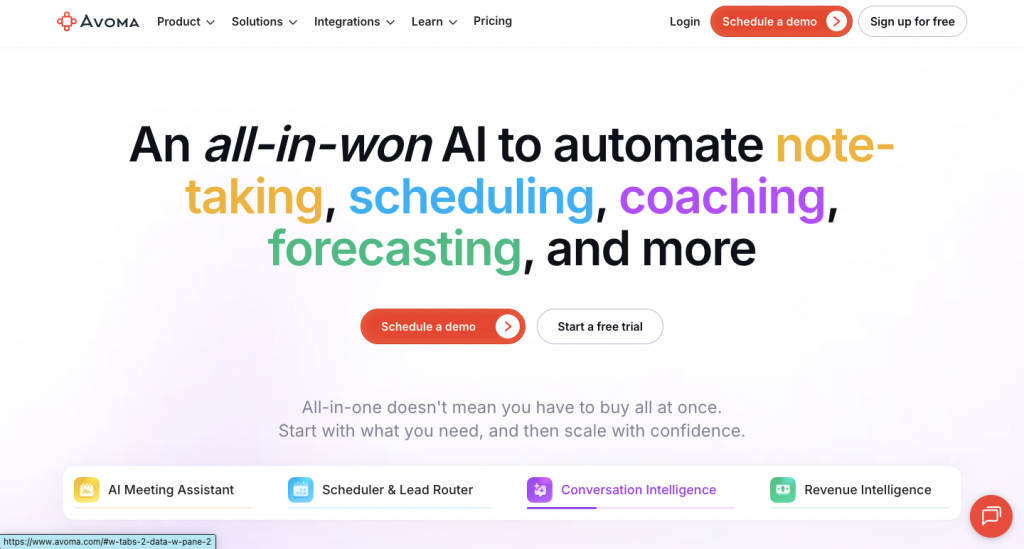
Avoma adds revenue intelligence to its meeting assistance capabilities. Its conversation intelligence features include call scoring, AI coaching suggestions, performance trends, customizable scorecards and topic identification using keywords or phrases.
Thus, Avoma is suitable for organizations whose reps are looking to use reports to support their own self-assessment of how they're doing and/or who also rely upon managers to provide additional coaching.
Key features
- AI call scoring
- Custom scorecards
- Topic and keyword tracking
- Coaching recommendations
- Performance-trend analytics
- Real-time assistance
Best for
Sales teams that want structured coaching and conversation reporting without moving immediately to a large enterprise platform.
Limitations
Advanced conversation and revenue intelligence are sold as add-ons to the base platform. Teams should calculate the full per-user cost rather than comparing the add-on alone.
Pricing
Conversation Intelligence and Revenue Intelligence add-ons are each listed at $29 per user per month with annual billing. Base platform pricing applies separately.
Verdict
Avoma is a strong middle-ground option for teams that need meeting analytics, coaching and customizable evaluation frameworks.
10. Fireflies.ai: Best for accessible meeting analytics

Fireflies.ai captures, transcribes and provides analysis of meetings. It also offers a Conversation Intelligence dashboard to help track trends in recorded meetings (e.g., talk time, number of questions asked, etc.), along with tracking specific topics like competitors, objections, pricing, etc.
It is an ideal solution for teams that need searchable meeting data and basic conversation metrics. Users can filter analytics by meeting title, organizer, attendees and meeting length.
Key features
- Meeting recording and transcription
- Talk-time analytics
- Topic tracking
- Questions and conversation trends
- Search, summaries and AI assistance
Best for
Individuals and teams that want meeting documentation first, with the option to add broader conversation analytics.
Limitations
The full Conversation Intelligence dashboard is available only on Business and Enterprise plans. Some advanced AI actions also use separate AI credits.
Pricing
Fireflies has a free plan. Its Business plan is listed at $19 per user per month annually or $29 monthly; this is the entry point for the Conversation Intelligence dashboard.
Verdict
Fireflies is a practical choice when the immediate need is to capture meetings and identify recurring conversation patterns at a relatively accessible cost.
11. Zoho Analytics: Best for combining sales data from multiple systems

Zoho Analytics is a business intelligence and analytics solution rather than a direct sales execution tool. It imports CRM and application data, blends multiple sources and builds reports on pipeline, win-loss rates, rep performance, territories and campaigns.
Zia, an artificial intelligence analytics assistant built into Zoho Analytics, enables end-users to ask specific questions regarding their data and generate corresponding reports or KPI widgets. In this way, leadership has access to a single reporting layer across all solutions.
Key features
- CRM and sales-app connectors
- Cross-source data blending
- Custom dashboards and KPI widgets
- Win-loss and pipeline analysis
- AI-assisted questions and forecasting
- Data alerts
Best for
Teams whose sales data is spread across several applications and needs a shared analytics layer.
Limitations
Zoho Analytics requires more configuration than a rep-first tool. An AE may depend on an operations or analytics owner to define the right datasets and dashboards.
Pricing
Cloud pricing starts at $24 per month when billed annually for two users, according to Zoho's pricing documentation. An always-free plan is also available for limited reporting needs.
Verdict
Choose Zoho Analytics when the main challenge is fragmented data rather than missing guidance inside the sales workflow.
Which sales reporting software should you choose?
Determine which decision your sales reporting software is trying to support.
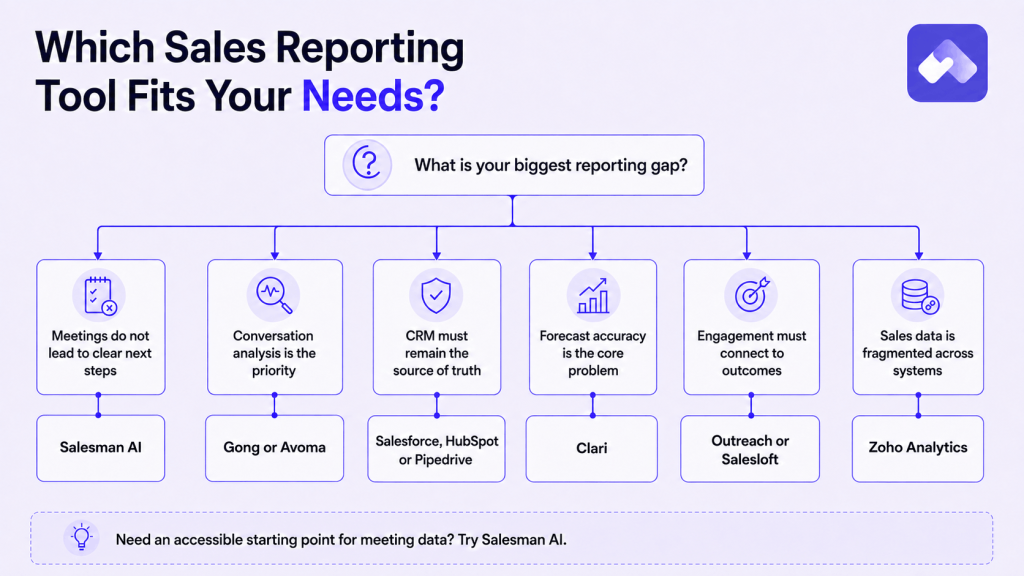
Use Salesman AI if meetings are not producing clear next steps
Salesman AI helps AEs prepare, practise and execute after a meeting. It also keeps the buyer and deal context together.
Use Gong or Avoma to focus on how the conversation went
Gong works well for larger organizations that need conversation intelligence. Avoma provides similar features in a more modular format. Teams can create their own call scorecards and coaching analytics.
Use Salesforce, HubSpot or Pipedrive if the CRM is your central source of information
Salesforce provides the greatest customization. HubSpot balances CRM functionality with ease of use. If you need simple, visual pipeline reports, Pipedrive is the best fit.
Use Clari if forecast accuracy is the root issue
Clari is primarily used for centralized revenue forecasting and analysis. It is better suited to analysing large amounts of revenue data than providing lightweight reporting for each user.
Use Outreach or Salesloft if engagement data must connect to outcomes
Both work well when users' prospecting and execution workflows already exist inside these platforms.
Use Fireflies to start capturing and organizing meeting data
Fireflies is a useful first step before committing to a larger revenue intelligence platform.
Use Zoho Analytics when data is spread across multiple systems
Zoho Analytics can build a shared business intelligence layer. However, it will not guide an AE on what action to take immediately after a call.
Sales reporting metrics that matter to account executives
A useful sales dashboard software configuration combines outcomes, pipeline progress, quality activities and customer signals.
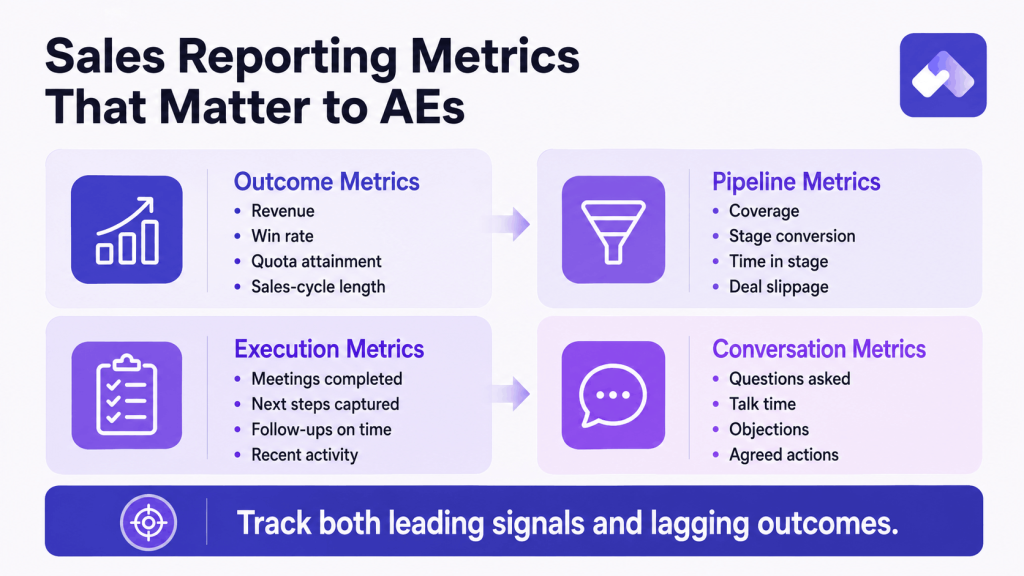
A lagging indicator tells you whether you were successful. A leading indicator shows how to get there before the result is fixed. Account executives require both.
Leading versus lagging indicators: Leading indicators show what you may win. Lagging indicators show whether you actually did.
Implementation checklist
Before purchasing a reporting tool, test it with real workflows rather than a polished demo.
Frequently asked questions
What is sales reporting?
sales reporting refers to collecting and reporting on activity such as sales pipeline, conversations, performance and revenue. It gives your team visibility into performance, risks and the actions to take next.
What should I look for in sales reporting software?
Look for reports that guide data-based decisions, automatic data capture, real-time integrations, ease of use and transparent per-rep pricing. Above all, the platform should create actionable insights instead of another dashboard full of useless data.
What is the main difference between sales reporting and sales analytics?
sales reporting provides a means to organize historical data regarding what has taken place. Sales analytics takes that same data and uses it to develop trends, find cause-and-effect relationships, predict future events/numbers, and/or give recommendations on a course of action. Many modern solutions provide both capabilities.
Which CRM systems integrate with sales reporting software?
Salesforce, HubSpot and Pipedrive have native CRM reporting. Gong, Clari, Outreach, Salesloft, Avoma, Fireflies and Salesman AI offer integrations or workflows that connect to one or more CRMs, depending on the product and plan. Zoho Analytics can pull data from multiple CRMs to build custom reports.
Before purchasing, confirm your CRM, the fields you need and the required direction of data flow.
Will AI enhance my sales reporting experience?
Yes. AI can summarize calls, determine next steps, categorize topics, flag issues, answer questions about sales data and support forecasting. However, AI cannot correct missing source data or unclear metric definitions. Teams still require accurate inputs and a defined decision-making process.
Final verdict
The best sales reporting software does more than report history. The right sales reporting software tells the account executive where to focus today.
CRM tools report on opportunities. Engagement platforms link activity to results. Conversation platforms show what buyers said.
Revenue Intelligence Platforms help predict revenue. Salesman AI differs in its "rep-first" approach by providing context for the meeting, buyer and opportunity as part of each call's prep/rehearsal/post-reporting process. This will allow insights from one conversation to help the next.
Explore AI Sales Coaching, practise with AI Sales Roleplay or view pricing.