
Contents
A customer may be satisfied with your product’s utility yet choose to take no action. This may have little to do with the product, price or customer experience. In many cases, the customer has not found sufficient reason to reconsider the company’s current way of working.
The Challenger sales model is designed for this situation. Challengers bring a third-party perspective, make it relevant to different stakeholders and guide the prospect towards a decision.
They do not argue with prospects or apply unnecessary pressure. Good Challenger selling creates constructive tension by encouraging the customer to evaluate an assumption about the cost of the status quo or available alternatives. The aim is to improve the buyer’s decision, not manufacture urgency.
This article explains how an account executive can apply the approach in a complex B2B sales environment.
What is the Challenger sales model?
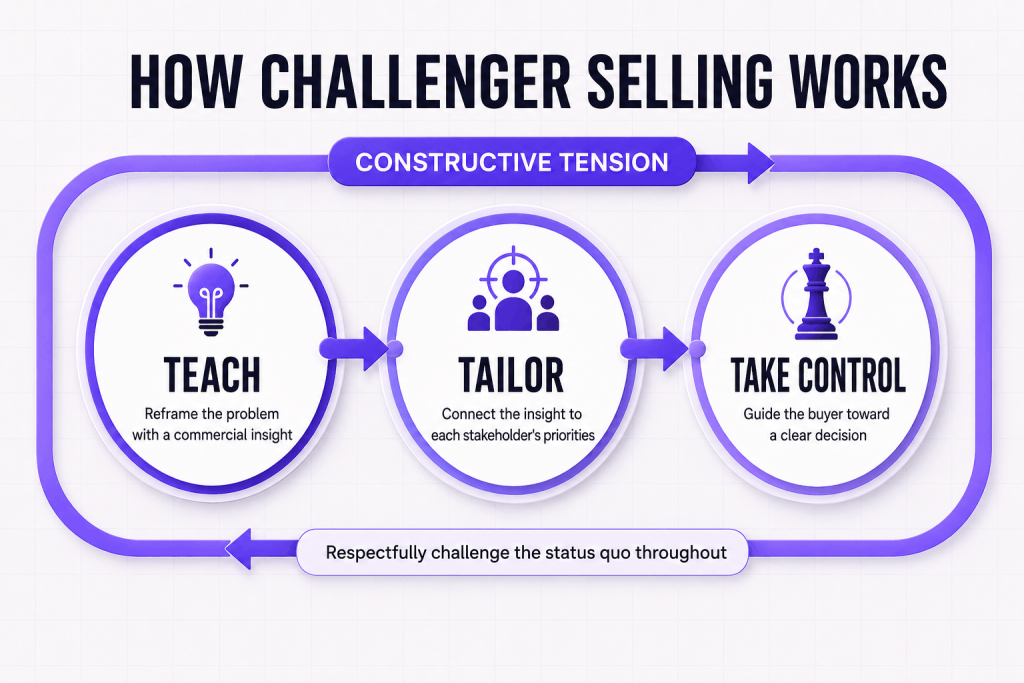
The Challenger sales model is a B2B methodology based on three seller behaviours: Teach, Tailor and Take Control. Matt Dixon and Brent Adamson popularised it in The Challenger Sale, based on research into successful sellers.
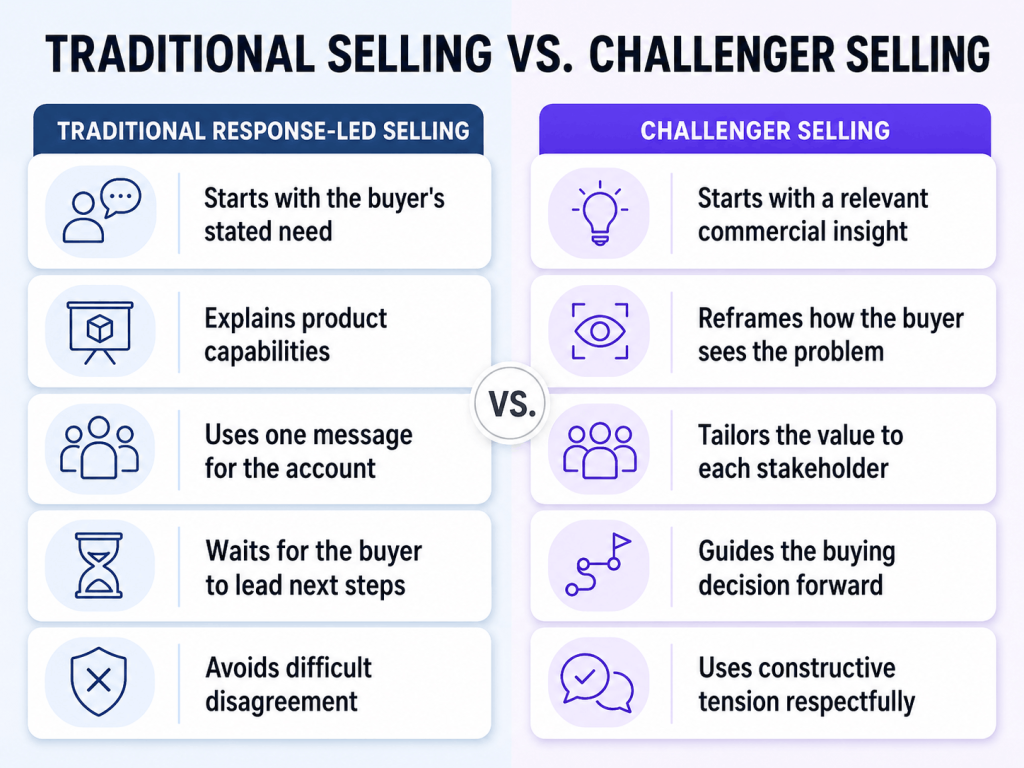
The researchers identified five salesperson profiles. Challengers stood out in complex sales because they did more than address expressed needs. They understood the customer’s business, introduced a relevant commercial insight and confidently guided difficult conversations.
The methodology is most relevant when:
- Buyers are considering several alternatives, including doing nothing.
- Several people will be affected by the purchase.
- The product requires a change in process or belief.
- Feature comparisons alone do not create urgency.
- The AE must build consensus around a new way of thinking.
The five seller profiles in the Challenger model
The profiles describe behaviours an account executive demonstrates frequently, not fixed personality traits.
- Hard Worker: Persistent and willing to do what is needed, although effort alone may not change the buyer’s perspective.
- Relationship Builder: Builds trust, but may avoid useful disagreement.
- Lone Wolf: Relies on instinct, which can be difficult to coach or repeat.
- Reactive Problem Solver: Resolves customer issues quickly, but may neglect the commercial conversation.
- Challenger: Understands the customer’s business and introduces a more useful way to view the problem.
The model does not expect AEs to eliminate their natural strengths. A Relationship Builder can remain empathetic while becoming more comfortable with respectful disagreement. A Hard Worker can apply their effort to better research and sharper conversations. Challenger skills can strengthen every selling style.

How the Challenger sales model works
1. Teach with a commercial insight
Teaching is not giving the customer a statistic or describing the product. A commercial insight changes how the customer understands a business problem.
For example, an AE may hear, “We need sales reps to log more CRM activity.” A response-led seller shows automatic updates. A Challenger shows how disconnected meeting context creates wasted time and missing deal information. The conversation moves from data entry to sales execution.
An effective insight should be:
- Relevant to the customer’s work or business.
- Specific enough to change their thinking.
- Connected to a problem your solution can address.
- Useful even if they do not purchase immediately.
It should point towards your advantage without becoming a disguised feature pitch.
2. Tailor the message to each stakeholder
Tailoring preserves the core insight while adjusting the evidence, language and emphasis for each stakeholder. CROs may value predictability, sales operations may value accurate CRM information, and AEs may value saved time.
Ask yourself:
- What outcome is this person accountable for?
- How does the current situation affect that outcome?
- What evidence would they believe?
- What concerns could make them resist change?
A direct executive may want the consequence first. An analytical evaluator may need the assumptions behind it.
3. Take control of the buying process
Taking control means accepting some responsibility for guiding a buyer who is confused or losing momentum. A Challenger rep can:
- Discuss money and trade-offs.
- Identify who must join the decision.
- Replace “Just let me know” with a clear next action.
- Question an unrealistic timeline.
- Test whether polite objections hide deeper concerns.
- Step away when there is no legitimate reason to continue.
4. Maintain constructive tension
Constructive tension appears when the buyer realises the current approach may create more risk than expected. The rep questions the assumption, not the buyer’s intelligence, and uses proof and curiosity instead of provocation.
For example: “You said the primary need is faster CRM updates. Could the larger issue be that every phase of the meeting workflow holds different context? Automating the final field may save time, but it does not explain how reps will develop and advance the opportunity.”
How to build a Challenger commercial insight
A good fact is not automatically a good commercial insight. The buyer must be able to connect it to action.
Begin with a familiar belief
Identify an assumption the target customer often makes. For example, “The biggest post-meeting problem is that reps do not update the CRM quickly.” The belief must genuinely exist before you challenge it.
Uncover what the belief ignores
Show the concealed reason, cost or risk. Delayed CRM updates may result from disconnected preparation, missing conversation context and poor follow-through. Use customer observations, internal data or credible research, and separate evidence from inference.
Explain the consequence of doing nothing
Reps may repeat research, follow-ups may miss commitments, and managers may rely on incomplete deal information. The consequence should be relevant, not exaggerated. Excessive alarmism creates distrust.
Outline a better method
Explain the new approach before connecting it to the product. In this example, the better method is carrying buyer, meeting and opportunity context before, during and after every call.
| Commercial teaching stage | Sales workflow example |
| Familiar assumption | CRM admin is the biggest post-meeting problem. |
| Overlooked challenge | Business context becomes fragmented across the opportunity. |
| Business impact | Reps lose momentum and managers lack complete deal information. |
| Better approach | Connect preparation, conversation and follow-up. |
| Relevant solution | Use one system to carry context through the opportunity. |
A practical Challenger sales model example
Imagine an AE speaking with the VP of sales at a 60-person SaaS company. The buyer wants an AI note-taker because reps are slow to update the CRM.
Conventional response
The rep presents transcription, automatic summaries and CRM integration. The demo answers the stated need, but the product is compared with every other note-taking tool.
Challenger response
The rep first validates the concern, then tests the assumption behind it:
“CRM updates are visible, so they often become the focus. Across similar teams, we also see reps entering calls without the context from the previous meeting. They then spend the next call repeating questions, and the follow-up treats each conversation as a separate event. How often does that happen here?”
The rep is able to present a specific example of how much "lost" time there was in searching for information (the amount of time they spent researching/going through the recordings & notes).
Now that the rep has an idea of what this lost time means and how it can affect momentum on deals, the rep will tailor their message to each person's interests.
Finally, the rep takes control:
“Before we compare note-taking features, I suggest we map what happens before and after a call. If the problem is larger than documentation, we should evaluate whether each option carries context across the opportunity. Can we include Sales Operations in that session?”
The rep has not ignored the buyer's request. They have expanded the decision criteria by teaching a more complete view of the problem.
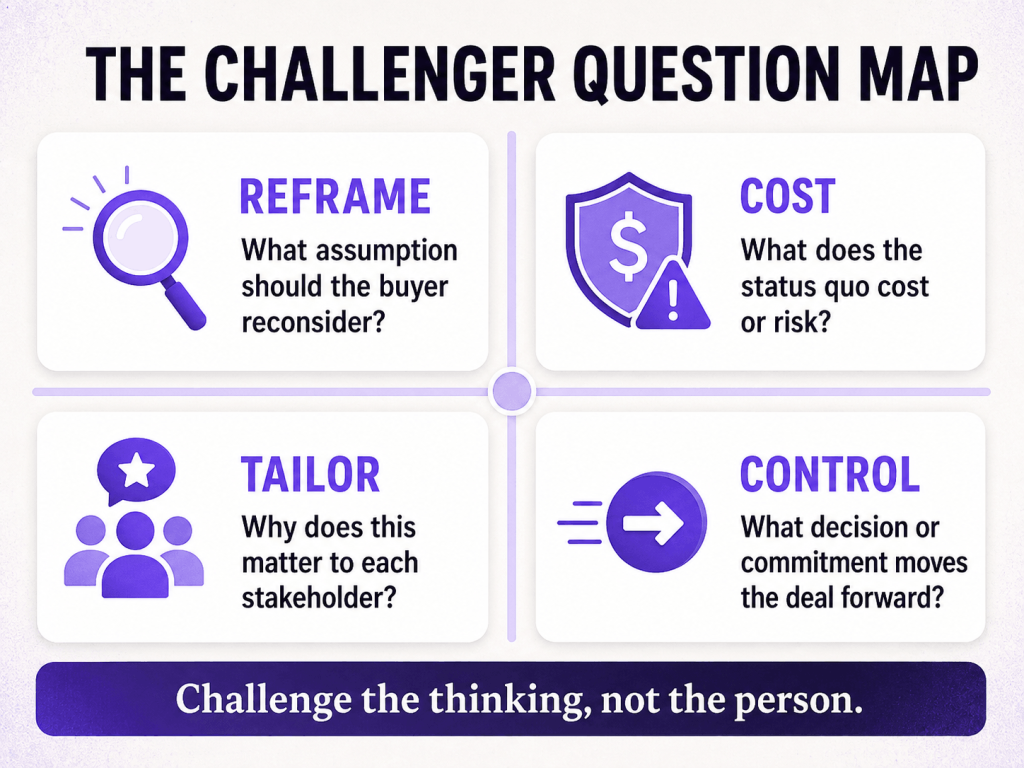
Challenger sales model questions for AEs
Challenger sales model questions should help customers examine assumptions and make decisions without sounding confrontational.
Reframe the problem
- What if the visible issues are symptoms rather than causes?
- Where does information lose context?
- What have we accepted as normal because it has always been done this way?
Expose the cost
- What happens if this continues across every rep or account?
- Which revenue, efficiency or risk metrics are affected?
- What becomes harder if nothing changes?
Tailor the message
- Who experiences this problem differently?
- Which outcome matters most to the decision-maker?
- What evidence would finance or operations trust?
Take control
- What decision is required before the next step?
- Who is missing from the conversation?
- Does the proposed timeline match the approval process?
- Should this evaluation be paused if other priorities matter more?
Common Challenger sales model mistakes
- Reframing without credibility: An unsupported opinion is not an insight. Reps need enough knowledge of the customer’s business to explain their reasoning.
- Using statistics without meaning: Data may spark curiosity, but the buyer must understand how it affects their decision.
- Becoming aggressive: Constructive tension does not justify interrupting, cornering or embarrassing a buyer. If they become defensive, slow down and examine the disputed logic.
- Teaching too much too soon: A prepared insight can feel irrelevant before the rep establishes context.
- Tailoring only by job title: Two CROs may have different priorities. Tailor to the person’s objectives, incentives and concerns.
- Mistaking pressure for guidance: Requesting another meeting serves the seller. Recommending a step because it reduces decision risk helps the buyer.
- Treating the framework as a script: Live conversations are unpredictable. Reps must listen, adjust and abandon the reframe when evidence does not support it.
When the Challenger sales model works best
The model works best in complex B2B sales where buyers need a reason to change and consensus among stakeholders. It is also useful when competitors appear similar or the greatest risk is no decision.
It may be less useful for transactional purchases, when the buyer already understands the problem and needs fast execution, or when the rep lacks evidence to challenge the current view responsibly.
Qualification frameworks such as MEDDIC can complement Challenger. MEDDIC tests whether an opportunity has measurable value, decision authority, an approval path and internal support.
How AEs can practise Challenger selling
Salesman AI supports the seller’s workflow around an active opportunity. Pre-call Notes surface the buyer’s priorities, likely objections and communication cues.
AI Rehearsal builds a customer clone from the upcoming meeting and deal context, allowing the rep to practise discovery, business-case and objection conversations. FOCUS Reporting and AI Helper support AI sales coaching after the call by helping reps analyse what the buyer said and determine the next step.
On-Call Nudges are marked as “coming soon” and should not be treated as a live feature. Salesman AI does not replace seller judgement. It helps the rep test whether the message is relevant, clear and compelling before discussing it with the customer.
Frequently asked questions
How does the Challenger sales model work?
Reps teach customers using a relevant commercial insight, tailor the message to stakeholder needs and guide the buying decision while maintaining constructive tension.
What are the three elements of the Challenger sales model?
The three behaviours are Teach, Tailor and Take Control. Constructive tension supports all three.
What are the five types of Challenger sellers?
The profiles are Hard Worker, Relationship Builder, Lone Wolf, Reactive Problem Solver and Challenger. They describe behaviours, not permanent personality types.
Can Challenger selling become aggressive?
It should not. Challenging assumptions and guiding a better decision differs from applying pressure only for the seller’s benefit.
Is the Challenger sales model still relevant?
Yes, particularly when buyers have several options, disagree internally or may choose to do nothing. Its effectiveness depends on evidence and responsible seller judgement.
Can MEDDIC and Challenger be used together?
Yes. Challenger guides the sales conversation, while MEDDIC helps determine whether the opportunity is qualified.
Challenge the status quo with something useful
The Challenger sales model is not about being the loudest voice in the meeting. It helps the customer see their situation differently by first understanding how they currently think.
Use evidence to teach, tailor the consequence to the stakeholder and guide the process when the buyer needs clarity. Create enough tension to support a better decision, not enough pressure to serve only the seller.
Want to practise your next Challenger call with the buyer and current deal in context? Start with your next meeting.