
Contents
There are two ways reps can blow discovery calls when using SPIN Selling. They can either quickly go through a checklist or ask open-ended questions that start good conversations but never develop a buying case for the customer.
The SPIN Selling sequence is much more effective. It gives an account executive information about the customer's current situation, identifies a significant issue, explores its implications, and then allows the customer to explain the value of resolving it.
The process is easy to remember. Applying it requires judgment, listening skills, and self-control.
TL;DR: SPIN stands for Situation, Problem, Implication, and Need-payoff. The questions move from context to consequences and then to value. It should feel like a conversation, not an interrogation, because the rep follows the buyer's responses instead of forcing them down a scripted path.
What is SPIN Selling?
SPIN Selling is a sales method based on research conducted at Aston University by Neil Rackham. It was popularized in the SPIN Selling book and is now offered as a training program by Huthwaite International.
If you are looking for information about SPIN Selling and Neil Rackham, this SPIN Selling overview explains how to apply the structure without providing detailed chapter-by-chapter summaries of the book.
The SPIN model is an acronym outlining four types of questions:
| Question type | Purpose | Simple example |
|---|---|---|
| Situation | Understand relevant context | How does the team prepare for calls today? |
| Problem | Surface difficulty or dissatisfaction | Where does that process break down? |
| Implication | Explore the consequence | What happens when a rep misses that context? |
| Need-payoff | Help the buyer express value | How would consistent preparation affect ramp time? |
The process is helpful, but it does not have to follow a rigid format. A new stakeholder might enter the conversation at any time, and you may need to return to a situation question. You might also ask several problem and implication questions before discussing value with the buyer.
In essence, this SPIN Selling summary provides a flexible conversational framework, or SPIN method, rather than a survey that must be followed in a fixed order.
The real skill is not asking all four question types. It is recognizing which buyer response deserves further inquiry.
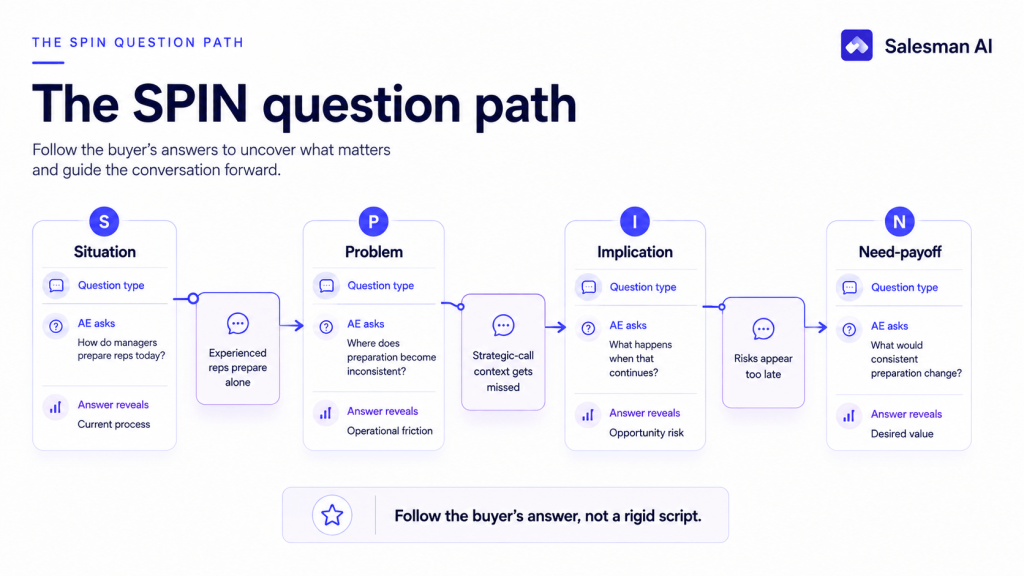
The four SPIN Selling question types explained
1. Situation questions establish relevant context
Situation questions give you insight into the buyer's current circumstances, including their processes, people, technology, priorities, and limitations.
Examples include:
- What do representatives currently do to prepare for important sales meetings?
- Who reviews a sales meeting after it takes place?
- What information is available before the meeting and can be referenced during it?
- How much time does the current preparation process require?
- Are other departments involved in providing coaching?
These questions are necessary. However, asking too many can turn a conversation into a survey.
Research basic facts about the buyer's business before calling. Ask only the additional situation questions that reveal how their circumstances differ from what you already know.
2. Problem questions uncover friction
Problem questions identify where the current process creates difficulty. The buyer should describe the problem in their own words.
Examples include:
- Where is there inconsistency in call preparation?
- What prevents managers from coaching each representative?
- Which parts of the workflow do representatives tend to bypass or postpone?
- When a call is unsuccessful, what is typically missing?
- What alternatives have you attempted?
3. Implication questions make the problem matter
A problem by itself may not justify change. Buyers take action when they understand the consequences of allowing the problem to continue.
Implication questions connect an issue to revenue, risk, time, confidence, or customer experience.
Examples include:
- How does inconsistent call preparation affect discovery quality?
- What happens when new representatives do not receive enough call reviews?
- How are follow-up calls affected when reps do not know the buyer's context?
- What would another three months with the current process look like for the team?
- How many other people experience this problem?
Do not manufacture urgency. Ask with curiosity and allow the buyer to determine whether the consequences justify action.
4. Need-payoff questions help the buyer define value
The need-payoff question moves the conversation towards a positive future. Instead of telling customers what they will gain, the rep helps them explain the outcome they want.
Examples include:
- If all reps had useful context before a call, how would that help?
- How would faster feedback affect the role of managers?
- What would consistent discovery mean for forecast confidence?
- If reps could practise difficult calls safely, where would you begin?
- What result would be sufficient to justify making a change?
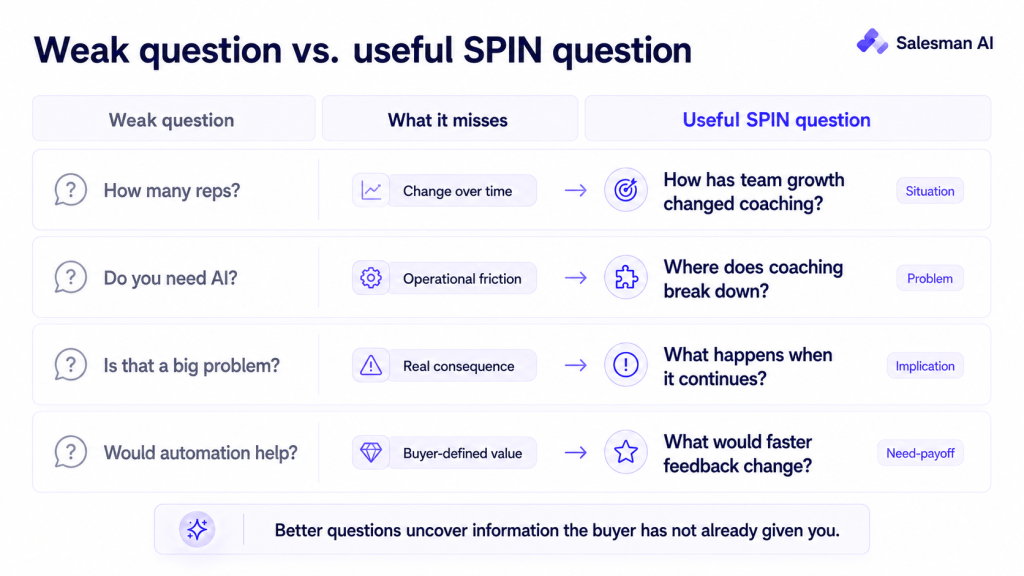
A complete SPIN Selling example
A VP of sales has expressed frustration about inconsistent coaching before important customer calls.
AE: How are your sales managers preparing reps for these calls now?
Buyer: Primarily through one-on-one meetings. Some managers review recordings, but it is inconsistent.
AE: Where does that inconsistency create difficulties?
Buyer: New reps receive extensive coaching and preparation, while experienced reps tend to prepare independently, even for strategic accounts.
AE: What happens when an experienced rep enters a strategic call without support?
Buyer: They know our products, but they may miss the politics of the call or fail to challenge an assumption.
AE: How does that show up later in the opportunity?
Buyer: We discover risks too late. Sometimes we realize there was never a champion, or procurement appears at the end.
AE: If reps could practise with the buyer and opportunity context already connected, what would be different?
Buyer: Managers could focus on the highest-risk parts of the call instead of recreating the entire opportunity history.
AE: Which opportunities should we use to test that method first?
A practical SPIN Selling questions library for AEs
Use this library to prepare, not to conduct the call word for word.
Situation questions
- What prompted today's conversation?
- How does the workflow currently operate?
- Who owns the process?
- Which other teams or systems interact with it?
- Have there been significant changes over the last six months?
Problem questions
- Where do you experience delays or errors?
- Which part of the process is difficult to execute consistently?
- What workarounds do people use, and how much additional effort do they create?
- What frustrations do users or managers have with the process?
- Why has fixing the process been difficult?
Implication questions
- How will delayed execution affect what happens next?
- How does the problem affect revenue or costs?
- What consequences do customers or employees experience?
- Will the issue become more complex as the team grows?
- What happens if it is not addressed this year?
Need-payoff questions
- What would an effective change look like?
- Which key performance indicator should improve first?
- How would the team use the time it saves?
- Who would benefit most from the change?
- What evidence would make the team confident about moving forward?
How to use SPIN Selling without sounding scripted
Develop hypotheses ahead of time, not a survey
Write down two potential issues and supporting evidence before the call. Develop one implication question for each. This gives you direction while preventing your assumptions from becoming the answers.
A connected pre-call preparation workflow can bring the buyer, meeting, and opportunity context together. This helps a rep develop relevant hypotheses instead of repeating generic questions.
Follow keywords with relevant questions
Buyers often signal importance through phrases such as "each quarter," "the board has asked," "we can't see this," or "my manager spends." Ask a simple follow-up question when you hear these cues.
Try, "What happens then?" or "How does that affect others?" The best follow-up is often simpler than the question you prepared.
Before summarizing, reflect the logic back to the customer so they can confirm or correct it:
"So it is not only taking up managers' time. It also creates opportunity risk after the team commits to the forecast. Is that correct?"
This prevents the conversation from becoming a series of unrelated questions.
Earn the right to provide a demo
Do not jump into a demo after identifying one problem. Understand its impact, desired outcomes, affected stakeholders, and the next decision.
A discovery call is complete when both parties agree on whether further work should happen, not when the rep has exhausted every prepared question.
Common SPIN Selling mistakes
Using too many situation questions
Research can tell you the customer's size, location, and products. Use meeting time to uncover information you cannot find online.
Turning implication questions into fear-based questions
Implication questions reveal the consequences of action or inaction. Do not exaggerate the risk. If the buyer says the impact is minimal, accept that response and qualify accordingly.
Jumping from pain to pitch
When reps hear a familiar pain point, they often jump straight to a feature. The buyer may learn about the product but still have no reason to change.
Treating need-payoff questions as a closing trick
Need-payoff questions are not requests for compliments. They help you understand the buyer's desired outcome and provide language for the business case.
Using the same sequence for every stakeholder
Managers, financial decision-makers, security leads, and end users experience consequences differently. Tailor the questions to each person's role and influence.
SPIN Selling compared with other methodologies
| Method | Main job | Best used for |
| SPIN Selling | Develop a problem through questions | Discovery and value conversations |
| Sandler | Mutually qualify the relationship and process | Full-cycle qualification |
| MEDDIC | Test whether a complex deal is truly qualified | Opportunity inspection and forecasting |
| Challenger | Teach a commercial insight and reframe thinking | Creating urgency around an overlooked issue |
These methodologies can be combined. An account executive might use SPIN questions during early discovery, document MEDDIC qualification gaps, and apply a Challenger insight when a buyer has underestimated an important consequence.
Practising SPIN questions for each opportunity
Knowing what the letters stand for is different from responding naturally when a buyer is skeptical, brief, or defensive. That requires practice.
AI sales role-play allows a rep to practise a discovery conversation with a realistic buyer persona. Afterwards, AI sales coaching can help assess the questions asked, how effectively the rep listened, and whether any important implications were missed.
The FOCUS Report and AI Helper can then provide feedback connected to the actual meeting.
Frequently asked questions
What does SPIN stand for in sales?
SPIN stands for Situation, Problem, Implication, and Need-payoff. Each word represents a type of question used to develop a buying need.
Is SPIN Selling still relevant in 2026?
Yes. Buyers still need to connect an operational problem to a meaningful consequence. However, modern reps should research basic context before the call and adapt the method to multi-stakeholder decisions.
How many SPIN questions should I ask?
There is no ideal number. Ask enough to understand the relevant context, problem, consequence, and value. Stop when additional questions no longer improve the decision.
Can SPIN Selling be used for demos?
Yes. Ask problem and implication questions before showing a workflow. Then connect the demonstration to the need-payoff outcome the buyer described.
Turn better questions into better decisions
SPIN Selling works because it gives discovery a logical path without removing human judgment. Situation questions establish context, problem questions reveal friction, implication questions build meaning, and need-payoff questions clarify value.
The method improves through preparation and review. Explore Salesman AI pricing, choose an upcoming discovery call, and start with your next meeting.