
Contents
A lot of sales processes expect the rep to keep persuading the customer until they finally agree. The Sandler sales methodology takes a different approach, avoiding the long demonstrations, vague follow-up activities, and opportunities that appear much stronger than they really are.
Both parties qualify each other in a truthful, low-pressure way. If either party decides there is no mutual fit, both understand what happens next.
This guide explains the seven stages of the Sandler Selling System, questions you can ask at each stage, a practical example, and the mistakes that make the method feel robotic.
TL;DR: The Sandler System uses a relationship-based approach. It establishes rapport and an up-front agreement, explores the customer's pain, qualifies budget and the decision process, presents a solution that fits the agreed need, and confirms what happens after the sale.
What is the Sandler sales methodology?
David Sandler's consultative selling approach is based on the idea that buyer and seller have equal business stature.
The goal is mutual qualification and a clear agreement about what happens after the conversation.
The official system describes seven steps:
| Step | Main question |
|---|---|
| 1. Bonding and rapport | Can we have an honest business conversation? |
| 2. Up-front contract | What will we discuss, and what happens afterward? |
| 3. Pain | Is there a problem worth solving? |
| 4. Budget | Can and will the organization invest? |
| 5. Decision | How will the choice actually be made? |
| 6. Fulfillment | Does the proposed solution match the agreed need? |
| 7. Post-sell | What could disrupt commitment after the decision? |
Sandler uses a submarine analogy to illustrate these steps. Each compartment represents one area of qualification. If you skip one, a polished presentation will not put the deal back on track. That is why the framework is sometimes called the sales submarine.
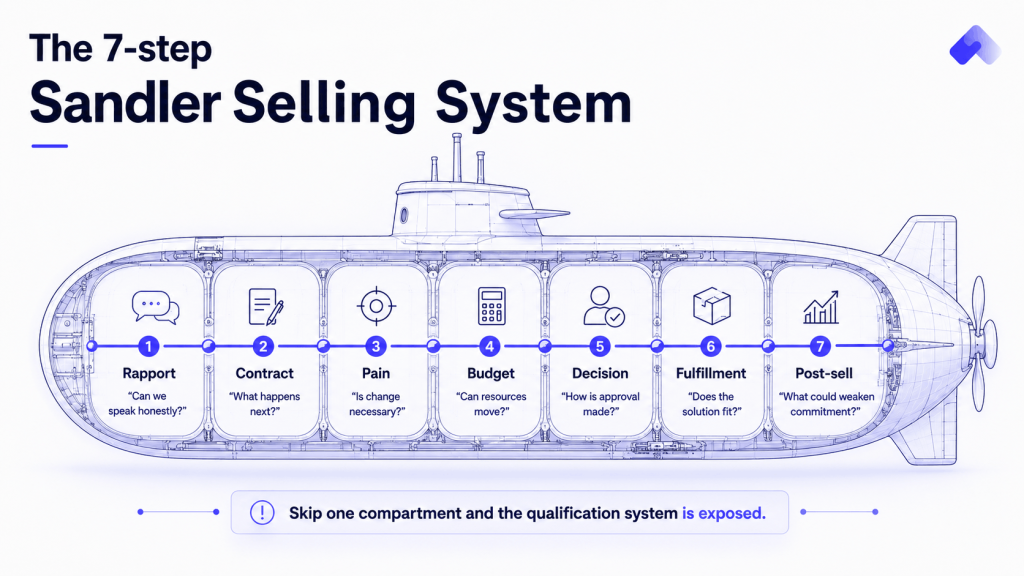
The seven steps of the Sandler Selling System
1. Establish bonding and rapport
Rapport is not small talk for its own sake. It means creating enough trust and comfort to discuss difficult business questions directly.
The rep should match the buyer's energy, communicate openly, and show genuine interest in the buyer's needs. Problems begin when reps imitate the buyer's behaviour or fake familiarity. That usually damages trust.
Opening questions could include:
- What would make this an effective conversation for you?
- I read that [relevant change] has affected your team. How is that showing up in your priorities?
- Before we begin, is there any other context I should know?
2. Set an up-front contract
An up-front contract outlines the conversation. It should cover the available time, agenda, roles, expected outcome, and what happens afterwards.
For example:
“Do you still have 30 minutes? I would like to understand how your team prepares for strategic calls, what is not working, and what you would like to improve. If it is relevant, I can explain how we may be able to help. At the end, we can decide whether another conversation makes sense.”
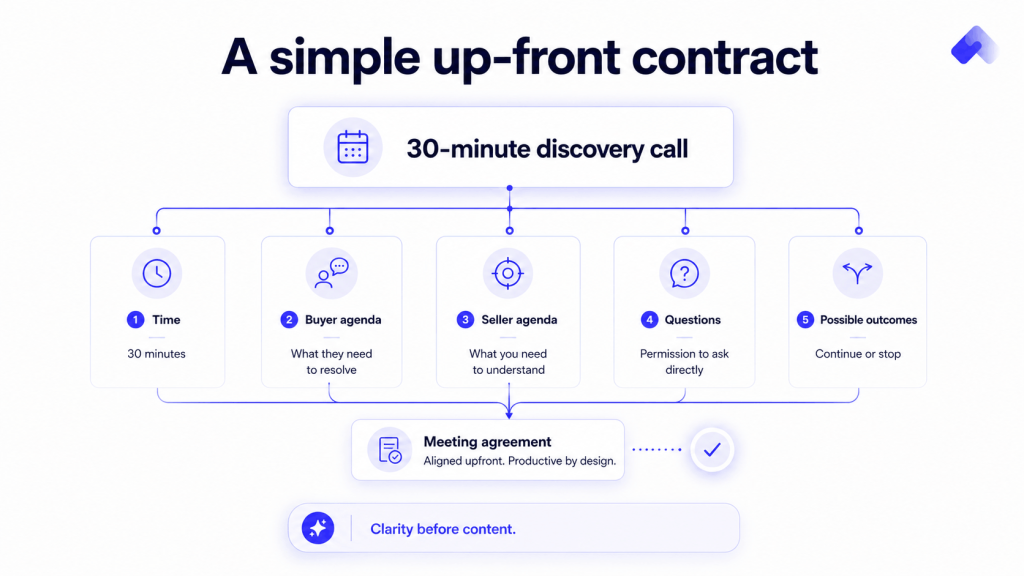
3. Identify the buyer’s pain
In Sandler, pain is a problem with enough personal or organisational impact to justify action. The customer's surface-level complaint is only the starting point.
The rep moves through the Sandler pain funnel with questions such as:
- Tell me more about that.
- How long has this problem existed?
- What have you tried so far?
- Why did the previous solution not work?
- Which parts of the business are affected?
- How do you feel about the current situation?
- What happens if no solution is found?
You do not need to ask every question. Ask one, follow the response, and summarize what you heard.
For example: “It sounds like inconsistent coaching is taking managers' time. But the larger issue may be that risks emerge after the forecast is committed. Is that the main thing you want to change?”
4. Uncover budget and resources
Budget is broader than price. It includes money, time, people, internal influence, and the willingness to redirect resources from other projects.
Useful questions include:
- Has funding been allocated for this initiative?
- How does the organisation normally support changes like this?
- What resources would implementation require?
- What budget range has the team discussed?
Understand the problem before discussing budget. Asking too early can feel transactional, but waiting until the end creates avoidable surprises.
5. Understand the decision process
A supportive contact does not mean the decision is approved. The rep needs to understand who participates, which criteria they use, how the decision will be made, and when it should happen.
Ask questions such as:
- Who else needs to be involved?
- What will each person evaluate?
- Has the organisation purchased something similar before?
- Which approvals follow the business decision?
- What could cause the team to miss the target date?
- If everyone agrees on one option, who gives final approval?
6. Present fulfillment
After establishing the pain, budget, and decision process, the rep presents a solution. It should match the needs already defined rather than showcase every capability.
Keep the presentation simple:
- Restate the agreed problem and expected outcome.
- Demonstrate the workflow that addresses the issue.
- Connect the product to the buyer's language.
- Identify what fits and what does not.
- Agree on the next step in the buying process.
For example, if managers lack time to prepare every rep before a call, demonstrate how reps can assemble context and identify areas to rehearse. Do not spend equal time on unrelated reporting features.
7. Confirm the post-sell process
When a “yes” becomes a “maybe,” the reason is often what happens inside the organisation after the meeting. The buyer may face internal criticism, competing priorities, procurement delays, or implementation concerns.
Post-sell questions uncover risks around the decision:
- What could make the team second-guess the decision?
- Who might disagree with it?
- What does procurement need before moving forward?
- How will the buyer justify the decision internally?
- What must happen before kickoff?
The goal is not to create fear. It is to make sure the commitment is solid on both sides.
A practical Sandler sales methodology example
Consider an account executive speaking with a revenue leader who wants more consistent coaching across the sales team.
Rapport: The AE acknowledges the leader's territory expansion and asks how the change has affected each manager's workload.
Up-front contract: They agree to review the current coaching process, its effect on deals, and whether another conversation would be useful. Either party can decide there is no fit.
Pain: The revenue leader explains that managers review calls inconsistently. New reps improve, but experienced reps continue repeating discovery mistakes on strategic accounts.
Budget: The company has enablement funding, but any new platform must replace two separate tools and reduce managers' workload.
Decision: Sales enablement will assess workflow fit, IT will review security, and the chief revenue officer will approve the business case before quarterly planning.
Fulfillment: The AE demonstrates a rep-first workflow that keeps buyer, meeting, and opportunity context connected. The demo focuses on pre-call preparation, AI Rehearsal, and post-meeting analysis through FOCUS.
Post-sell: Both parties identify the security contact, schedule the business-case review, begin contracting, and set a target kickoff date.
This example works because the demonstration happens after qualification and directly addresses an agreed problem.
Common Sandler sales methodology mistakes
Treating the up-front contract as a tactic
The agreement must be reciprocal. Both parties need flexibility and a genuine choice about whether to proceed.
Using pressure
Some business problems are urgent, but that does not justify emotional pressure. Explore concerns respectfully and understand why the buyer is saying no.
Treating price as a single number
Price is only one factor. Consider implementation cost, ownership, time, required resources, and vendor credibility.
Assuming the buyer is ready to decide
“My boss will sign” is not enough. Understand what the approver needs, who makes recommendations, and what must happen operationally after purchase.
Demonstrating before qualification
A premature demo rewards surface-level curiosity and creates unqualified opportunities. Before demonstrating, agree on further discovery steps or disqualify the opportunity.
Sandler vs. SPIN, MEDDIC, and Challenger
| Method | Main focus | Useful moment |
| Sandler | Mutual qualification across the sales process | From first conversation through post-sell |
| SPIN | Developing needs through four question types | Discovery and value conversations |
| MEDDIC | Testing evidence in complex opportunities | Deal inspection and forecast review |
| Challenger | Teaching an insight and reframing the status quo | When the buyer underestimates a problem |
How to practise the Sandler sales methodology
Work on one behaviour at a time. Start by using an up-front contract during your next seven discovery calls, then evaluate whether the conclusions became clearer.
Next, practise conversations about pain, budget, and decisions. AI sales role-play lets reps simulate buyer conversations before real meetings. After a live call, AI sales coaching can support review through FOCUS and AI Helper.
Salesman AI uses a rep-first design. The buyer, meeting, and opportunity remain connected through preparation, rehearsal, and review instead of becoming disconnected notes.
Frequently asked questions
What is Sandler in simple terms?
Sandler is a mutual qualification system that helps buyers and sellers define the problem, available resources, decision process, solution fit, and post-sale commitment.
What are the seven steps of the Sandler Selling System?
The seven steps are bonding and rapport, up-front contract, pain, budget, decision, fulfillment, and post-sell.
What is the Sandler pain funnel?
The Sandler pain funnel is a series of questions that move from the surface problem to its history, failed attempts, broader impact, and consequences. The rep should adapt the order based on what they learn instead of reading questions from an index card.
Why is Sandler illustrated as a submarine?
A submarine shows how each compartment of the complete selling system connects to the others. If one compartment is weakened or skipped, the entire process is at risk.
Does Sandler apply only to new business sales?
No. The same principles apply to expansion, renewal, and internal alignment conversations. Each requires clarity about the buyer's pain, resources, decision, and next steps.
Create clarity before your presentation
The Sandler sales methodology helps salespeople qualify the relationship, problem, available resources, and decision criteria before presenting a solution.
Its value comes from open dialogue, not the mechanical repetition of a formula.
Want your reps to simulate these conversations using the context of a live opportunity? Explore Salesman AI and its pricing, then start with your next meeting.