Contents
Search for sales software today and almost every tool calls itself an AI sales platform.
But that label can describe anything from a CRM or prospecting database to a meeting assistant or forecasting tool.
So, the useful question is not, “Which platform has the most AI features?” It is, “Which part of my sales process do I need this tool to own?”
This guide compares 12 platforms by the work they actually handle, where they fit in your sales stack and what you may still need alongside them.
TL;DR: which part of sales does each platform own?
| Platform | Primary ownership | Strong supporting coverage | Does not primarily replace |
|---|---|---|---|
| Salesforce | CRM and customer data | Agents, automation, opportunity management | Specialist enablement or external data tools |
| HubSpot | CRM for connected GTM teams | Prospecting, engagement, content and service | Deep enterprise revenue intelligence |
| Microsoft Dynamics 365 Sales | CRM in the Microsoft ecosystem | Sales agents, research and productivity | Independent engagement or conversation stack |
| Salesloft | Revenue orchestration | Engagement, deals, conversations and forecast | CRM system of record |
| Outreach | Sales execution | Engagement, deal guidance and forecasting | CRM or external contact database |
| Gong | Revenue and conversation intelligence | Coaching, pipeline, forecast and engagement | Core CRM administration |
| Apollo | Prospecting data and outbound | Enrichment, sequencing and workflow automation | Complex CRM or enablement programme |
| 6sense | Account intent and prioritisation | Buying-stage signals and sales intelligence | CRM and full opportunity execution |
| Clay | GTM data enrichment and orchestration | Research, scoring, routing and personalisation | CRM, forecasting or call coaching |
| Highspot | Sales enablement | Content, training, coaching and guided selling | CRM and prospecting database |
| Avoma | Meeting and conversation layer | Coaching, CRM updates and revenue intelligence | Broad CRM and outbound engine |
| Salesman AI | AE conversation execution | Preparation, rehearsal, post-call analysis and deal support | CRM, prospecting or enterprise forecast system |
A platform should own a defined layer. If every vendor claims to own the entire revenue cycle, compare the data it controls and the actions users can complete without leaving it.
What is an AI sales platform?
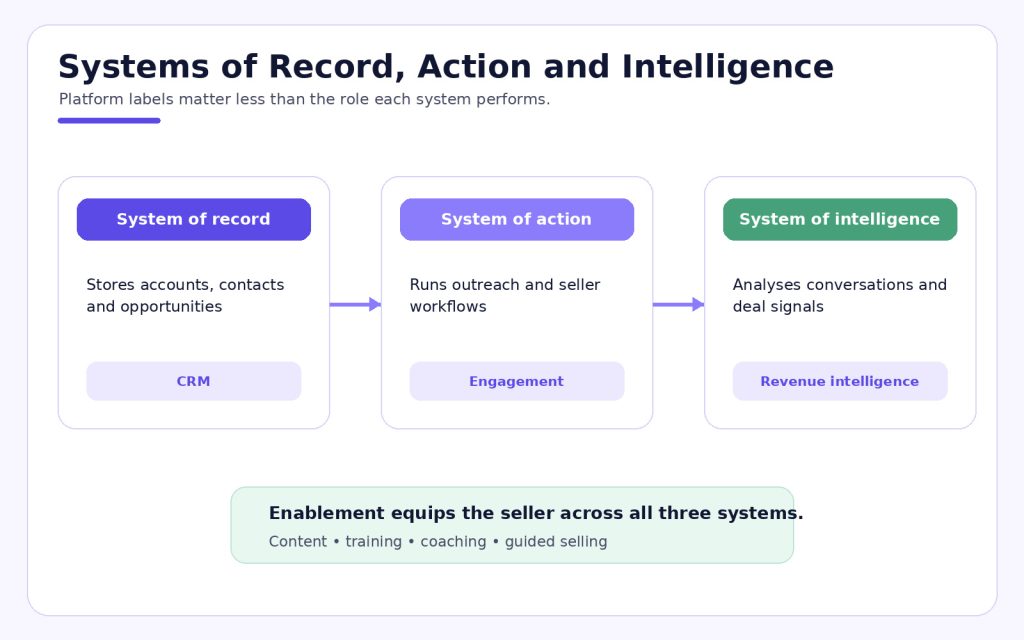
An AI sales platform is a connected system that uses sales data and AI to support or automate part of the sales process. A single-purpose application typically handles one workflow, such as email sending. A platform usually connects multiple workflows through a common data model, interface or automation layer.
The previous definition covers many different categories. The following represents those categories.
- CRM platforms hold customer and opportunity records.
- Data and intent platforms help teams find, enrich and prioritise buyers.
- Engagement platforms coordinate activities such as emails, calls and tasks.
- Revenue intelligence platforms analyse interactions, deals and forecasted revenue.
- Enablement platforms provide access to content, training and coaching.
- AE copilots improve preparation for buyer conversations and follow-through on commitments.
These categories can overlap. However, the platform's centre of gravity is what matters. It determines which data is native, how complete the workflows feel and which team manages the platform.
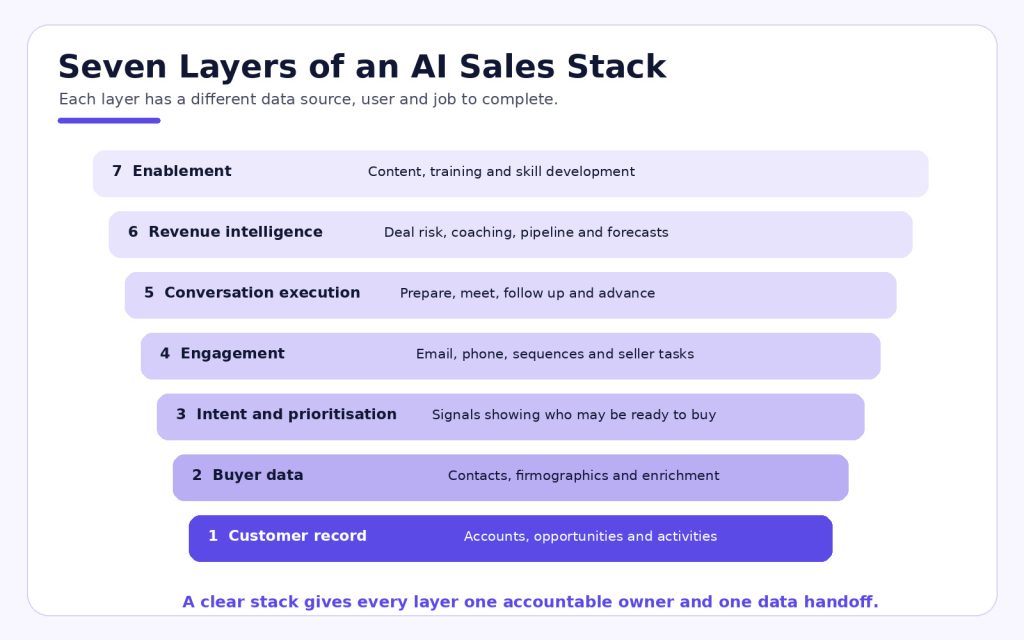
The seven layers of an AI sales stack
Before you compare vendors, define the work clearly:
| Layer | What it covers |
|---|---|
| Customer record | Accounts, contacts, opportunities and activities |
| Buyer data | Contact information, firmographics and enrichment |
| Intent and prioritisation | Signals that indicate who is likely to buy |
| Engagement | Email, phone, sequences and seller tasks |
| Conversation execution | Meeting preparation, live execution, follow-up and next steps |
| Revenue intelligence | Deal risk, coaching, pipeline and forecasting |
| Enablement | Content, messaging, training and skill development |
How we evaluated the best AI sales platforms
We used six practical criteria:
- Native data: What information does the platform collect or govern itself?
- Workflow depth: Can a user finish the job or only receive a recommendation?
- AI context: Does the AI use live CRM, buyer, conversation or content data?
- Primary user: Is the product designed for reps, managers, operations or enablement?
- Integration role: Does it act as the system of record, a system of action or an intelligence layer?
- Boundary: Which essential sales job still requires another platform?
This approach prevents a prospecting database from being judged as a forecasting product, or a meeting copilot from being judged as a CRM.
The 12 best AI sales platforms in 2026
1. Salesforce: best for CRM-centred enterprise sales
Salesforce Sales Cloud and Agentforce combine CRM records and workflows with automation and AI agents.
Agentforce works with Salesforce data and business logic across areas such as prospecting, opportunity management and coaching.
Owns: the customer record and CRM workflow.
Supports: AI agents; pipeline management; automation; ecosystem integrations.
Best for: organizations requiring an enterprise CRM with configurable processes to serve as the central hub for the sales stack.
Boundary: Specialised prospecting, conversation and enablement tools may offer more advanced workflows in their respective categories.
Verdict: When CRM governance and extensibility matter more than simplicity, Salesforce is a strong foundation for the wider sales stack.
Before choosing it, verify how much configuration your team can maintain and which specialist workflows still need separate products.
2. HubSpot: best connected platform for growing teams
HubSpot Sales Hub unites CRM, prospecting, engagement and customer-platform data. Breeze adds conversational support, agents and AI capabilities across HubSpot's hubs.
Owns: A unified CRM and customer platform designed for small and medium-sized businesses.
Supports: Prospecting, lead capture, outreach, meeting preparation, deal management and service handoffs.
Best for: Companies looking for broad GTM coverage without the heavier implementation demands of an enterprise system.
Boundary: More complex organisations may require advanced analytics, forecasting or specialised revenue intelligence systems.
Verdict: HubSpot is a practical option when ease of use and connected front-office data are the priorities.
Test whether its native workflows remain deep enough as your sales process, reporting requirements and team structure become more complex.
3. Microsoft Dynamics 365 Sales: best for the Microsoft ecosystem
Microsoft Dynamics 365 Sales combines sales-force automation, Microsoft 365, Copilot and configurable AI agents. Its agents can support qualification, opportunity research and sales insights.
Owns: CRM and sales automation within Microsoft's application environment.
Supports: Research, opportunity insights, productivity workflows and customisable agent development.
Best for: Large enterprises that have already committed to Microsoft 365, Azure and Power Platform.
Boundary: Teams can still use dedicated engagement, intelligence and/or coaching layers on top of this solution.
Verdict: It is a logical system of record when your organisation already uses Microsoft for identity, productivity and business applications.
The practical test is whether sellers can move between Microsoft tools and opportunity workflows without creating extra administrative work.
4. Salesloft: best for revenue orchestration
Salesloft brings engagement, conversation intelligence, deal management and forecasting into one product. Rhythm uses signals to help sellers decide what to prioritise.
Owns: Revenue orchestration and the workflow that guides a seller towards the next action.
Supports: Engagement, conversation intelligence, deal management and forecasting.
Best for: Full-cycle sales organisations that want consistent execution across teams and departments.
Boundary: Salesloft typically works with your CRM rather than replacing it.
Verdict: Salesloft excels at turning buyer and account signals into consistent seller behaviour.
Confirm that its recommended actions reflect your sales methodology and that completed work returns cleanly to the CRM.
5. Outreach: best for structured sales execution
Outreach Outreach allows Revenue teams to connect their sales engagement, conversation support, deal guidance, and forecasting. The outreach platform fills a gap in executing all phases of the pipeline from pipeline generation through the progression of deals.
Owns: sales execution (multi-channel) & rep workflow.
Supports: real-time live meeting support, account intelligence, deal analysis/inspection, and forecast activity.
Best for: Revenue teams that have well-defined processes but want to deliver repeatable execution at scale.
Limitations: a CRM and reliable account data must exist underneath the platform.
Verdict: Select Outreach when process consistency and coordinated seller activity are the most important goals.
During evaluation, run an active opportunity through the full workflow and check whether the guidance helps beyond outbound activity.
6. Gong: best for revenue intelligence
Gong's Revenue AI Platform collects data from customer interactions, including calls, meetings and emails, alongside CRM and other revenue signals. It applies this evidence to coaching, deal progression, pipeline management and forecasting.
Owns: The interaction and revenue intelligence layer.
Supports: Sales engagement, coaching, deal visibility, and forecasting.
Best for: Larger sales teams that want customer-interaction evidence to inform rep and management decisions.
Boundary: Gong will never be your organization’s primary CRM for managing customer records.
Verdict: Gong can serve as an intelligence anchor for leaders who need one view of what customers and sellers are actually doing.
Check whether managers and AEs can turn the surfaced evidence into decisions without creating another dashboard-review routine.
7. Apollo: best for data-led prospecting and outbound
Apollo combines B2B contact data with enrichment, research, sequencing and AI-assisted workflows for finding and engaging buyers.
Owns: The prospecting data as well as the sales outreach.
Supports: Lead scoring, data enrichment, engagement and early-stage pipeline creation.
Best for: Organisations looking to centralise contact information and sales engagement processes.
Boundary: It is not a complete enterprise CRM or enablement platform for training and coaching sellers through late-stage deals.
Verdict: Apollo is most attractive when creating new pipeline is the main challenge, rather than managing existing opportunities.
Evaluate data accuracy in your target markets and confirm how enrichment, sequencing and CRM updates behave in a real campaign.
8. 6sense: best for account intent and prioritisation
6sense Revenue AI for Sales helps B2B teams discover in-market accounts, understand buying-stage signals and decide where to focus engagement. Its value sits around the point at which a seller reaches out to a prospect or customer.
Owns: Account-level intent, predictive prioritisation and buying-stage intelligence.
Supports: Sales intelligence, recommended next steps and coordinated account-based programmes.
Best for: Large B2B companies looking to drive success through account-based motions as well as those who have large target-account lists.
Boundary: It requires integration with CRM and execution systems to manage opportunities and complete seller workflows.
Verdict: Choose 6sense when account prioritisation needs stronger buying evidence before sellers decide where to spend their time.
Test whether the intent signals are specific enough to change seller behaviour rather than simply adding another score to review.
9. Clay: best for GTM data enrichment and orchestration
Clay helps GTM teams connect multiple data sources for research, enrichment, scoring, routing and workflow automation. Teams can build customised data processes without relying on a single provider.
Owns: the enrichment/orchestration layer between external data providers and GTM systems.
Supports: Account research, lead scoring, personalization & CRM data quality.
Best for: GTM operations teams creating flexible, data-heavy prospect development systems.
Boundary: does not replace opportunity management in CRM, forecast governance or conversation coaching.
Verdict: Clay is useful when your competitive advantage depends on how well you collect, assemble and activate data.
Confirm who will build, monitor and repair the workflows as data sources, fields and routing requirements change.
10. Highspot: best for AI sales enablement
Highspot brings sales content, training, guided selling, coaching and buyer engagement into one place. Highspot's AI can find relevant information, identify skill gaps and give sellers deal-specific guidance.
Owns: The enablement layer: what the seller needs to know, say and do.
Supports: Training, content governance, coaching and next-best-action recommendations.
Best for: Large organisations with an established enablement programme and substantial amounts of content.
Boundary: Highspot supplements rather than replaces your CRM, engagement and data platforms.
Verdict: Highspot is worth considering when seller readiness and consistent execution are the two main problems.
Test whether sellers can find the correct content inside a live deal workflow, not only during a controlled enablement demonstration.
11. Avoma: best for the meeting and conversation layer
Avoma combines meeting scheduling, recording, transcription and note-taking with coaching and revenue intelligence. It supports sales, customer success and other meeting-intensive teams.
Owns: Meeting capture and conversation workflows.
Supports: CRM updates, coaching, call scoring, deal risk and pipeline review.
Best for: Organisations looking for a broad meeting platform with sales intelligence capabilities.
Boundary: It does not offer the same breadth as dedicated CRM, prospecting or multichannel engagement platforms.
Verdict: Use Avoma when meetings are the primary source of information your organisation needs to organise and analyse.
Confirm whether meeting insights flow into the tools where sellers manage follow-up, opportunities and customer relationships.
12. Salesman AI: best for AE conversation execution
Salesman AI supports pre-call preparation, buyer-specific practice and post-call follow-up within one account executive workflow.
It was created to help AEs convert booked meetings into actual progress rather than simply generate a transcript.
Pre-call notes provide background information about the customer and deal.
AI rehearsal allows the AE to practise responding to a customer avatar.
After the meeting, FOCUS organises the evidence from the discussion. It identifies barriers, lists the stakeholders involved and captures commitments made during the meeting.
The AI Helper allows the AE to ask questions about the relevant context.
Owns: The AE workflow from preparation through conversation follow-through.
Supports: Coaching, qualification reviews and deal-specific actions.
Best for: AEs who manage complex buyer conversations within an existing CRM and sales stack.
Boundary: Salesman AI does not replace prospecting data, a CRM or an enterprise forecasting system.
Verdict: Use it when your current stack can create opportunities, but your AEs need more help turning meetings into buyer-backed progress.
Test it with real upcoming meetings. Review whether preparation, rehearsal, evidence and follow-up stay connected across the same opportunity.
How to choose an AI sales platform without creating more tool sprawl
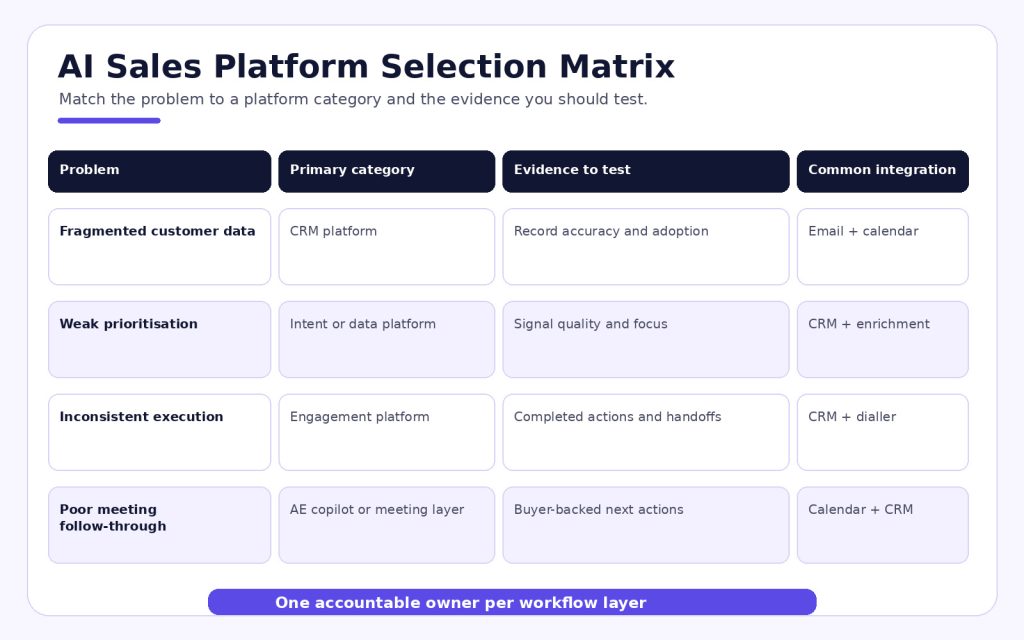
Start with the layer, not the vendor
Identify the job that requires an accountable system. “Use AI” is not a job. Keeping opportunity data current, identifying in-market accounts and preparing AEs for complex calls are clear jobs.
Determine which system owns the data
All platforms produce signals. Determine where the final records for accounts, contacts, opportunities, activities and conversations will live.
If you do not make that decision, AI can create more versions of the truth.
Separate recommendations from execution
Some systems tell an AE which action to take. Others can complete that action. This distinction is central to evaluating sales automation.
Ask which actions require approval, which will be automated and where the results will be recorded.
Test the handoffs
Run a real workflow from target account to closed opportunity. Observe how contact-role changes, rescheduled meetings, stakeholder blockers and slipping opportunities affect each handoff.
Consolidate only when workflow depth remains sufficient
A broad platform can reduce procurement and integration work. However, consolidation adds value only when the remaining workflow is deep enough to support its users.
Replacing three effective tools with one shallow module simply transfers cost from software to seller effort.
Three practical AI sales platform stacks
Lean full-cycle team
- HubSpot for CRM and basic engagement
- Apollo for additional prospecting data when required
- Salesman AI for meeting preparation, rehearsal and post-call action
Enterprise revenue team
- Salesforce or Dynamics 365 Sales for the system of record
- Salesloft or Outreach for sales execution
- Gong for revenue intelligence
- Highspot for enablement
Data-led outbound team
- Salesforce or HubSpot for CRM
- Clay for enrichment and orchestration
- 6sense for account intent
- Apollo, Salesloft or Outreach for engagement
These are architecture examples, not bundled packages. The correct bundle will be determined by sales motion, deal complexity, the number of people in your team, and what you currently have as a system.
AI sales platform implementation checklist
Before you sign a platform agreement, confirm that:
- There is one clear owner of the platform.
- The required CRM, email, calendar and meeting integrations are available.
- You have enough historical data to support the intended AI use case.
- Permissions match the sensitivity of customer and employee data.
- AEs can understand why the system recommended an action.
- Review and approval controls exist for automated actions.
- Adoption is measured through completed workflows, not just logins.
- The exit plan covers data export and continuity of core sales records.
A platform is not successfully implemented because people can log in. It succeeds when they can complete the work it was purchased to support.
Frequently asked questions
How do you pick the right AI sales platform for your business?
The answer is not simple because no single product fits every sales cycle. Salesforce, HubSpot and Microsoft Dynamics lead with CRM. Salesloft and Outreach focus on execution, while Gong focuses on revenue intelligence.
Apollo, 6sense and Clay cover data and prioritisation. Highspot focuses on enablement, while Avoma and Salesman AI support different parts of conversation workflows.
What is the difference between an AI sales platform and an AI sales tool?
An AI sales tool typically addresses a specific task. A platform connects several workflows through shared data, administration or automation.
Vendor labels are inconsistent, so buyers should examine what the product actually provides rather than relying on the category named on its homepage.
Can an AI-powered sales platform replace your entire sales stack?
Some platforms combine several categories. However, most teams will still need a system of record and specialised depth in data, engagement, enablement or conversations.
A well-designed stack minimises overlap without weakening the workflows that matter.
Should you use the CRM as the main AI platform for sales?
In most organisations, the CRM should remain the authoritative customer record. That decision still depends on the CRM's capabilities, data quality and adoption.
A specialist platform may add value, but it should not quietly become another system of record.
How do you determine which AI sales platform is best for you?
Compare native data, workflow depth, integration role, primary user, automation controls and system boundaries. Test the platform with real accounts and opportunities.
A checklist cannot show whether a workflow is genuinely usable.
Own the moment that affects the deal
The largest gap in a sales stack is not always missing software. Often, it is an essential business process without a defined owner.
Salesman AI focuses on closing that gap. It supports account executive preparation before buyer conversations, enables AEs to practise what they need to discuss and organises the evidence after each meeting.
If your wider stack already generates opportunities, the next question is whether it helps AEs turn those meetings into clear, buyer-backed next steps. That is the workflow a dedicated AI sales assistant should strengthen.