Contents
Most sales teams are swimming in an ocean of data.
Typically, sales teams have no idea which of the numerous data platforms they utilize for customer communication, buyer signals or even the true context surrounding customer communications.
It is usually too late to act by the time an SDR compiles all of the relevant information from these sources.
In order to aid in this regard, sales intelligence software can assist. Its value is not simply in generating more data.
It can also help an SDR find the right contact, show an AE what a buyer is concerned about, and reveal why an active deal has stalled.
Many companies create various solutions designed to perform multiple functions in support of B2B data discovery.
However, most organizations are challenged with determining how to compare similar solutions since some focus on providing users’ access to B2B data contact lists while others focus on helping users execute their outbound prospecting activities. Additionally, other solutions assist in buyers’ intent identification through conversation intelligence tools and/or deal execution tools.
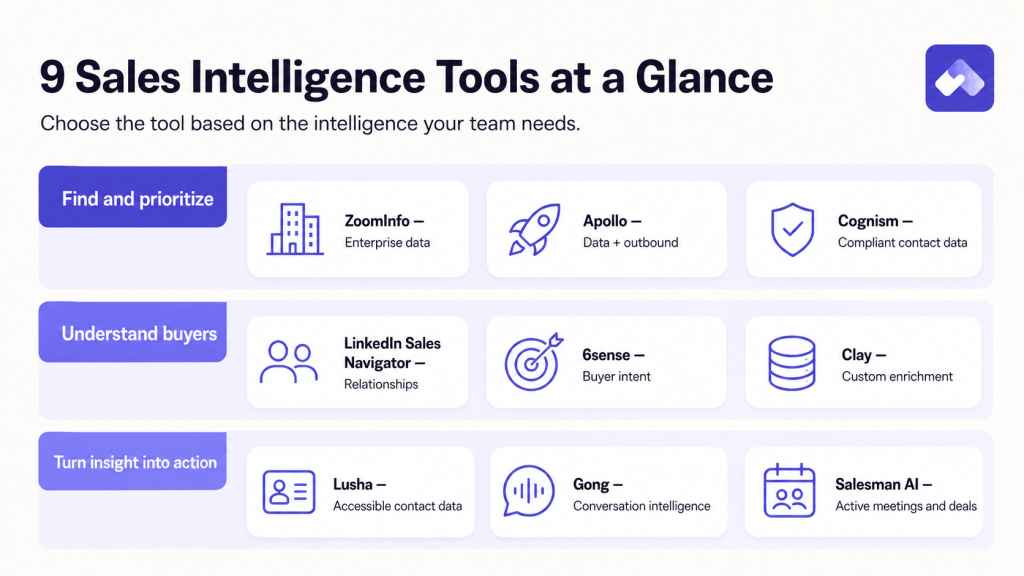
TL;DR: The best sales intelligence software at a glance
| Tool | Best for | Main intelligence layer | Pricing status |
|---|---|---|---|
| ZoomInfo | Enterprise prospecting | Contact, company, intent, and market data | Custom pricing |
| Apollo | Data plus outbound execution | Contact data, signals, enrichment, and engagement | Free and paid plans |
| Cognism | Compliant international prospecting | Verified contact and company data | Custom pricing |
| LinkedIn Sales Navigator | Relationship-led selling | Professional network and relationship data | Published plans and free trial |
| 6sense | Intent-led account prioritization | Buying intent and predictive account intelligence | Free entry point and custom plans |
| Clay | Flexible enrichment workflows | Multi-source data, research, and signals | Free and paid plans |
| Lusha | Accessible B2B contact data | Verified contacts, companies, and buying signals | Free and paid plans |
| Gong | Enterprise conversation intelligence | Calls, deals, coaching, and forecasting | Custom pricing |
| Salesman AI | Helping AEs turn meetings into deal progress | Buyer, meeting, conversation, and opportunity context | Free trial, $29 monthly plan, and enterprise option |
What is sales intelligence software?
Sales intelligence software uses information about buyer behavior, account activity, and sales actions. It helps revenue teams understand their opportunities, learn what matters to buyers, prioritize work, and make informed decisions.
A B2B sales intelligence platform could include:
- Verified emails, phone numbers, job titles, and firmographic data
- Buyer intent, website activity, job changes, and company signals
- Account research and relationship mapping
- CRM enrichment and workflow automation
- Conversation intelligence for sales calls
- Deal intelligence, risk detection, and next-step recommendations
This category provides much more than a contact database. A database tells you who to contact, while actionable sales intelligence can also explain why now, what matters, and what to do next.
The four types of sales intelligence tools
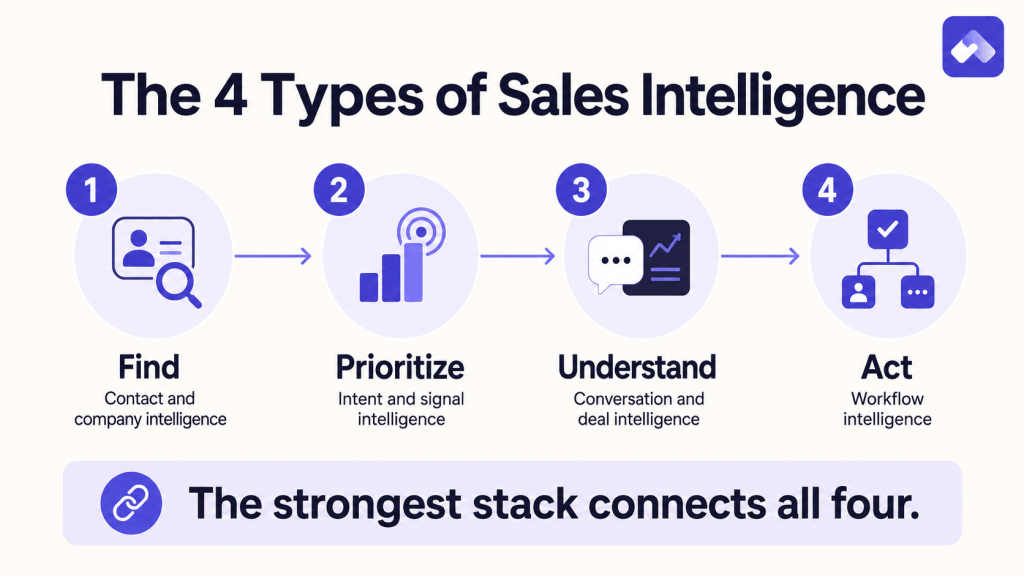
Most sales intelligence platforms fall into four overlapping groups:
- Contact and company intelligence: Finds people, accounts, emails, phone numbers, and firmographic details.
- Intent and signal intelligence: Identifies accounts showing research, hiring, funding, engagement, or other buying signals.
- Conversation and deal intelligence: Analyzes buyer conversations, opportunity health, risks, and next steps.
- Workflow intelligence: Combines data sources, enriches records, and triggers personalized sales actions.
The real challenge is turning a signal into an action
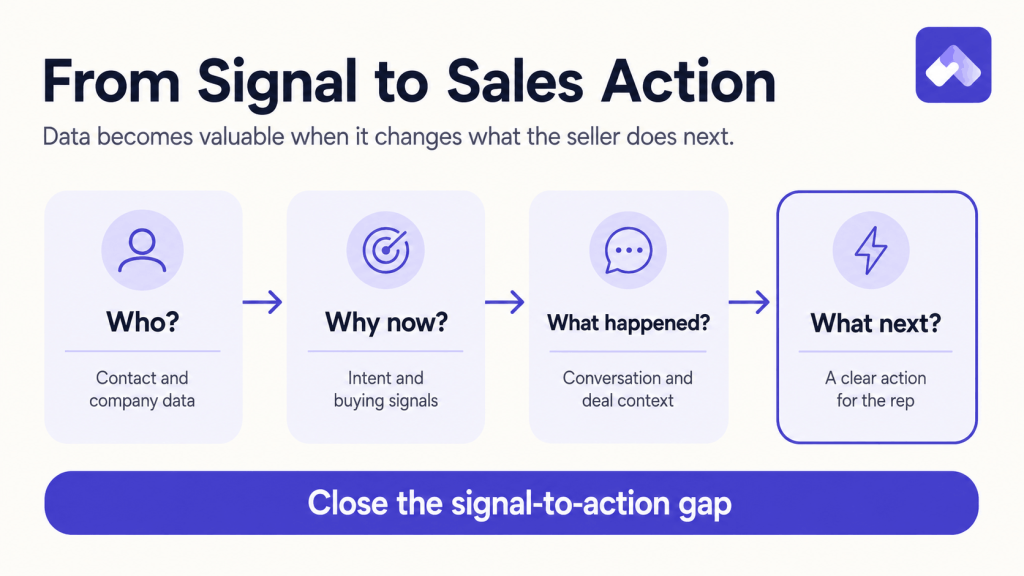
The best tool will not always provide the most data to your team, but will always shorten the distance from an important signal to a helpful sales activity.
Salesforce reported that sales representatives spent 60% of their time doing non-selling activities such as researching, updating the CRM, and other internal tasks. Additionally, 6sense’s 2025 buyer research showed that 94% of buying groups ranked their preferred vendors before contacting a sales representative. Therefore, based on both of these studies there are fewer opportunities for a sales representative to develop a customized conversation with a prospect upon initial contact.
Contact databases show you “who” the buyer is; intent platforms explain “why” an account is currently active; conversation tools record “what” the buyer has said; and deal focused tools tell you “what” should happen next.
Therefore, current sales research makes understanding the difference between providing a piece of information (signal) and using the information to guide your sales actions, much more significant.
How we evaluated the best sales intelligence tools for B2B sales teams
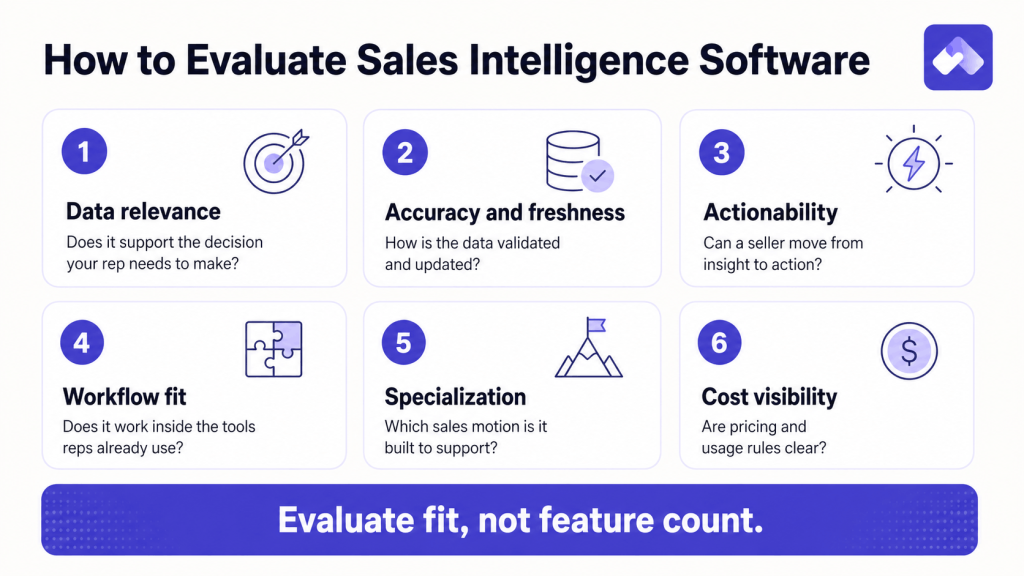
We assessed each product using six practical criteria:
- Data relevance: Does the information help the intended user make a decision?
- Accuracy and freshness: How does the platform validate or update its data?
- Actionability: Can a seller move from insight to action without heavy manual work?
- Workflow fit: Does it connect with the CRM, browser, meeting, or outreach workflow?
- Specialization: Is the product clearly stronger for a particular sales motion?
- Cost visibility: Is there a free trial, published pricing, or only custom pricing?
There is no universal winner because a longer feature list does not automatically make a platform more useful. The comparisons below focus on where each product fits in the sales process and what a team should check before buying it.
1. ZoomInfo: Best for enterprise B2B sales intelligence
ZoomInfo is one of the most all-encompassing sales intelligence platforms for enterprise prospecting. This includes contact and company data, intent signals, enrichment, workflows, and other go-to-market tools.
How it works: Teams search for target accounts & decision makers. Enrich CRM Records. Use Signals to Prioritise Outreach.
Key features:
- B2B Contact & Company Database • Account/Intent/Mktg Signals • CRM Enrichment/Data Management • Prospect/Workflow Tools
Best for: Large B2B sales teams looking for an enterprise-wide sales intelligence software layer across sales & marketing.
Limitations: Too Much for Small Teams. Customised pricing: Make sure to get the full contract cost, coverage of data and what add-ons are required.
Verdict: Zoominfo is a great choice for enterprise teams when an all-inclusive database and connected GTM intelligence matter more than a lightweight setup.
2. Apollo: Best for contact data and outbound prospecting in one platform
Apollo Apollo includes B2B Contact Data (enrichment), Buyer Signals, Sales Engagement Tools and Workflow Automation. The product page on Apollo's website also places itself at both Prospect Outreach and Deal Execution phases of the sales process.
How it works: Representatives use various filtering options to create lists of contacts with the contact information they need. Then, reps select which prospects they will add to their outreach sequence(s) or CRM workflows based upon their criteria.
Key features:
- Searching for contacts/accounts
- Email/phone number data
- Buying Intent and Job Change Indicators
- Chrome Extension as well as many CRM integration capabilities
- Sequencing/Automation and Engagement Analytics
Best for: Startups and growing outbound teams who want all of their data (prospect) collection needs met within one single platform.
Limitations: Usage of credits, enrichment rules and quality of data may vary depending on where you operate.
Verdict: Apollo is likely the most useful B2B sales intelligence tool for those teams who do not have an existing prospect outreach tool and engagement product.
3. Cognism: Best for compliant international contact data
Cognism Cognism's focus is primarily on premium B2B contact data, including phone-verified mobile numbers and business information, as well as compliance. This will be most useful to teams that plan to do outreach across the United Kingdom, Europe, or other heavily regulated areas.
How it works: Sellers build targeted lists of accounts and contacts, using verified mobile data (to ensure accuracy) and syncing specific data from those lists directly into your sales workflow.
Key features:
- Mobile-verified diamond level contact data
- Search functionality by company & contact
- Trigger options for hiring, funding, events
- Compliance solutions that meet GDPR and CCPA standards
- Integration options with CRM platforms and sales tool
Best for: Outbound teams working internationally who require high-quality mobile data, and/or have significant concerns about regulation compliance.
Limitations: The pricing model has not been made public. Sales teams looking at Cognism should first determine what percentage of their target countries' population they can verify with their existing vendor. They should also compare connect rates with both vendors.
Verdict: Cognism would be a viable option if you need to prioritize compliant and phone focused prospecting over using an all-in-one sales engagement solution.
4. LinkedIn Sales Navigator: Best for relationship-based B2B selling
LinkedIn Sales Navigator LinkedIn Sales Navigator utilizes LinkedIn’s Professional Graph to assist sales professionals in finding buyers, tracking company account changes and identifying warmer paths into their target companies.
How it works: Representatives can utilize advanced filters to research; save prospects and accounts; receive notifications; and utilize the Relationship Paths function of TeamLink (formerly known as Connection Path) in planning an approach to reach out to a prospect/ customer.
Key features:
- Advanced Lead and Account Search
- Lead, Role Change and Engagement Alerts
- Team Link Relationship Paths
- Account Intelligence through Account IQ and Lead Intelligence through Lead IQ
- Integration with select CRMs
Best for: AEs and SDRs that have an element of Social Selling, stakeholder Mapping and Warm Introductions included within their outbound processes.
Limitations: The Sales Navigator application is not intended as a complete Contact Database nor an Outreach Sequencer. AI and CRM features will vary based upon pricing tier.
Verdict: LinkedIn Sales Navigator is a strong choice for sellers who need to understand people, relationships, and account changes before reaching out.
5. 6sense: Best for predictive account and buyer-intent intelligence
6sense Sales Intelligence The 6Sense Sales Intelligence Platform provides sellers with information about in-market accounts and buying-group members, as well as relevant talking points.
It brings buyer context directly into the browser, CRM; sales engagement platform, and the 6Sense workspace.
How it works:
- Analyzes Account Activity & Intent Signals;
- Uses Predictive Models to Estimate Buying Stage;
- Prioritises accounts based upon estimated buying stage;
Key features:
- Intent Data/Account Activity;
- Predictive Account Prioritisation;
- Buying Group Intelligence;
- Company/People Search;
- Revvy AI Account Research/Talking Points
Best for: Mid-market and enterprise teams operating account-based sales/marketing programmes.
Limitations: Its value depends on signal coverage, integrations, and organizational adoption. The broader platform may be more than a smaller team needs.
Verdict: 6sense is a strong fit when the key question is which accounts are showing signs that they may be ready to buy.
6. Clay: Best for custom enrichment and signal workflows
Clay Clay provides an agile environment for Go-To-Market (GTM) teams to build lists; add enrichment across multiple sources; research with AI; identify signals; and automate outbound workflows.
How it works: Teams pull records from other data sources, enrich those records using many providers; perform research/qualify those records; and then deliver that record into their customer relationship management (CRM), or engagement platforms.
Key features:
- Multiple provider data enrichment
- Data Enrichment Waterfalls
- Claygent AI Research
- Intent and Trigger-based Workflows
- Outbound and CRM Integrations Best for: RevOps teams and GTM engineers who wish to create customized prospecting systems for their organisations.
Limitations: The flexibility of Clay creates a steep learning curve. Active governance is required in regards to credit usage and workflow maintenance.
Verdict: Clay is one of the most robust workflow-oriented solutions available within AI-powered sales intelligence tools; and would be an excellent option if you have a specific use case where a single database will not meet all of your needs.
7. Lusha: Best for accessible contact data and buying signals
Lusha Lusha offers B2B Verified Contact & Company Data and Buying Signals for the purpose of Sales Outreach. For Teams (RevOps) with no need to roll out Enterprise-wide, Lusha provides an easy entry point into Prospect Data.
How it works: Sellers search for contacts to find details via the browser extension, while RevOps Teams will enrich records and track selected buying signal indicators related to companies or contacts.
Key features:
- Search by Company/Contact
- Verified Email & Phone Data
- Browser Extension
- Enrichment to CRM
- Hiring, Headcount & Job-Change Buying Signals Best for: Smaller and mid-sized teams who desire an accessible, user-friendly contact data intelligence tool.
Limitations: The usage credit rules and coverage testing will determine if this solution fits your target segment. More advanced users may require additional Intent Tools or Workflow Tools beyond what Lusha has to offer.
Verdict: Lusha is a good fit for basic prospect outreach and enrichment efforts where ease of adoption is important.
8. Gong: Best for enterprise conversation and revenue intelligence
Gong platform captures sales conversations; and then using this captured information, provides users with insight in areas of (1) Deals, (2) Coaching, (3) Market Trends, and (4) Forecasting.
How it works: The platform records customer calls or interactions and then analyses them. This analysis will turn these interaction patterns into intelligence on the customer’s current deal(s), and also on the customer-facing team(s).
Key features:
- Call Recording
- Conversation Analysis Deals: Visibility & Next-Best-Action Guidance
- Enablement/Coach Insights
- Pipeline Intelligence & Forecasting
- Revenue Analytics Across Customer Interactions Best for: Enterprise-level revenue organisations wishing to implement an “intelligence” layer which all managers, RevOps teams, enablement teams, and sellers share access to.
Limitations: Due to custom pricing from Gong, wider implementation is required by some customers. Customers looking to capture only contact data should look at platforms that are focused specifically on prospect management.
Verdict: Gong is a good choice for large-enterprise sales teams that wish to have call evidence tied directly to their pipeline decision-making.
9. Salesman AI: Best rep-first intelligence for active deals
Salesman AI Salesman AI was designed to help Account Executives (AEs) prepare for their upcoming meetings that are already scheduled in their calendars. It does this by connecting buyer, meeting, and opportunity context at all times including during preparation, rehearsal, actual conversation, and follow-up.
How it works: Before a call, the rep receives a short Buyer & Meeting Brief. Prior to the call, an AE may also use an AI clone of the buyer to practice the call. The AI will take the actual conversation from the meeting and create structured deal intelligence and provide coaching and next action. When an AE needs to ask a specific question about a deal, they can ask using AI Helper.
Key features:
- DISC based pre-call notes
- Buyer-Specific AI Rehearsal
- FOCUS meeting reports and post-call analysis
- Deal Specific AI Helper
- Meeting notes, next steps, and opportunity context related to each meeting
Best for: AEs, founders, and active sellers looking for valuable intelligence before and after meetings with customers
Limitations: Salesman AI is not a B2B contact database for list building. In-call context exists if the platform supports it and it should not be assumed to be live nudging across every meeting setup.
Verdict: Salesman AI is the rep-first choice when the focus is converting buyer conversations into better preparation and greater deal momentum.
Which sales intelligence platform should you choose?
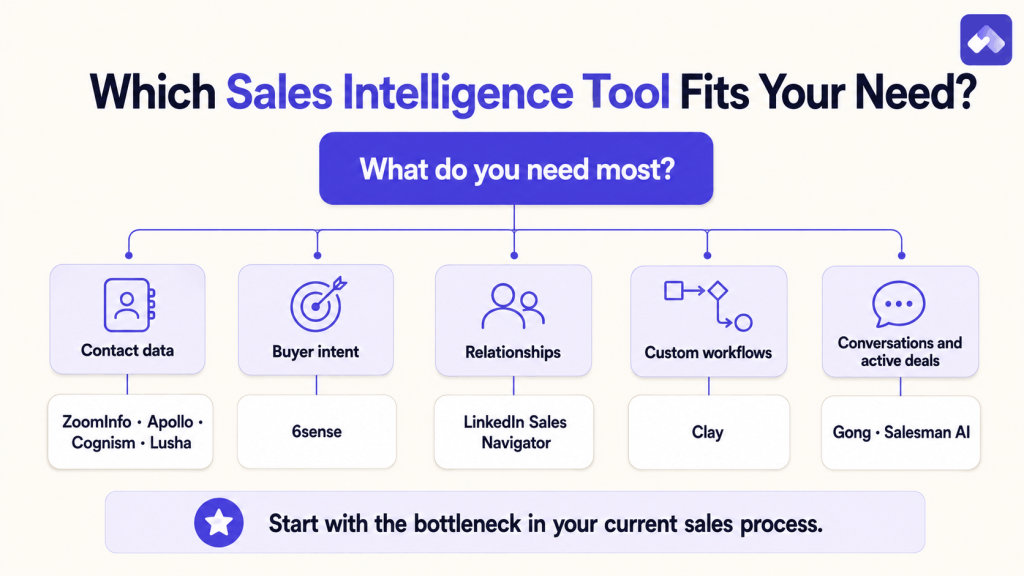
First, identify the bottleneck in your current sales flow:
- Need an enterprise-level data layer? Look at ZoomInfo.
- Need contact information and outbound execution? Check out Apollo.
- Need compliant international mobile data? Review Cognism.
- Need relationship maps and social insights? Review LinkedIn Sales Navigator.
- Need predictive intent and account prioritization? Take a look at 6sense.
- Need custom enrichment and automated research? Build with Clay.
- Need a simpler prospecting tool? Take a look at Lusha.
- Need enterprise call, coaching, and forecast intelligence? Look at Gong.
- Need rep-first support around booked meetings and active deals? Take a look at Salesman AI.
Then run a short proof of concept using real workflows. Test 50 to 100 target contacts for coverage and accuracy. If you are testing meeting intelligence, use recent calls and active opportunities. Finally, measure whether reps actually use the product.
Sales intelligence software implementation checklist
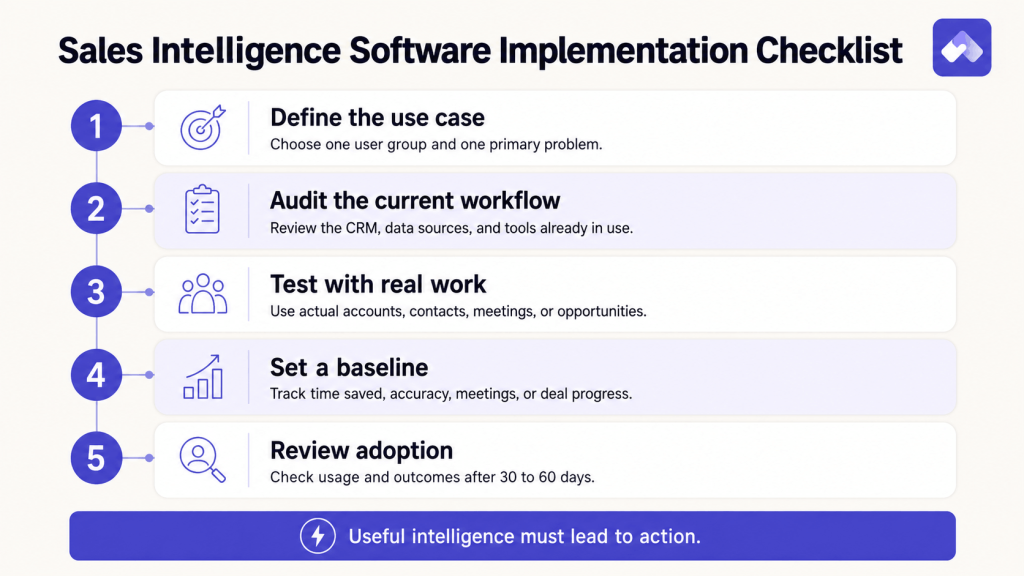
- Define one primary use case and user group.
- Audit the data and tools already in your CRM workflow.
- Test the product with real accounts, contacts, meetings, or opportunities.
- Set a baseline for time saved, data accuracy, meetings booked, or deal progression.
- Review adoption and outcomes after 30 to 60 days.
Frequently asked questions
What is the best sales intelligence software in 2026?
The right choice depends on what your team needs. ZoomInfo suits enterprise data requirements, while Apollo combines prospecting and engagement. Cognism focuses on compliant international data, 6sense on buyer intent, and Gong on enterprise conversation intelligence. Salesman AI provides rep-first meeting and deal support.
What is the difference between sales intelligence tools and CRM software?
CRMs store customer and opportunity records. Sales intelligence software adds external data, signals, conversation insights, or recommendations that make those records more useful. Most tools integrate with a CRM instead of replacing it.
Do sales intelligence tools support only prospecting?
No. While most contact databases enable prospecting, many categories exist under the umbrella of "sales intelligence tools" including buyer intent, conversation intelligence, predictive sales intelligence, deal analytics, coaching, and workflow automation.
What should a small B2B sales team look for when choosing a tool?
First, identify your team’s biggest bottleneck and find the smallest tool that addresses it. Check its coverage in your market, integration effort, credit policy, and ease of adoption. Apollo and Lusha are accessible prospecting options. Salesman AI is relevant when you want to improve booked meetings and active deals.
Final verdict
The best sales intelligence software is the one that removes uncertainty from a specific part of your sales process.
Some teams will find the right contact information and other teams may identify buyers who have shown buying intent or know where they were at during the previous conversation and make a decision on how to take the next step.
When comparing tools, look beyond how much data each one provides. Consider how easily a rep can use that information in their actual workflow.
As long as you have to open multiple pages (tabs), do additional research and then go back into the CRM and manually update this piece of information again prior to utilizing it, the gap remains.
Salesman AI connects pre-meeting preparation, buyer-specific rehearsal, post-call analysis, and deal support through the same buyer and opportunity context.
You can start with your next meeting and see whether this connected workflow helps the rep move the deal forward with less manual work.