Contents
Every customer call gives a salesperson something new to learn. The problem is that the learning often arrives after the moment when it would have helped most.
A manager may review the call, share feedback and explain what the rep could have done differently. The feedback is useful. But by then, the customer conversation is already over.
This was the challenge for Animaker’s global B2B SaaS sales team. Its reps spoke with buyers across industries, company sizes and markets. One buyer wanted proof of ROI. Another wanted to understand implementation. A third was comparing the product with an existing tool.
The conversations kept changing, but the preparation and coaching process could not always keep up.
That is where Salesman AI came in. Animaker introduced it to help reps prepare for the real buyer, practise difficult conversations and learn from every completed call. Instead of waiting for the next manager review, reps could get support while the opportunity was still active.
Animaker at a glance
| Industry | B2B SaaS |
| Sales motion | Global inbound and product-led sales |
| Participating team | 12 salespeople |
| Evaluation period | June 1–August 31, 2026 |
| Customer calls analysed | 420 |
The challenge: every conversation required different preparation
The team handled customer conversations across industries, company sizes and use cases. Naturally, no two meetings looked the same.
Some buyers wanted to understand the product. Others focused on implementation, adoption or pricing. Many wanted to know how the product would fit into their current workflow.
Before every important meeting, reps moved between calendar invites, company websites, past calls and internal notes. Only after gathering that information could they decide what to ask and what to prepare for.
As the team looked closer, four problems stood out.
Buyer context was scattered
Important information about the buyer and the opportunity was spread across different tools.
So, before every important meeting, reps had to collect the information and make sense of it themselves.
Practice was too generic
Traditional roleplays helped reps practise general sales skills. However, they rarely felt like the conversation waiting on the calendar.
For example, a generic pricing objection could not prepare a rep for a buyer worried about implementation effort, team adoption or the value of replacing an existing tool.
Insights remained inside transcripts
Recordings and transcripts captured every word. Still, reps had to work out what mattered and what they should do next.
They had to find the buying signals, unresolved objections and missing information hidden inside the conversation.
Managers could review only a fraction of calls
Managers could provide detailed feedback on selected calls. But reviewing every conversation was not practical.
As a result, a rep often received coaching based on the manager’s availability, not the needs of the deal.
Why the team introduced Salesman AI
The team decided to place Salesman AI around the meetings reps were already having.
The goal was simple. Salesman AI would not replace managers or force the team to adopt a new methodology. It would make useful coaching available throughout the rep’s normal workflow.
To do that, Salesman AI connected four activities that had previously happened separately:
- Preparing for the meeting
- Rehearsing the conversation
- Reviewing the completed call
- Asking questions about the deal
Now, reps could prepare and reflect on their own. Meanwhile, managers could spend more time on deal strategy, difficult objections and priority opportunities.
Before the call: preparing for the actual buyer
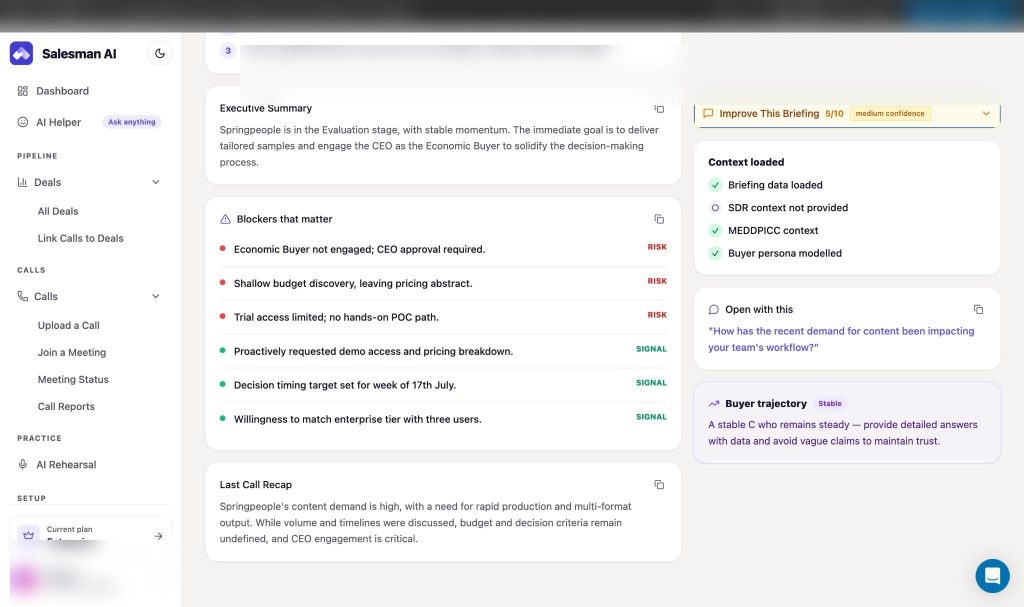
The workflow began before the meeting. Salesman AI created a pre-call brief with the buyer, company and conversation context in one place.
The brief brought together the information a rep needed to start the call well:
- Buyer and company context
- Likely priorities
- Previous conversation history
- Suggested discovery areas
- Information still missing from the deal
Instead of starting from scratch, reps received a structured view of the upcoming conversation. They could quickly see what was known, what was missing and where to focus.
The aim was not to give them more information to read. It was to help them enter the meeting with the right questions.
Before important meetings: rehearsing with an AI customer clone
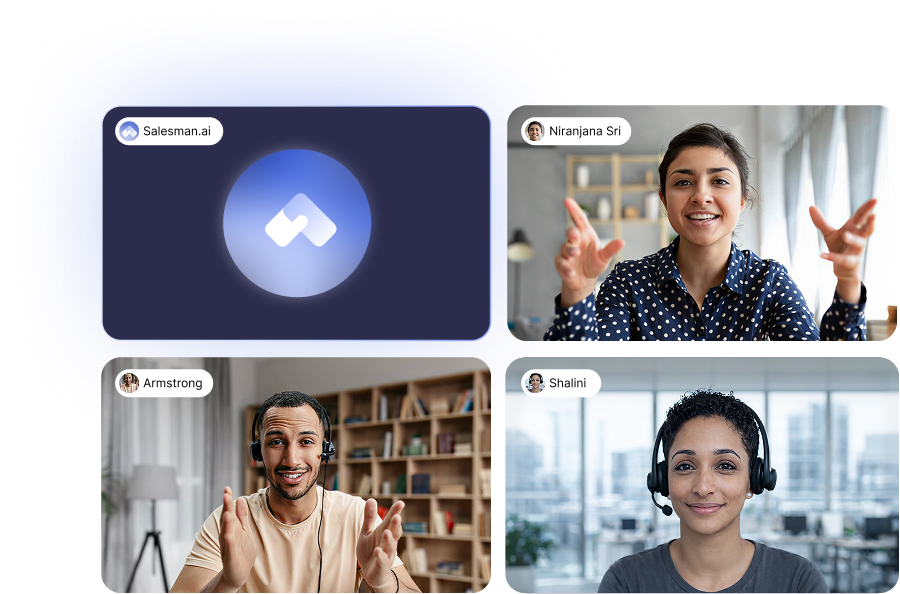
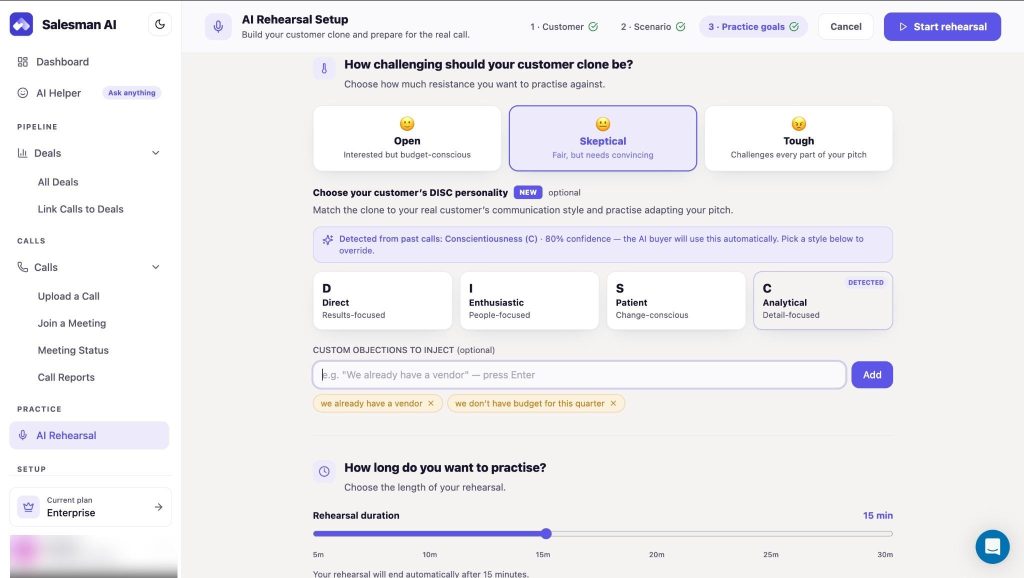
For priority and difficult opportunities, the team went one step further. Reps created an AI clone of the customer they were about to meet.
The rehearsal used the buyer, deal context and likely objections. A rep could test an opening, practise discovery questions and work through the difficult moments before the real conversation began.
Most importantly, it gave reps a private place to make mistakes.
They could try a response, see how the AI customer reacted and start again. If an answer did not work, they could test a different approach without performing in front of a manager or colleague.
The change was visible in usage. During the three-month evaluation, the team completed 86 AI rehearsals before priority calls. The earlier comparison period included only 12 structured rehearsals.
After the call: turning the conversation into next steps
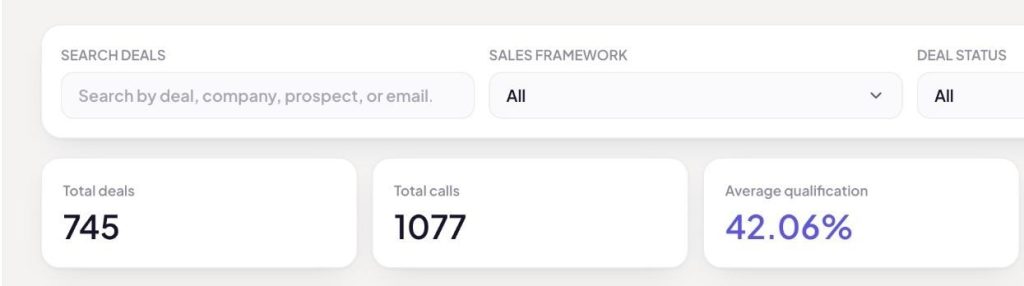
Once the meeting ended, Salesman AI analysed the conversation using the FOCUS framework.
The post-call report then organised the conversation into:
- Positive buying signals
- Risks and unresolved objections
- Customer commitments
- Missing discovery information
- Areas requiring clarification
- Recommended next steps
So, instead of rereading an entire transcript, a rep could go straight to the moments that mattered.
They could see whether an objection remained unresolved, whether the right stakeholders were involved and whether the buyer had agreed to a meaningful next step.
The report did not make the decision for the rep. Instead, it gave them a clear starting point for the next action.
Whenever help was needed: asking questions about the deal
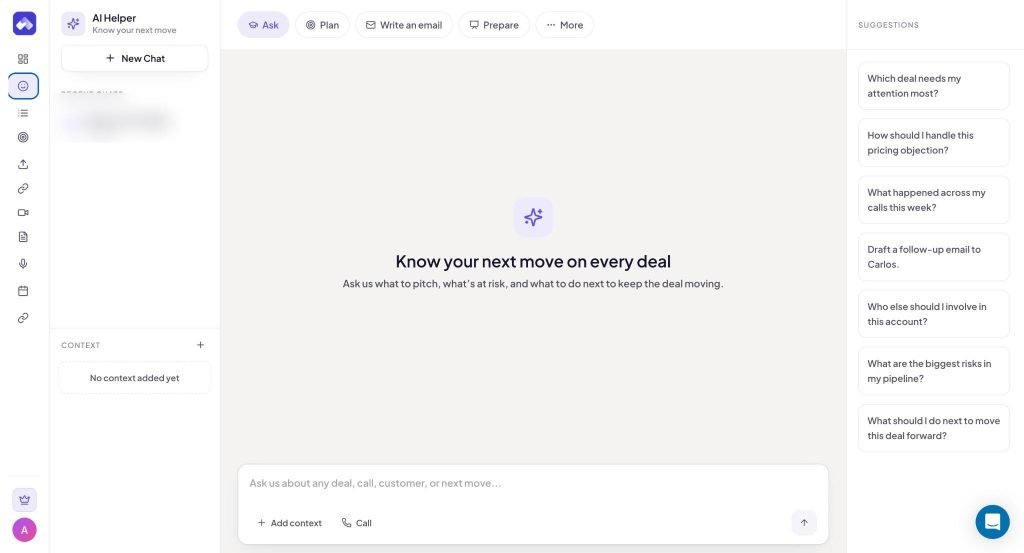
Whenever a rep needed a second opinion, they turned to AI Helper and asked questions about the live deal.
For example, they asked:
- “What did I fail to clarify during this call?”
- “Which objection is still unresolved?”
- “How should I respond to the implementation concern?”
- “Who else should be involved in this opportunity?”
- “What should I cover during the next meeting?”
Because AI Helper used the actual conversation and deal context, the answers were specific to the opportunity rather than pulled from a generic playbook.
This meant a rep could get help while the opportunity was still moving. They did not have to wait for the next scheduled coaching session.
What changed after introducing Salesman AI
Together, these steps changed more than the team’s toolset.
They moved coaching closer to the customer conversation itself.
Before Salesman AI, preparation, practice and call review happened separately. After the rollout, they became one continuous workflow around every meeting.
| Before Salesman AI | With Salesman AI |
| Preparation across multiple sources | Structured context before the meeting |
| Generic roleplay scenarios | Rehearsal based on the actual buyer |
| Only selected calls received reviews | Every connected call could receive a structured review |
| Insights remained inside transcripts | Signals, risks and next steps were surfaced |
| Coaching depended on manager availability | Reps could access guidance when needed |
Managers still coached the team. However, they spent less time reading transcripts and more time discussing strategy, complex objections and priority opportunities.
Results from Animaker’s internal deployment
During the three-month evaluation, 12 salespeople used Salesman AI across 420 customer conversations.
| Metric | Before Salesman AI | With Salesman AI | Change |
| Average meeting-preparation time | 32 minutes | 11 minutes | 66% reduction |
| Calls receiving a structured review | 40% | 88% | 120% relative increase |
| Rehearsals before priority calls | 12 | 86 | 617% increase |
| Follow-ups with confirmed next steps | 54% | 78% | 44% relative increase |
| Time required to review a completed call | 24 minutes | 7 minutes | 71% reduction |
| Priority-call rehearsal coverage | 12 rehearsals | 86 rehearsals | 74 additional rehearsals |
| Calls with a structured review | 168 of 420 | 370 of 420 | 202 additional reviewed calls |
| Average manager review time saved | — | 17 minutes per reviewed call | About 35 hours saved per month |
| Average analysed conversations per rep | — | 35 conversations | Consistent coaching across 12 reps |
Here is what changed across preparation, call review and follow-up quality.
More consistent preparation
With buyer and deal context in one place, average preparation time fell from 32 minutes to 11 minutes. That is a 66% reduction.
More conversations received a structured review
Before the rollout, 40% of calls received a structured review. With Salesman AI, that number increased to 88%. In total, about 370 conversations received a consistent review during the evaluation.
Follow-ups became more specific
Across the evaluation, the team completed 202 additional structured call reviews and 74 additional rehearsals. Because each call also took less time to review, the workflow saved about 35 hours of manual review work every month.
Follow-ups became clearer as well. The share of follow-ups with a confirmed next step increased from 54% to 78%. Reps could use the customer’s commitments, risks and missing information to decide what to send next.
| “Reps can practise a difficult call, understand what they missed and walk into the next meeting with a clearer plan.” Head of Sales Animaker |
Why Animaker’s internal deployment matters
This is an internal deployment case study documenting how Animaker uses Salesman AI.
Salesman AI was deployed across Animaker’s sales organisation, where the team used it around real customer meetings and active sales opportunities.
The internal rollout also gave the product team something valuable: access to real sales workflows, real customer conversations and direct feedback from the reps using the product.
This helped the team understand:
- What information reps needed before a meeting
- Which roleplay scenarios felt realistic
- Which post-call insights were genuinely useful
- Where the coaching workflow created unnecessary effort
- How Salesman AI could fit into an existing sales process
This helped the team find practical gaps that would have been difficult to spot in a controlled product demo.
Building an AI sales coach around real selling
Sales conversations will always be unpredictable.
A buyer may raise an unexpected objection. A positive call may still end without a clear next step. Important decision criteria may remain unknown even after several meetings.
That is why reps need more than a score after the call. They need useful context before the meeting, a safe place to practise and clarity about what to do next.
By using Salesman AI internally, the team could build and evaluate the product around these real moments.
The result is an AI sales coach built around the reality of selling. It helps reps prepare for a specific buyer, practise difficult conversations and learn from what happens next.
Prepare for the buyer. Practise the conversation. Learn from what happens next.