Contents
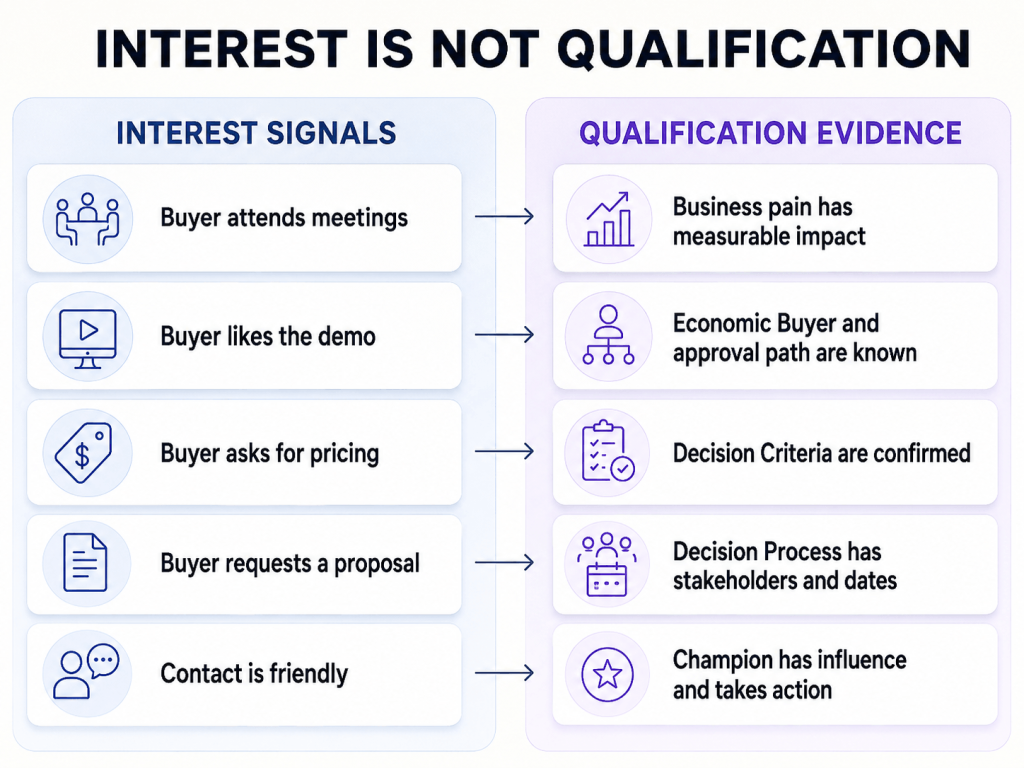
The buyer’s presence at every meeting and enthusiasm about the product do not guarantee a sale. Without access to the budget owner or a clear reason to move forward, you may have interest rather than a qualified opportunity.
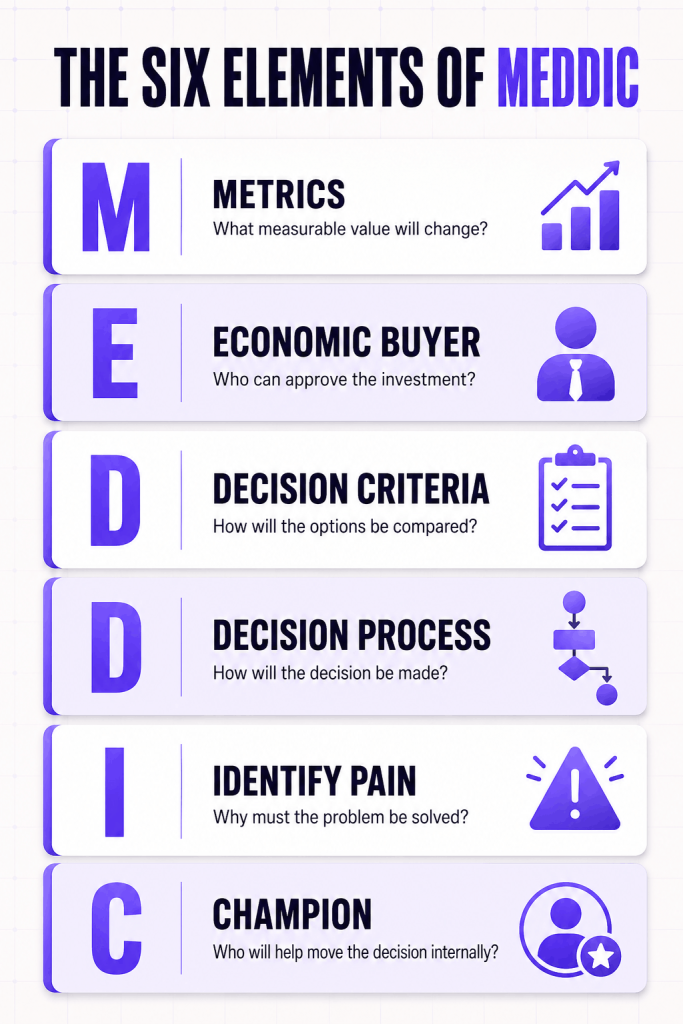
MEDDIC sales methodology helps account executives evaluate complex B2B deals through the business case, decision-makers and buying process. MEDDIC stands for Metrics, Economic Buyer, Decision Criteria, Decision Process, Identify Pain and Champion. It shows what is known and what still needs to be confirmed.
What is MEDDIC in sales?
PTC developed the MEDDIC qualification framework in the 1990s. It is often used in B2B sales where contracts are large, several stakeholders are involved and purchasing takes time.
Reps do not complete MEDDIC once and forget it. They continue gathering and verifying evidence as stakeholders and requirements change. It helps answer three questions:
- Is the problem significant enough for the company to act?
- Can the company fund and make a decision about the solution?
- Is there enough internal support to move the deal forward?
Why apparently healthy deals still fail MEDDIC qualification
Salespeople naturally notice positive signals. A buyer responds quickly, involves colleagues, asks for a proposal and sees value. These indicate interest, but none guarantees that the opportunity will survive the purchasing process.
An RFP may come from someone researching competitors without an approved project. A crowded demo may include users but exclude the budget owner. A successful pilot may go nowhere if procurement, security or executive sponsorship enters too late.
MEDDIC shifts the focus from activity to proof. Instead of asking, “Did the meeting go well?”, reps ask, “What changed because of it?” Did the customer verify the cost of the problem? Is the final decision clear? Has someone inside taken responsibility for advancing the evaluation?
Deals should advance because the evidence matches the stage requirements, not because the buyer appears enthusiastic.
What does MEDDIC stand for?
1. Metrics
Metrics turn the buyer’s problem and your solution into quantifiable business results, such as revenue, cost savings, time saved or risk avoided.
“Increase sales productivity” is vague. “Give each AE five additional hours per week and reduce customer follow-up time” can support a business case.
Ask:
- What does the problem currently cost the business?
- What result would justify the investment?
- How will the customer define success?
Create an initial estimate using the best available data, explain the assumptions and ask the buyer to validate them.
2. Economic Buyer
The Economic Buyer can approve the investment. Your main contact may influence the outcome without controlling the final budget. Understand who owns the budget, their priorities and how they will receive the business case.
Ask:
- Who owns the budget?
- Who approves the team’s recommendation?
- What outcome will that person expect?
The sale is at risk when the rep does not understand how the budget owner will decide.
3. Decision Criteria
Decision Criteria describe how the buyer compares options through technical requirements, commercial requirements and relationship factors. For sales software, these may include CRM integration, security, adoption and cost. Knowing the criteria helps you narrow the demo and identify where a competitor may be stronger.
Ask:
- What must the selected solution accomplish?
- How will the options be compared?
- Which criteria are non-negotiable?
4. Decision Process
Decision Criteria identify what the buyer evaluates. The Decision Process explains how and when the decision will be made. Map the people, meetings and approvals involved, including technical, security and procurement reviews.
Ask:
- What happens next in the evaluation?
- Who must approve the recommendation?
- What determines the decision deadline?
5. Identify Pain
Identify Pain means understanding why change is required and how the problem affects operations and the bottom line. An AE may say post-call admin takes too long. Further investigation may reveal delayed follow-ups, incomplete CRM data and poor visibility into deal risk. The admin is not merely inconvenient; it affects momentum and forecasting.
Ask:
- What happens if this continues for another six months?
- Who else is affected?
- Why is solving it important now?
6. Champion
A Champion is an influential person who supports the proposed solution and explains how the organization works. A friendly contact is not necessarily a Champion. A real one has influence, a vested interest and the ability to act internally. They can share information and help you reach other stakeholders.
Ask:
- Who benefits personally or professionally if this succeeds?
- Does this person have credibility with decision-makers?
- Have they taken action when we were not present?
A practical MEDDIC sales example
Consider an AE selling an AI sales copilot to a SaaS company with 50 reps.
| Element | Evidence collected |
| Metrics | Each rep spends five hours per week preparing and following up. |
| Economic Buyer | The CRO owns the productivity budget and wants more accurate CRM data. |
| Decision Criteria | CRM integration, rep adoption, security and measurable time savings. |
| Decision Process | Sales operations review, security review, pilot and CRO approval. |
| Identify Pain | Poor follow-through and incomplete context weaken deal momentum. |
| Champion | The sales enablement lead will run the pilot and arrange CRO access. |
The table also exposes gaps. The buyer may still need to validate the estimated time savings. MEDDIC displays both the evidence supporting the sale and the assumptions that remain.
After the next discovery call, the sales enablement leader confirms that delayed follow-ups affect stage progression.
They cannot approve the purchase, but offer to connect the AE with the CRO and provide the security checklist.
That conversation strengthens the pain, improves access to the budget owner, demonstrates internal advocacy and adds a step to the buying process.
MEDDIC should remain dynamic. New evidence may strengthen one element while exposing a gap in another. The goal is not to complete every field; it is to show an honest picture of the opportunity.
How to use MEDDIC throughout the sales process
Before the meeting
Review the opportunity context, identify the MEDDIC area that needs more evidence and prepare buyer questions.
During the meeting
Ask follow-up questions based on the buyer’s answers. If they mention an approval committee, identify who is involved, what they review and when they meet.
After the meeting
Document confirmed evidence separately from assumptions, then determine the next action required to close each gap.
During deal reviews
Evaluate the evidence behind each answer. “Strong internal support” means little without influence and meaningful action.
How to evaluate the strength of each MEDDIC element
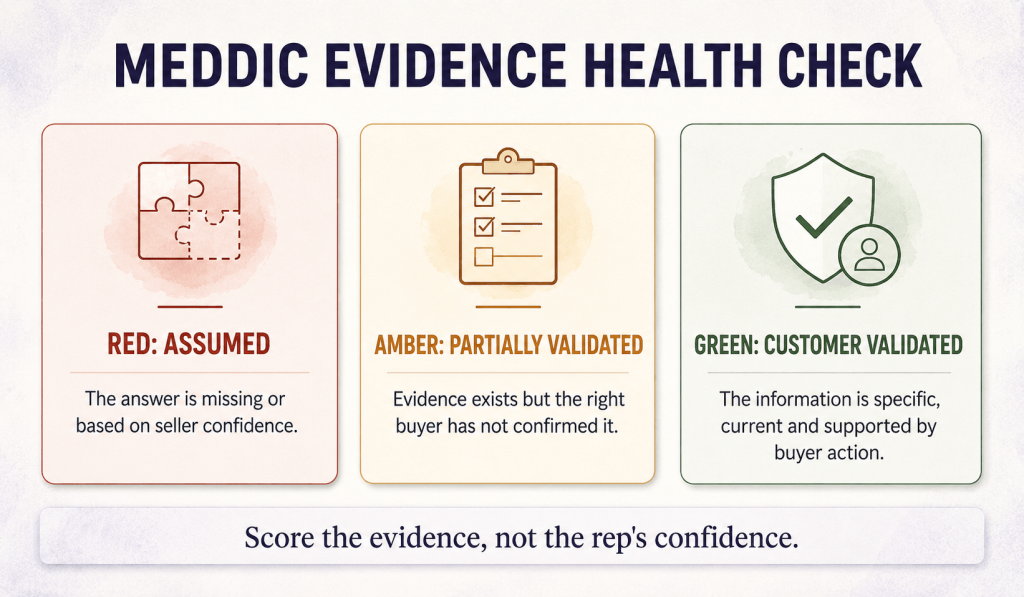
A red, amber and green system allows a team to review evidence without pretending qualification is a mathematical score.
- Red: The answer is missing or depends on assumptions.
- Amber: Some evidence exists, but the right stakeholder has not verified it.
- Green: The customer has validated the information and the rep can show supporting evidence.
An untested estimate is amber; a number confirmed by the budget owner is green. A helpful contact remains amber until they show influence and take internal action. Managers can coach the next move when reps must show their evidence.
Do not combine all six elements into one score. Strong value and pain cannot compensate for missing internal support, and executive interest cannot replace an undefined buying process.
MEDDIC vs. MEDDPICC
MEDDPICC adds two factors to MEDDIC:
- Paper Process: Legal, security, procurement and contracting steps needed to execute the purchase.
- Competition: Alternative vendors, internal alternatives and doing nothing.
MEDDPICC works best for enterprise deals with a substantial paper process or competition. Use a model that matches the complexity of your sales process.
How to introduce MEDDIC without creating more sales admin
MEDDIC implementation often fails when a leader adds six required CRM fields and expects behaviour to change. The fields are useful only when the team agrees on credible evidence and uses it during coaching.
Define credible evidence
Create examples of red, amber and green evidence for your sales motion. A department manager may have enough influence in a small deal but not in an enterprise opportunity.
Connect MEDDIC with existing stages
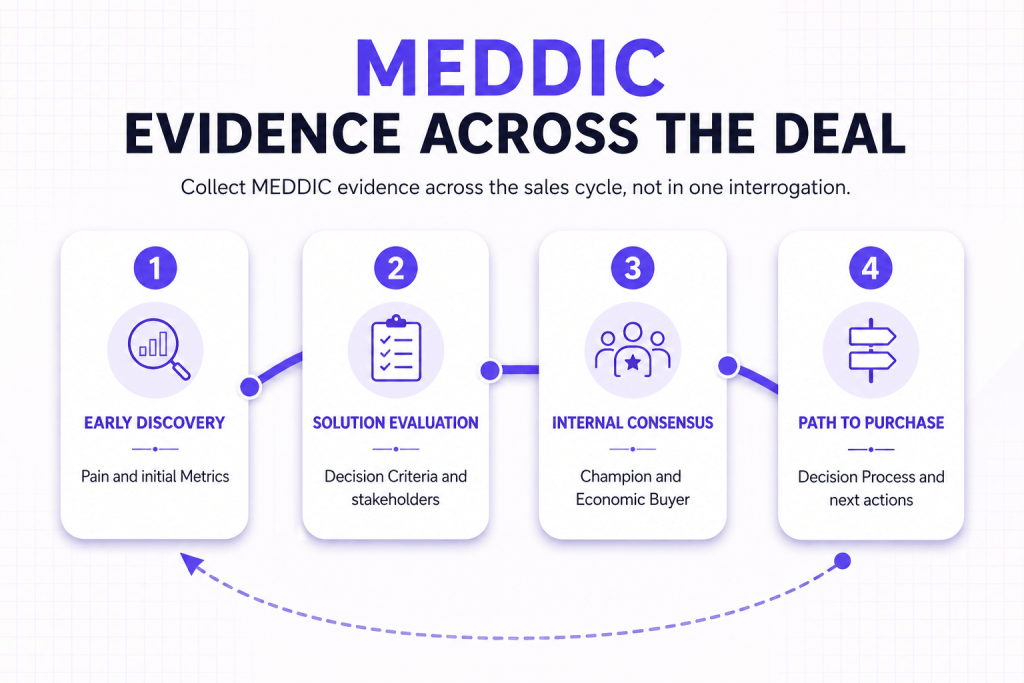
Define the evidence required before a deal advances. Early discovery may require pain and an initial metric. Later stages may require confirmed selection criteria, a mapped approval path and access to the budget owner. Do not require every element after the first meeting, as this encourages guessing.
Coach the gaps
Instead of asking whether the fields are complete, ask, “What did the customer do that proves this person has influence?” or “Who validated this metric?” These questions encourage judgement.
Keep the information current
Buying groups change, budgets move and internal supporters leave. Review MEDDIC after important conversations and before forecast discussions.
Use the framework to disqualify
Qualification also means deciding where not to spend time. If the pain is minor, the budget owner will not support the project and nobody will act internally, reducing effort or closing the opportunity may be responsible. MEDDIC should protect selling time, not justify keeping every deal alive.
Common MEDDIC mistakes
- Treating it as a form: CRM fields do not qualify a deal without current evidence.
- Asking every question on every call: Use the framework across the buying cycle.
- Confusing friendliness with influence: Support without action is not enough.
- Accepting vague metrics: A valid objective needs a baseline, expected change and customer agreement.
- Ignoring the approval path: Interest cannot compensate for missing approvals or an unrealistic timeline.
- Updating only before forecasting: Review qualification after every material customer interaction.
MEDDIC questions by deal stage
MEDDIC questions should sound like the information an important stakeholder needs to make a sound business decision. Do not read them as a checklist during a buyer call.
Early discovery
- Why did the team decide to investigate now?
- What impact does the issue have today?
- What result would make solving it worthwhile?
Solution evaluation
- Which capabilities matter most to the evaluators?
- Who else must believe in this option?
- How will the team compare solutions?
Internal consensus
- Who must endorse the recommendation?
- What objections might they raise?
- How can the business case be presented internally?
Purchase process
- What happens after the team selects a preferred solution?
- Which legal, security or procurement steps are required?
- What might delay the target decision date?
These are starting points. A strong account executive follows the buyer’s answer instead of moving through every question mechanically.
How AI can help AEs apply MEDDIC
What makes the MEDDIC sales process challenging is not remembering the acronym. It is carrying buyer, meeting and opportunity context from one conversation to the next.
Salesman AI provides AEs with pre-call notes on buyer priorities, likely objections and communication cues. Reps can use AI sales roleplay to practise important qualification conversations before the meeting. Afterward, FOCUS reports and AI Helper make it easier to analyse the conversation, clarify deal gaps and decide what to do next. This also supports continuous AI sales coaching around real opportunities.
Frequently asked questions
What does MEDDIC do?
It helps sales teams qualify complex opportunities using measurable value, buying authority, selection criteria, the approval process, business pain and internal support.
What is included in MEDDIC?
The six elements are Metrics, Economic Buyer, Decision Criteria, Decision Process, Identify Pain and Champion.
When should I use MEDDIC?
Use it for complex B2B opportunities with substantial value, multiple decision-makers or long sales cycles. It may be unnecessary for small transactional sales.
Can MEDDIC build a complete sales process?
No. It helps qualify a sale, but it does not replace a complete sales process. It works best when connected to established sales stages.
What is the difference between MEDDIC and MEDDPICC?
MEDDPICC adds Paper Process and Competition, which are particularly relevant to enterprise deals involving procurement, contracting and competitive evaluation.
Turn MEDDIC into evidence, not admin
MEDDIC can improve what an AE asks and reveal whether the opportunity has measurable value, buying authority, a decision path and internal support.
When the framework becomes a collection of CRM fields, it adds administration without improving qualification. Use real customer evidence, review it after every significant conversation and let the gaps shape the next move.
For buyer and deal context before your next call, start with your next meeting.