Contents
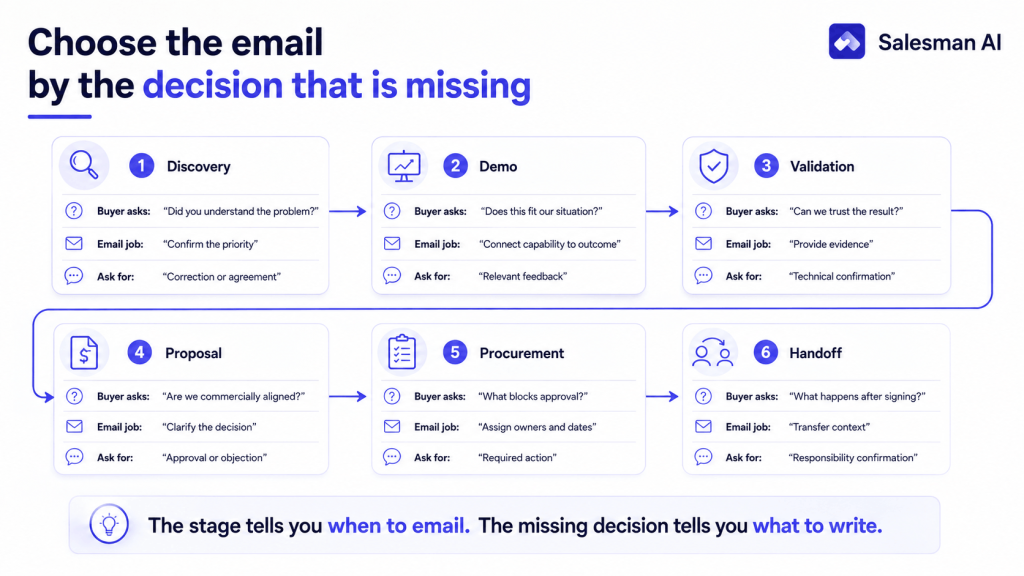
Many sales emails fail for one reason: they make the prospect do too much thinking. The tone may be good, but the intent is unclear, the value is difficult to find, and the next action is easy to postpone.
Strong sales email templates do the opposite. They tell the prospect what matters, clearly state the next action, and read like a continuation of the conversation rather than a new sales pitch.
The sales email examples below include a follow up email to sales call, a sales follow up email template, and messages for the stages before and after them. If you are learning how to write a short sales email, these principles will help you keep every message focused.
TL;DR: A useful sales email has one purpose, one relevant detail, and one clear next step. Keep it short enough to scan, but include enough context for the buyer to act without searching through an old thread.
Before you use any sales email template
A template should be treated as a starting point, not a final draft. If buyers can tell that your email could have been sent to anyone, they will probably lose interest.
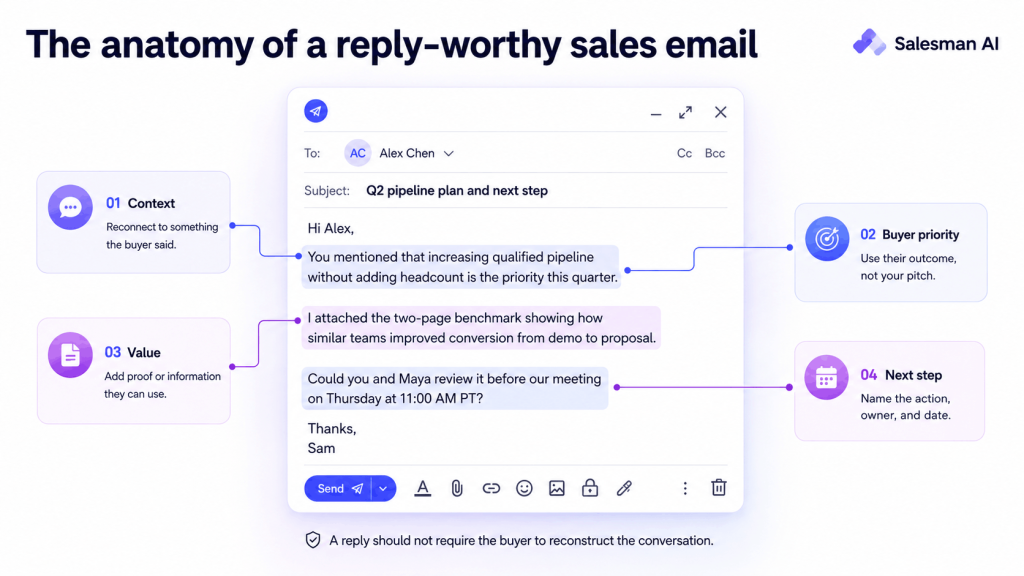
Add these four elements before sending:
- Context: What was said during the last conversation?
- Buyer priority: What problem or outcome matters most to this buyer?
- Value: What relevant information are you adding now?
- Next step: Who needs to do what, and by when?
Your goal is not to make every email funny or clever. Your goal is to make it easier for the buyer to respond.
Follow up sales email template options after discovery
1. Discovery call recap
Subject: What I took away about [priority]
Hi [Name],
Thank you for the open conversation today. From what I understand, [current issue] is resulting in [business impact]. The team wants to achieve [desired outcome] by [time frame].
I will complete [agreed item] before our next meeting on [meeting date and time], when we will discuss [specific decision or topic].
Did I capture the priority correctly?
[Signature]
2. Follow-up email to a sales call
Subject: Next step for [initiative]
Hi [Name],
You mentioned that [specific detail] is the main obstacle to [goal]. Based on that, I suggest we use the next call to explore [relevant solution area] and confirm whether it fits your process.
Would [date and time] still work?
[Signature]
3. Sending a promised resource
Subject: The [resource] we discussed
Hi [Name],
Here is the [resource] I promised. The section on [topic] is most relevant because it connects directly to your concern about [buyer concern].
Take a look when convenient. On [date], I’ll ask what felt useful and what did not match your situation.
[Signature]
4. Introducing another stakeholder
Subject: Bringing [stakeholder] into the conversation
Hi [Name],
You mentioned that [role or team] will influence the decision. It would help to include them before we go deeper, particularly on [area they own].
Would you be comfortable introducing us? I can send a short note that explains why the conversation is relevant to them.
[Signature]
5. Confirming the next meeting
Subject: Plan for [date]
Hi [Name],
For our meeting on [date], I propose that we cover:
- [Buyer question]
- [Workflow or use case]
- [Decision or next step]
If there is anything else the team needs to see, send it over and I’ll adjust the plan.
[Signature]
Sales email templates after a demo
6. Demo recap
Subject: Recap and next step for [team]
Hi [Name],
Today we focused on [use case one] and [use case two]. The strongest fit appeared to be [capability] because it could help the team [desired result].
You agreed to [buyer action], and I’ll [seller action]. We will reconnect on [date] to review [decision point].
[Signature]
7. Answering a technical question
Subject: Answer to your question about [topic]
Hi [Name],
I checked with [internal expert or team]. The short answer is [accurate answer]. In your setup, that means [plain-language implication].
I have included [documentation or attachment]. Would it help to bring [technical role] into our next call for a deeper review?
[Signature]
8. Following up after a no-show
Subject: Should we reschedule [topic]?
Hi [Name],
We missed each other today. I know schedules change, so no problem.
Is [initiative] still a priority? If it is, I can hold [option one] or [option two]. If the timing has changed, tell me and I’ll update my notes.
[Signature]
9. Sharing a tailored business case
Subject: A working business case for [initiative]
Hi [Name],
I used the figures you shared to outline the current cost of [problem] and the possible value of improving [metric]. I have kept the assumptions visible so your team can challenge them.
Could we review the model together on [date] before it circulates internally?
[Signature]
10. Re-engaging a second stakeholder
Subject: A question for [stakeholder’s function]
Hi [Name],
In the demo, [champion] highlighted [business issue]. Since your team owns [relevant area], I would value your view before we recommend a path forward.
Would a 20-minute conversation on [option one] or [option two] work?
[Signature]
Proposal and negotiation follow-up sales email templates
11. Sending the proposal
Subject: Proposal for [company or initiative]
Hi [Name],
Attached is the proposal we discussed. It reflects [scope], [business priority], and the timing agreed with [stakeholders].
Rather than review it separately, let’s walk through it on [date]. That will let us resolve questions before the internal decision.
[Signature]
12. sales follow up email template after a proposal
Subject: Questions on the [initiative] proposal
Hi [Name],
When we sent the proposal, the open points were [point one] and [point two]. Has anything changed since then?
If the team is still evaluating, I suggest a short review on [date] to identify what is needed for a decision.
[Signature]
13. Responding to a pricing objection
Subject: Re: investment for [initiative]
Hi [Name],
I understand the concern about [price or budget]. Before changing the scope, I want to separate the investment question from the value question.
If we revisit [business impact] and [required outcome], we can decide whether the current approach is justified or whether a smaller option makes more sense. Can we review that on [date]?
[Signature]
14. Budget timing has changed
Subject: Adjusting the plan around [budget date]
Hi [Name],
Thanks for explaining the budget timing. If funding cannot be approved until [date], we should decide whether to pause or use this period for [useful preparation].
Which option is more realistic for your team?
[Signature]
15. Confirming verbal alignment
Subject: Confirming what we agreed
Hi [Name],
To make sure we are aligned, the team is comfortable with [scope], [commercial term], and [target start date]. The remaining approval sits with [person or group].
You will [buyer action] by [date], and I will [seller action]. Please correct anything I have misunderstood.
[Signature]
Procurement, security, and legal sales email templates
16. Starting procurement early
Subject: Procurement steps for [company]
Hi [Name],
To protect the target date, could you share the procurement steps and typical review time? We can prepare [documents] before the commercial decision is final.
Who should own the process on each side?
[Signature]
17. Security review follow-up
Subject: Security review status and open items
Hi [Name],
We have completed [submitted items]. The remaining questions appear to be [open items].
Could the security owner confirm whether anything else is required? If useful, our [technical role] can join a working session on [date].
[Signature]
18. Legal review follow-up
Subject: Open contract points for [company]
Hi [Name],
The current draft has [number] open points: [brief list]. Our team can respond by [date], provided we receive comments by [date].
Does that sequence still support the planned start date?
[Signature]
19. Asking the champion for help
Subject: Help navigating the remaining step
Hi [Name],
We appear to be waiting on [approval or stakeholder]. Since you understand the internal process better than I do, what is the most useful action from our side?
I can provide [option one], [option two], or step back while you confirm the right path.
[Signature]
20. Mutual action plan update
Subject: Updated path to [target date]
Hi [Name],
I updated the plan with the owners and dates from our call. The critical items are [item one] by [date] and [item two] by [date].
If either date moves, the target start will also move. Can each owner confirm their step?
[Signature]
Emails for quiet deals, wins, and losses
21. No reply after a demo
Subject: Has the priority changed?
Hi [Name],
When we last spoke, [problem] was affecting [impact], and the next step was [agreed action]. I have not heard back, so I may be working from an old assumption.
Has the priority changed, or should we choose a new date?
[Signature]
22. No reply after a proposal
Subject: Close the loop on [initiative]?
Hi [Name],
I have followed up a few times and do not want to create noise. Should I close this for now, or is there a specific event we should wait for?
Either answer is useful, and you can reopen the conversation when the timing is better.
[Signature]
23. Decision postponed
Subject: Revisit [initiative] in [month]?
Hi [Name],
Thanks for the honest update. I will pause active follow-up until [date]. Before then, I can send [useful item] if it helps your internal planning.
I’ll reconnect in [month] with the context from our previous conversations.
[Signature]
24. Closed-lost follow-up
Subject: Thank you, and one final question
Hi [Name],
Thank you for considering us. I respect the decision and will close the opportunity on my side.
For my learning, what mattered most in the final choice? A brief answer would help us improve, and there is no need to reconsider anything.
[Signature]
25. Closed-won handoff
Subject: Your next steps with [company]
Hi [Name],
Welcome aboard. I have introduced [customer owner], who will lead [onboarding or implementation]. They have the context on [goals], [success measure], and [target date].
Our kickoff is booked for [date]. I’ll remain available during the handoff if anything needs clarification.
[Signature]
How to personalize templates without rewriting every email
Personalization should come from the opportunity, not from a prospect’s social profile. That means using the buyer’s language, identifying a measurable consequence, addressing an objection, or referring to an agreed action.
The context from the meeting should remain connected to the next message. Salesman AI is built as a rep-first workflow across the buyer, meeting, and opportunity. Using AI sales coaching, reps can reflect on what happened and create the next message from the actual conversation instead of a generic sequence.
Before a critical follow-up, reps can ask themselves:
- What does the buyer identify as their number one priority?
- What evidence supports this priority?
- What was agreed by both sides?
- Which stakeholders or risks are still missing?
- What is the smallest useful step I could take next?
In addition, reps can use AI sales role-play to practise difficult negotiations or re-engagement conversations before sending an email.
Common mistakes in a sales follow up email
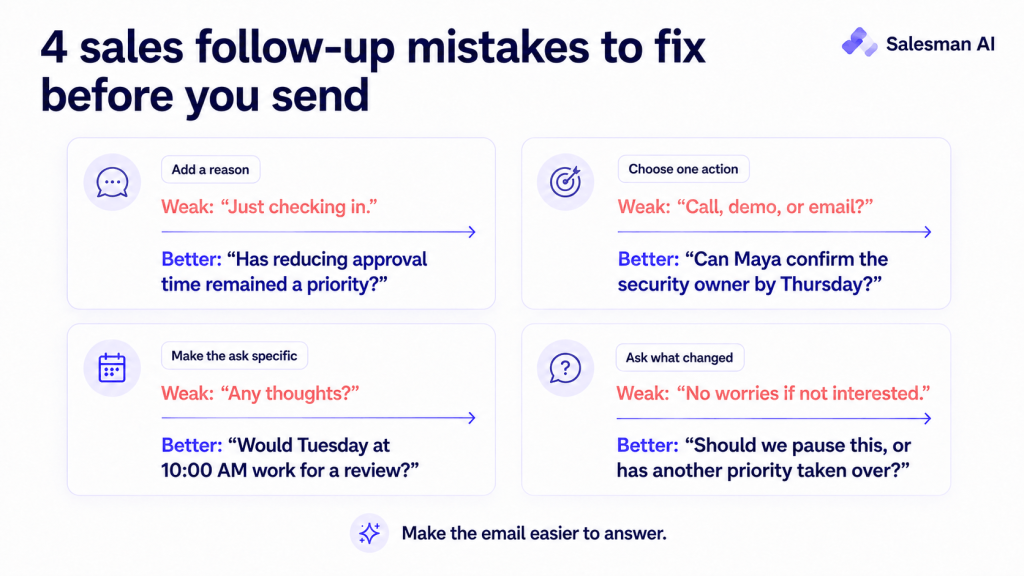
Writing “just checking in”
There is nothing in a generic check-in that gives the customer a reason to respond. Return to an important priority, provide an update, or ask a decision-based question.
Creating multiple calls to action
Do not request feedback, a meeting, an introduction, and a document in one email. If there are too many next steps, none of them feels like the next step.
Hiding the request
Place the desired action near the end of the email and make it specific. A customer can easily ignore “Thoughts?” However, it is easier to respond to a request such as, “Can the security owner confirm the required documents by Thursday?”
Treating silence as an objection
Silence can reflect changing priorities, internal issues, leave, or a crowded schedule. Use a neutral question to understand what changed before assuming what went wrong.
Frequently asked questions
How long should a sales email be?
Most deal-stage emails should fit on one phone screen. However, clarity matters more than an exact word count. A recap may need bullets, while a reminder may need only three sentences.
When should I send sales follow-up emails?
Recap emails work best when sent shortly after a meeting, while the context is still fresh. Later follow-ups should follow the timing agreed with the buyer.
If you did not agree on a timeline, follow up when you can provide additional value or ask a meaningful decision question.
Should I automate sales follow-up emails?
Automation works well for reminders and low-risk administrative tasks. Important deal emails still need human review because stakeholder perspectives, objections, and agreements change.
How do I create the best subject line for a sales email?
The subject line should help the buyer identify the topic quickly. Examples include “Next step for [initiative]” and “Open security items.” Avoid false urgency or curiosity tricks that misrepresent the message.
Make the next email easier to answer
The best sales email templates reduce work for both parties. They maintain context, clarify the decision, and turn an ambiguous conversation into a manageable next step.
If your follow-up depends on scattered notes or memory, improve the workflow before adding another sequence. Salesman AI connects the buyer, meeting, and opportunity context through pre-call preparation, AI Rehearsal, FOCUS post-call analysis, and AI Helper.
Review the Salesman AI pricing options, then start with your next meeting.