Contents
Even though it may have felt like a productive meeting at the time, in reality, nothing really got accomplished. The buyer provided some useful information, the representative answered their questions, and everybody parted ways on good terms.
Two days later, there is still no agreement on who owns the priority, who is responsible for the project, or when either party should follow up.
The purpose of a meeting summary template is to prevent this from happening. It converts a conversation into a short record of the priorities, decisions, and responsibilities that matter before you speak again.
This guide focuses solely on sales meetings, not formal board meetings. You will receive a reusable template, examples for different types of meetings, a buyer-facing summary email, and a checklist for keeping your note-taking process useful.
Additionally, the template can work as a sales call summary, meeting follow-up email, and framework for sales meeting notes. Its primary objective is to turn a raw conversation into decisions and meeting action items that your team can trust.
TL;DR: A sales meeting summary should capture the purpose, buyer priorities, evidence, decisions, objections, stakeholders, and next actions with owners and dates. Keep the buyer-facing version concise. Store deeper qualification details in the CRM or opportunity record.
What is a sales meeting summary?
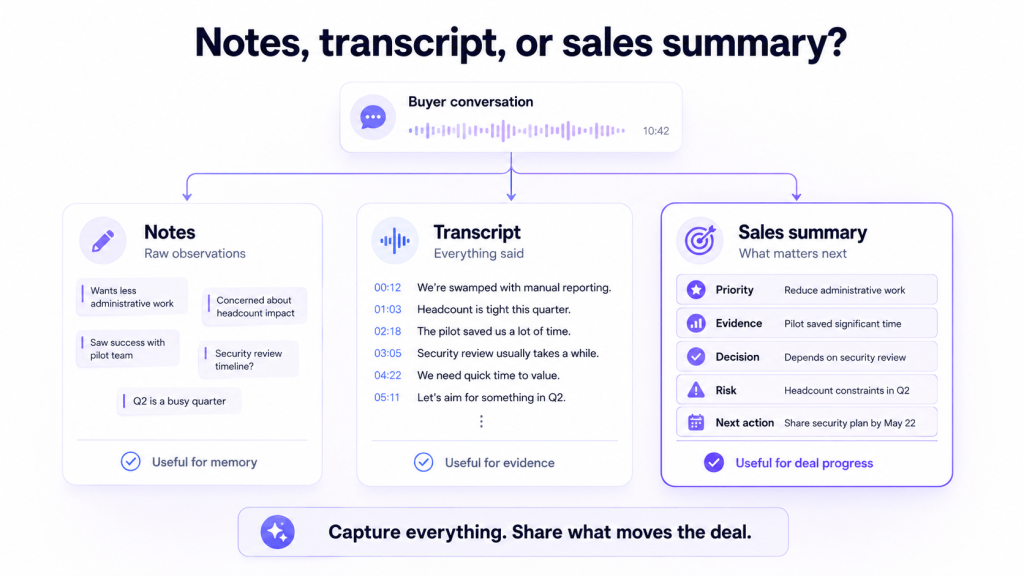
A sales meeting summary is a short account of the important information discussed during a buyer conversation. It is more useful than a transcript because it organizes the discussion around decisions and required actions.
The best summaries answer seven questions:
- Why did we have the meeting?
- What is the buyer trying to change?
- What evidence does the group use to show that the problem matters?
- What did the group agree or decide?
- Which concerns or risks remain?
- Who else is involved?
- What happens next? Who owns it, and by when?
A transcript records everything said. A summary preserves what your deal needs next.
Meeting notes, meeting minutes, and summaries
These formats serve different purposes.
| Format | What it captures | Best use |
|---|---|---|
| Meeting notes | Personal observations and raw details | Rep memory and preparation |
| Meeting minutes | Formal motions, decisions, and attendance | Boards and governed meetings |
| Sales meeting summary | Priorities, evidence, decisions, risks, and actions | Buyer follow-up and opportunity management |
| Transcript | Near-verbatim conversation | Search, review, and evidence |
Sales meeting summary template
Copy this structure into your CRM, note-taking tool, or document.
Meeting title:
Date and time:
Company and opportunity:
Attendees and roles:
Meeting purpose:
Buyer priorities
- [Priority or desired outcome]
- [Why it matters now]
Current situation and evidence
- [Current process]
- [Problem or friction]
- [Metric, example, or consequence]
What we learned
- [New stakeholder information]
- [Decision criteria]
- [Budget or timing context]
Questions and objections
- [Open question]
- [Concern, owner, and required response]
Decisions made
- [Decision or agreement]
Next actions
- [Owner] will [action] by [date]
- [Owner] will [action] by [date]
Next meeting
- [Date, purpose, and required attendees]
This format works because it clearly separates what was observed from what was agreed. For example, “the team will review security” can become: “Maya will send the security questionnaire to Daniel by September 14, and Daniel will return his answers by September 18.”
Specific owners and dates turn a vague intention into a commitment.
How to write a meeting summary step by step
1. Begin with the purpose, not the chronology
Don't start your entry with “Then we introduced ourselves.” State why the meeting happened and what a useful outcome would look like.
For example: “The meeting determined whether the sales team could standardize pre-call preparation before Q4 onboarding.”
2. Use the buyer's own words for their priorities
Use the buyer's exact terms wherever possible. If the VP said, “Managers are rebuilding the deal history before each coaching call,” retain that description.
Don't elevate a minor issue into a major business problem. Your summary needs to clarify the deal, not improve the story.
3. Keep facts separate from interpretations
A fact is: “Six regional managers use six different coaching templates.” An interpretation is: “The coaching programme has no standards or governance.” Both may be useful, but do not confuse them.
When an interpretation affects qualification, confirm it during the next meeting.
4. Document every decision explicitly
Decisions cover much more than purchases. The group may decide to involve security, test a workflow, delay an initiative, or reject a use case.
If no decision was made, document that too. Honest uncertainty is more valuable than recording an agreement that never happened.
5. Give every action an owner and date
“Send proposal” is vague. “Anisha will send the updated proposal by Friday” is specific.
If the buyer does not agree to a date, document the risk. A next step without an owner or timing is an intention, not a commitment.
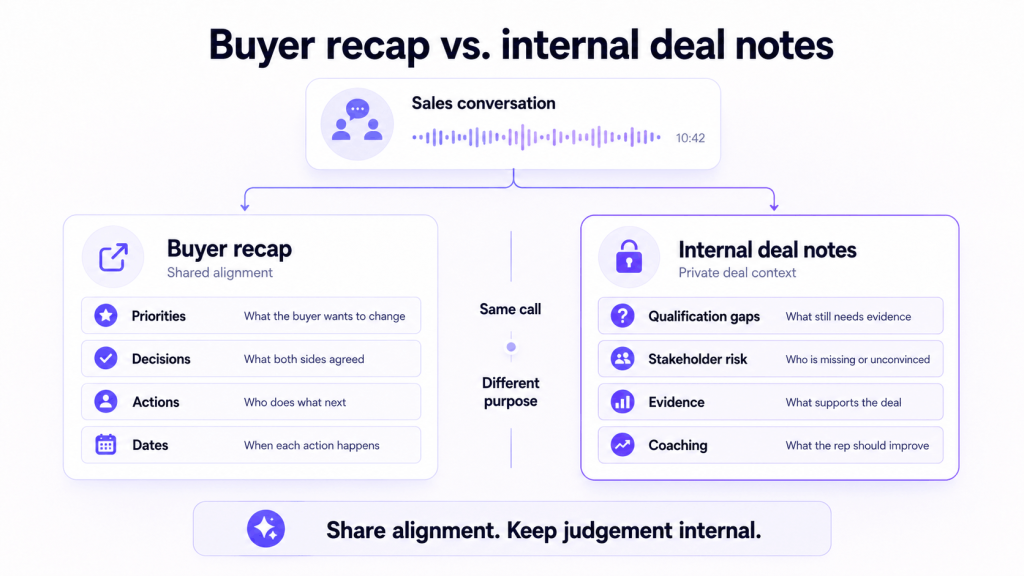
6. Separate the internal and buyer-facing versions
Buyer recaps should be functional and easy to read. Internal notes may include qualification gaps, relationship risks, forecast judgements, and coaching observations.
Never send confidential speculation to the buyer. However, do not remove an uncomfortable fact from your internal notes simply because you would not include it in the buyer's email.
Meeting summary example: Four sales call formats
Example 1: Discovery call summary
Meeting objective: Determine whether a full workflow assessment is needed for how Acme prepares account executives for strategic meetings.
Buyer priorities: Reduce the time managers spend preparing reps for strategic meetings. The buyer also wants more consistent coaching across all three regions before the next hiring cycle.
Present situation: Managers review recordings across multiple systems. Reps also rely on old CRM records that do not contain current stakeholder information. The sales enablement leader said managers often have to recreate an opportunity's history before they can coach effectively.
What we learned: Sales enablement owns the project. Regional leaders will help drive adoption, while IT must approve how the data will be handled. There is currently no approved budget.
Decision: The buyer wants to assess the preparation and rehearsal workflows used by two regional managers.
Next actions: Anisha will send a two-page workflow diagram by September 5. Priya will schedule a 30-minute review with the two regional managers for September 9.
Example 2: Demo meeting summary
Meeting purpose: Assess whether the proposed workflow, covering pre-call preparation, practice, and post-call review, can help reps prepare for customer calls.
Buyer priorities: Keep the buyer, meeting, and opportunity context connected without adding administrative work for reps.
What resonated: Pre-Call Notes and AI Rehearsal aligned with the buyer's preparation use case. The FOCUS Report addressed the need for structured post-call analysis.
Open questions: IT needs more information about user permissions and data retention. Enablement wants to understand how managers view results across a team.
Decision: Proceed with a technical review. No commercial commitments have been made by either party.
Next actions: The seller will submit the security document by Tuesday. The buyer will confirm the IT participant and provide two workflows for review by Thursday.
Example 3: Proposal review summary
Meeting objective: Review the scope of work, finalize commercial terms, define implementation responsibilities, and outline the remaining decision steps.
Agreements: The initial group agreed on the proposed success metrics. The start date remains November 1.
Outstanding issues: Finance requested a revised payment schedule. Legal has not yet reviewed the data processing terms.
Decision process: The revenue leader supports the purchase, and finance has approved the budget. IT must approve security, while legal must review the agreement.
Next steps: The seller will provide the revised schedule by September 11. Finance will respond by September 13. Legal will begin its review after security approval.
Example 4: Internal pipeline review summary
Opportunity: Acme coaching workflow
Stage evidence: Discovery and the demonstration are complete. A technical review is scheduled for an agreed date.
Risk: Although the revenue leader supports the initiative, finance has not confirmed that funds are available. Only one regional manager has participated.
Coaching action: Ask the champion how the second region will measure adoption. Do not move the opportunity to commit until budget evidence exists and the approval sequence is confirmed.
Meeting recap email template
External recaps should be short enough for the buyer to review and respond to quickly. Here is a basic follow-up email after a meeting. Use this structure, but keep the content brief.
Subject: Follow-up: [Initiative name]
Hi [buyer's name],
Thank you again for your time today. Based on our discussion, my understanding is:
- You would like [desired outcome].
- This matters because [reason or business impact].
- The current challenge is [problem with the existing process].
- We agreed to review [specific part of the initiative].
- We still need to answer [open question or concern].
Action items
- [Owner] will [action] by [date].
- [Owner] will [action] by [date].
This recap works because the buyer can correct anything you misunderstood. It also puts every agreed action in one place.
Use the same structure for every meeting recap, while keeping the external version limited to what the buyer needs. For additional follow-up at different sales stages, refer to your team's approved messaging and these sales email templates.
Templates for common sales meetings
Discovery meeting notes template
Focus on the trigger, current process, problem, consequence, desired outcome, affected stakeholders, decision path, and agreed next step.
Demo summary template
Document the use cases demonstrated, what resonated, what did not fit, questions raised, technical dependencies, decision criteria, and the next validation event.
Pricing call summary template
Identify the scope, investment, assumptions, objections, alternatives, approval owner, open commercial points, and target dates.
Pilot or trial summary template
List the success measures, users, data or setup requirements, owners, evaluation checkpoints, risks, evaluation date, and final decision meeting.
A faster workflow for accurate sales call summaries
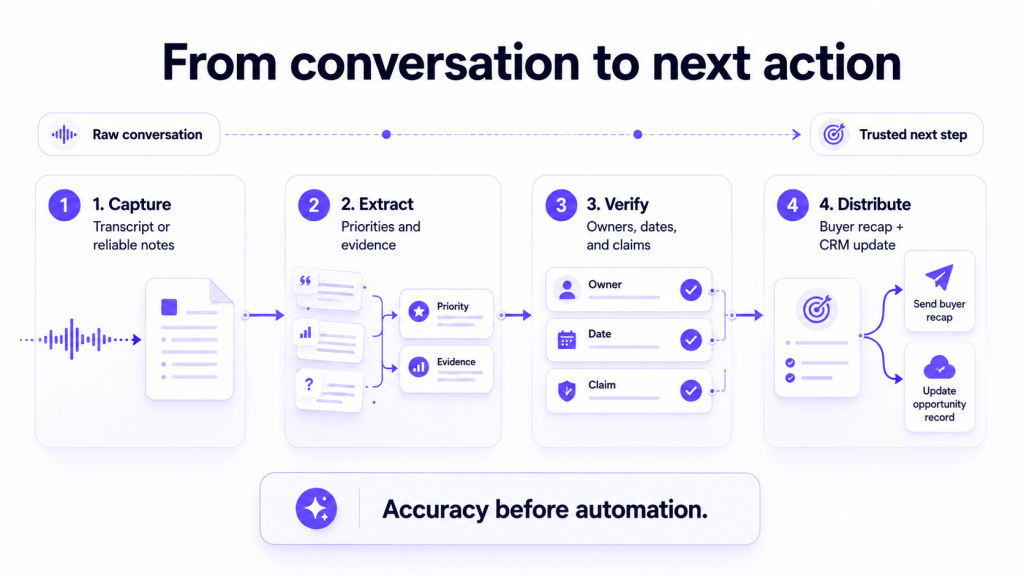
Writing from memory creates omissions and overly optimistic interpretations. A more reliable process has four phases:
- Capture: Create a transcript or a set of reliable notes.
- Extract: Identify buyer priorities, evidence, decisions, questions, and actions.
- Verify: Confirm owners, dates, stakeholder names, and product claims.
- Distribute: Send the buyer recap and update the internal opportunity record.
Salesman AI supports a rep-first workflow rather than acting as a standalone meeting note generator. Buyer, meeting, and opportunity context remain connected through Pre-Call Notes, AI Rehearsal, the FOCUS post-call report, and AI Helper.
Context matters because a summary has little value unless it improves the next action. Reps can use AI sales coaching to review calls and AI sales role-play to prepare for upcoming conversations.
Common meeting summary mistakes
Writing a play-by-play
Chronological notes force the reader to search for the decisions. Instead, organize the summary around priorities, evidence, decisions, risks, and actions.
Treating seller activity as buyer progress
Scheduling a finance review is a buyer action. Sending a proposal is a seller action. Show the difference clearly in the summary.
Leaving out uncomfortable information
Your internal summary should include a missing budget, an absent decision-maker, or a weak champion. Removing a risk from the notes does not improve the deal.
Using vague next steps
Replace “circle back soon” with who is responsible, what they will do, when they will do it, and why it matters.
Frequently asked questions
How long should a sales meeting summary be?
A buyer recap usually needs only a few bullet points and clear next steps. An internal summary may be longer because it includes qualification evidence and risks. Remove details that do not improve understanding or action.
Do I need to list every attendee in my meeting summary?
Include attendees and their roles when they matter to opportunity tracking. This helps the sales team see which stakeholders have participated and direct future communication appropriately.
What is the difference between a sales meeting summary and a follow-up email?
The summary is the documented record of the meeting. The follow-up email is a shorter, buyer-facing account of the shared understanding and agreed next steps.
Can AI create sales meeting summaries?
Yes. AI can identify themes, decisions, next actions, and questions from a recorded conversation. However, a person should verify commitments, commercial terms, stakeholders, and internal judgements that may affect how the opportunity is understood.
Use your summary to prepare for the next meeting
A practical meeting summary template should do more than document history. It records the current state of shared understanding so that decisions during the next meeting become easier.
Keep the record concise, separate buyer-facing notes from internal notes, and include owners and dates. Then connect the summary to your preparation, rehearsal, and coaching workflow. Explore Salesman AI pricing and start with your next meeting.