Contents
You may know your product very well and still struggle to manage a sale. A customer describes a problem, you recognise the appropriate feature and, before long, the call becomes a product demo.
Everybody now knows what your product can do. Nobody has made a compelling argument for why this customer should buy from you.
This is the challenge that the Command of the Message sales methodology attempts to solve. Developed by Force Management, it gives go-to-market teams a common method for linking customer problems, desired outcomes, required capabilities and meaningful product differentiators.
The practical objective for an account executive is simple: understand the customer's environment well enough to explain value in the customer's terms. This guide outlines the model and shows how it can be used during discovery calls, demos, deal reviews and call preparation.
TL;DR: Command of the Message at a glance
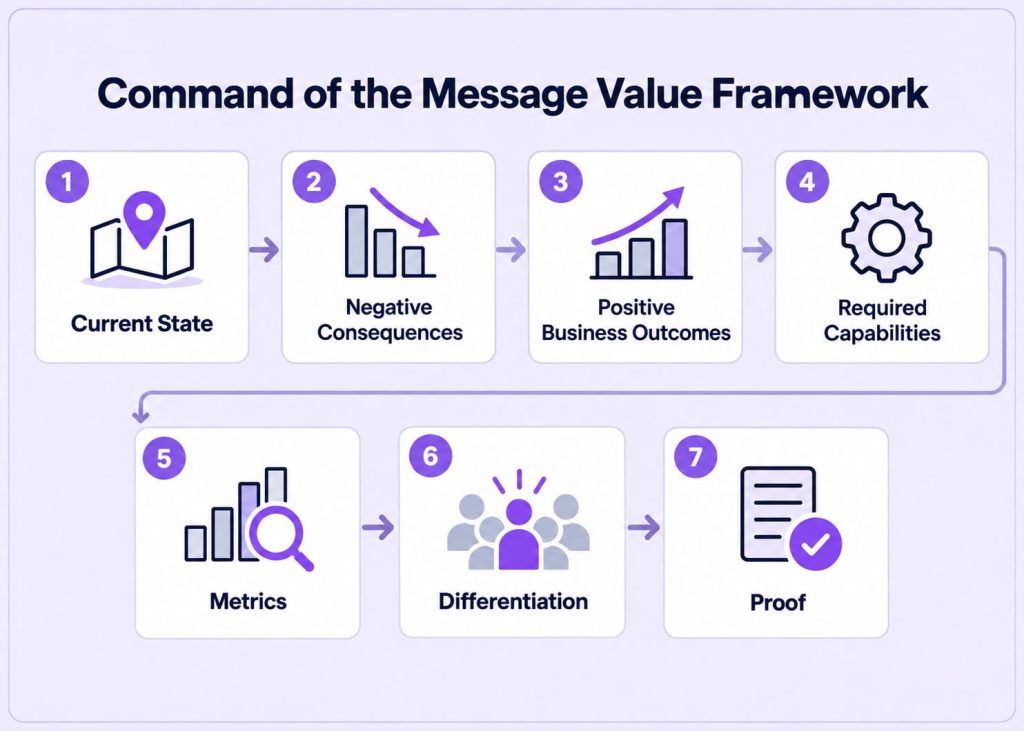
The framework helps a seller answer these buyer-focused questions:
| Framework element | Buyer-focused question |
|---|---|
| Current state | What is happening in the buyer's business today? |
| Negative consequences | What happens if the problem continues? |
| Positive business outcomes | What measurable or observable result should solving it create? |
| Required capabilities | What must a solution enable to create that result? |
| Metrics | How will the buyer measure or prove success? |
| Differentiation | Why is your approach better suited to these requirements? |
| Proof | What evidence supports that claim? |
The framework works when these elements come from discovery, not from seller assumptions.
What is Command of the Message?
Command of the Message is a value-based sales messaging methodology used by Force Management. It helps organisations align sales, marketing, product and leadership around the problems they solve, the results buyers want and why their approach is different.
This is broader than a call script. A script tells reps what to say at a particular moment. The framework provides an agreed structure for communicating value across multiple buyer conversations.
Force Management describes the method as executing revenue strategy at the buyer level. First, the organisation develops a consistent Value Framework.
Sellers then apply it to individual opportunities through discovery, qualification and customer-specific messaging.
The Command of the Message Value Framework
The Value Framework is the practical centre of the methodology. It links the buyer’s business situation with the differentiating capabilities of the seller's solution.
Current state
The current state explains how the customer operates today. It should be more specific than a statement such as “I don't like reporting.”
A useful current-state description might include:
- Managers use inconsistent CRM notes to create their forecast.
- AEs sometimes wait several days to update opportunity fields after meeting a prospect.
- Important objections remain buried inside call recordings.
- Management cannot tell whether the buyer agreed to a next step.
This gives you a factual starting point. It prevents the rep from moving to a solution before the problem is understood.
The current state should also be specific enough for the buyer to correct. “Reporting is difficult” leaves too much room for interpretation. Naming who performs the work, where information comes from and when the process breaks gives both sides a shared description of the problem.
Negative consequences
The negative consequences explain why the situation matters. Find out what the problem prevents, delays, increases or puts at risk.
Poorly timed CRM updates, for example, can create more than an administrative burden. They can weaken forecasts, misdirect coaching effort and keep deals in “commit” after buyer momentum has faded.
Do not exaggerate the consequences to manufacture urgency. Ask the buyer what the situation affects and how often it happens. A consequence becomes useful when the buyer recognises it as real, not when the seller makes it sound dramatic.
Positive business outcomes
Positive business outcomes describe what success will look like for the buyer. These outcomes should reflect the buyer's priorities rather than your product's capabilities.
Examples include:
- More frequent forecast reviews supported by buyer evidence
- Faster follow-up after customer meetings
- More opportunities with an acknowledged next step
- Greater consistency in the information discovered by sales teams
- Earlier detection of unresolved deal risk
An outcome should describe a meaningful change in the buyer's business. “Use our platform” is not an outcome. “Review forecast risk using evidence from recent buyer conversations” is closer because it describes what the team will be able to do differently.
Required capabilities
A required capability describes what the solution must enable for the buyer to achieve the intended result. Keep it neutral with respect to a particular product until after discovery.
For example, a team may need to track commitments made on every sales call, connect those commitments to the relevant opportunity and access them before the next meeting. This is clearer than stating, “The team needs an AI meeting assistant.”
Neutral language helps the buyer evaluate different approaches against the same need. It also prevents the seller from disguising a product feature as a requirement. Once the capability is agreed, the AE can demonstrate how the product supports it and what evidence proves that support.
Metrics
Quantifiable data makes it possible to see whether something has changed. The right measure depends on the problem, the intended outcome and the person evaluating the data.
Possible measures include:
- The time between a customer meeting and the next follow-up
- The percentage of active opportunities with a buyer-confirmed next action
- The number of forecast changes caused by missing information
- Conversion rates as buyers move through the buying cycle
- The frequency of unaddressed objections
- Adoption of a defined discovery process by sales reps
Do not invent a number simply because the framework includes metrics. Agree on what should be measured and how the baseline will be established if the customer does not already know it.
Not every useful metric needs to be financial. Time, frequency, accuracy, adoption and conversion can all provide meaningful evidence. The important point is to agree on the measure before claiming improvement, so the buyer and seller evaluate success in the same way.
Differentiation and proof
Differentiation explains why your approach is better suited to what the buyer needs. Proof gives the buyer a reason to trust that claim.
A useful differentiator fits the buyer's needs, can be defended and is tied to an agreed requirement. “We use AI” is weak because many products make the same claim.
“Preparation, rehearsal and post-call analysis use the same opportunity context as prior calls” is more meaningful when the buyer requires continuity.
Proof might include product demonstrations, workflow documentation, security information, customer examples or agreed results from a pilot.
Different stakeholders may require different proof. A sales leader may want to see how a workflow changes rep behaviour, while security needs documentation and operations wants reliable data flow. Connect each proof point to the requirement held by that stakeholder instead of sending the same evidence to everyone.
The Command of the Message Mantra
The Mantra is part of the Force Management system. It gives AEs a single-view snapshot of the prospect's situation:
- Current situation: Where is the prospect today?
- Negative consequences: What happens if nothing changes?
- Positive outcomes: What result is the prospect trying to achieve?
- Capabilities needed: What must be possible to reach that outcome?
- Metrics: How will progress or success be measured?
The Mantra does not need to become a long paragraph for every prospect. Build it from information gathered as the opportunity develops.
Before calling a new prospect, try writing one sentence for each component. If you cannot write one, you have found a discovery gap.
Treat that gap as direction for the next conversation. You do not need a complete value case before the first call, but you should know which parts come from buyer evidence and which parts remain a working hypothesis.
Command of the Message discovery questions
The quality of the message depends on the quality of the discovery behind it. Use questions that help the buyer describe their reality rather than confirm your pitch.
Current state questions
- How does your team currently manage this process?
- At which point does the process usually slow down?
- Who else needs to provide input before a decision is made?
- Which information is difficult to obtain when you need it?
Negative-consequence questions
- If the information arrives late, how does that affect your team or organisation?
- Which teams or targets are affected by an inaccurate or late response?
- At what point in the weekly or monthly schedule does the problem become visible?
- What has been delayed or changed because the information was incomplete?
Positive-outcome questions
- What would a more efficient process enable your team to accomplish?
- What would need to improve for you to consider this project successful?
- Who would notice the difference first?
- Which outcome matters most to the executive sponsor?
Required-capability questions
- What does a solution need to enable within your current workflow?
- Which integrations or controls are critical to success?
- What could prevent the team from adopting the solution?
- Which capabilities must exist from day one?
Metrics-and-proof questions
- How do you measure this today?
- Is historical data available as a baseline?
- What evidence would give the buying group confidence?
- What would you want to verify during a pilot?
You do not need to ask every question. Choose the question that develops the missing part of the value case.
A long checklist can make discovery sound like an interview. Listen to the answer and ask a relevant follow-up. Allow the buyer to explain how the issue appears in their environment.
One detailed answer can reveal more than several disconnected questions.
Command of the Message vs MEDDPICC
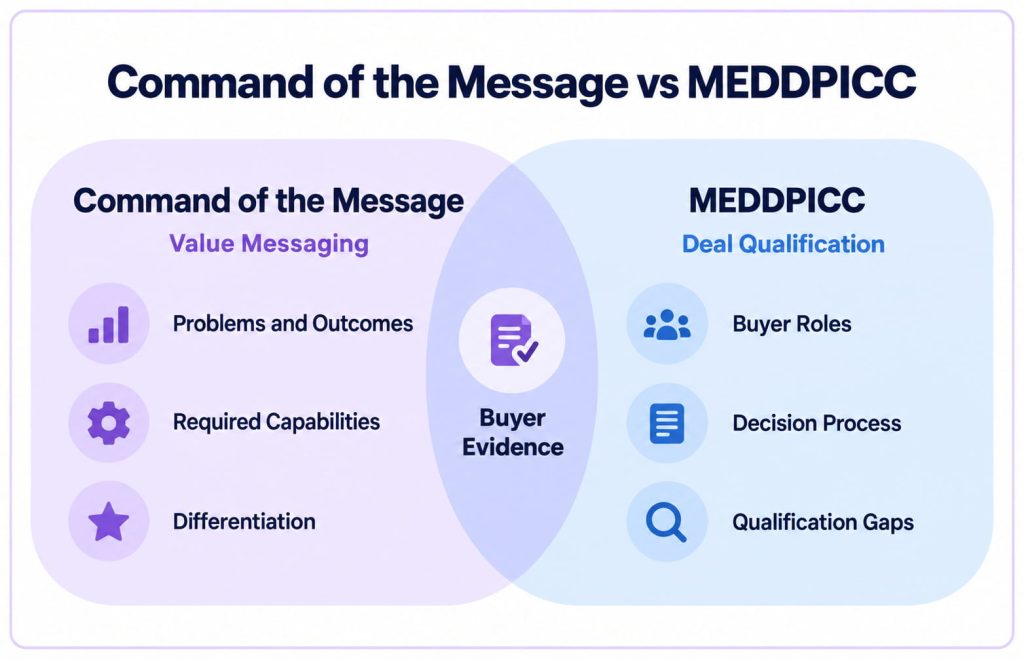
Command of the Message and MEDDPICC are often used together because they solve different problems.
| Framework | Primary purpose | Helps the AE understand |
|---|---|---|
| Command of the Message | Value messaging and buyer conversations | Problems, outcomes, capabilities, metrics and differentiation |
| MEDDPICC | Opportunity qualification and deal inspection | Metrics, buyer roles, decision process, pain, competition and champion strength |
Command of the Message helps you explain why a particular change matters. MEDDPICC helps you determine whether the opportunity remains viable and where important qualification gaps remain.
The two can work together. The first helps the AE communicate desired outcomes and required capabilities from the buyer's perspective.
MEDDPICC then helps the AE determine whether the economic buyer agrees, who can champion the change internally and how the final decision will be made.
For a practical view of how sales teams inspect opportunity movement, see this guide to deal tracking software.
Using both frameworks does not mean repeating the same work twice. The value message explains the buyer's reason to change and the relevance of your approach. Qualification tests whether the people, process and evidence exist for the opportunity to progress.
How account executives can apply the framework
1. Develop a working hypothesis
Before the meeting, study the company, buyer, opportunity and previous conversations. Develop a hypothesis about the possible issues or expected outcome, but label it as a hypothesis.
Pre-call preparation should help you ask better questions when you meet the buyer. It should never make you assume that you already know what they will say.
2. Use the buyer's language
Use the buyer's own words to describe the problem and its effect. This gives you more meaningful material for the demo, follow-up and internal business case than a polished summary created inside your company.
When a customer says, “We argue on Monday mornings about whether our CRM is accurate,” preserve those words when describing the current state.
3. Validate the value chain
At the close of discovery, ask the buyer to validate the value chain:
You are now at [current state], and this is resulting in [negative consequence]. You need to reach [positive outcome], so we need to ensure our solution provides [required capabilities]. Is that accurate?
This gives the buyer an opportunity to validate the message before you proceed with a formal proposal.
4. Design the demo around required capabilities
Design the demo around how your solution addresses the buyer’s identified required capabilities, not around your product navigation.
Each area of the demo should include:
- The buyer problem you are going to solve
- The capability you are using to address the problem
- How the workflow works
- The outcome the buyer can expect from this part of the process
- Any additional information or validation you require
5. Practise the difficult moments
Knowing a framework does not mean you can use it naturally in a high-pressure sales conversation. Practise explaining differentiation, handling price objections and moving from product features to buyer value.
Salesman AI's AI sales role play lets AEs rehearse buyer-specific situations using meeting and opportunity context. **The goal is not to memorise the framework.
It is to respond clearly when a buyer challenges your assumptions.**
6. Evaluate the call for evidence
After the meeting, separate what the buyer confirmed from what you assumed as the seller.
Review the call for:
- Confirmed problems and their consequences
- The outcomes the buyer wants
- Required capabilities
- Missing metrics or baselines
- Differentiators that mattered to the buyer
- Issues that remain unresolved
- Agreed next steps
AI sales coaching can help connect preparation, practice and post-call feedback around the same meeting context. The review should identify missing buyer evidence, not merely score whether the rep followed a script.
Bring those gaps into the next pre-call plan. If the metric is missing, prepare a question about how the buyer measures the current process.
If a required capability remains uncertain, confirm it before designing another product-led demo.
Common implementation mistakes
Using the framework as a script
You can tell when an AE is reading memorised questions. The framework should help you think about the buyer's answers, not dictate every line you say.
Creating value for buyers without their input
Using the method as a starting point in an internal messaging workshop is fine. The AE must still discover how each buyer understands the problem, outcomes and requirements within the specific opportunity.
Equating capabilities with features
Features are what products contain. Required capabilities are what buyers need to be able to do.
Keep that distinction clear.
Claiming differentiation because your company says so
A differentiator is not useful simply because your company calls it unique. It matters when it supports an agreed requirement and can be proven.
Treating training as a one-time event
The methodology becomes useful through repetition. Managers should reinforce it in call reviews, deal reviews, onboarding and opportunity coaching.
Reinforcement should use live opportunities whenever possible. A real deal forces the team to distinguish approved messaging from buyer evidence and exposes where the framework still feels unnatural in conversation.
A practical pre-call checklist
Before your next meeting, ask:
- Can I explain the buyer's current situation without referring to our products?
- Do I understand what happens if the issue remains unresolved?
- Has the buyer confirmed the desired outcome?
- Which required capabilities have been agreed?
- Which performance metrics matter, and is there a baseline?
- Is my differentiation connected to the buyer's needs?
- What evidence will the buying group require?
- Which parts of the value case remain assumptions?
If several answers are missing, make discovery the goal of the next conversation.
Frequently asked questions
Who created Command of the Message?
Force Management developed and owns the methodology. It is a registered method for aligning go-to-market teams around buyer value and differentiation.
How is the Command of the Message framework defined?
It is a value-based messaging framework that connects a buyer's current state and negative consequences with desired business outcomes, required capabilities, metrics, differentiation and proof.
Is Command of the Message a sales script?
No. It provides a structure for value conversations.
The seller must still listen, adapt their questions and apply the structure to each buyer.
What is the difference between MEDDPICC and Command of the Message?
MEDDPICC focuses on qualification and deal inspection, while Command of the Message focuses on communicating value. Many organisations use both because they address different parts of complex selling.
Can AI support Command of the Message training?
Yes. AI can help sellers prepare buyer-specific questions, practise conversations and review recordings for evidence.
It should reinforce the organisation's approved messaging rather than invent claims or replace seller judgement.
Turn the framework into an actual dialogue
The usefulness of Command of the Message depends on how well you apply it to the buyer in front of you. The document itself will not create value unless the conversation reflects the buyer's situation, priorities and evidence.
Before your next critical meeting, identify the missing part of the value case and practise that conversation. Start with your next meeting using Salesman AI.
The aim is not to deliver a perfect framework explanation. It is to help the buyer make sense of the problem, the desired change and the evidence required to move forward.