Contents
Outbound doesn’t typically fail because a sales representative forgets to send one email. It generally fails somewhere in the process of identifying a potential buyer, developing a meaningful message, continually following up, and handing a genuine dialogue to an account executive.
Outbound sales software is the right product to remove that friction. However, the solutions in this category solve different problems. Some tools give you contact information and let you reach out within one application. Others specialize in enterprise sequencing, multichannel campaigns, or cold email deliverability.
The best platform is the one that removes the biggest constraint in your existing outbound process. This guide compares eight legitimate alternatives by examining how each solution can be used, rather than simply asking which one has the most features.
TL;DR: the best outbound sales software by use case
| Platform | Best for | Primary strength | Main consideration |
|---|---|---|---|
| Outreach | Complex enterprise teams | Governed sales execution | Requires careful administration |
| Salesloft | Revenue teams wanting guided workflows | Cadences plus revenue intelligence | Broader than many small teams need |
| Apollo | Teams combining data and engagement | Prospect database and sequencing | Data quality still needs validation |
| HubSpot Sales Hub | Teams already using HubSpot CRM | Connected CRM and sales automation | Advanced capabilities sit in higher tiers |
| ZoomInfo Engage | Data-led prospecting teams | ZoomInfo data inside engagement workflows | Best value depends on the wider subscription |
| Reply.io | Multichannel outbound | Email, LinkedIn, calls and more | More channels create more setup work |
| lemlist | Personalised campaigns | Creative multichannel personalisation | Governance may be lighter than enterprise suites |
| Instantly | Cold-email scale | Deliverability-focused infrastructure | Less suited to complex rep-led sales motions |
What is outbound sales software?
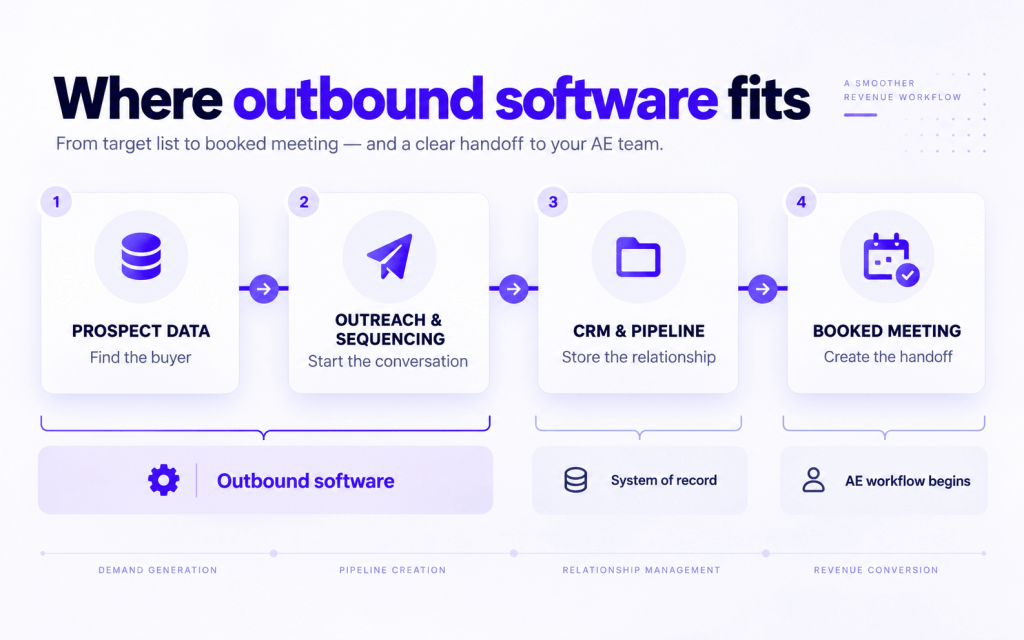
Outbound sales software identifies potential buyers for your team, organizes the first outreach efforts, and continues follow-ups via email, phone calls, or LinkedIn.
These tasks may include gathering prospect contact data, enriching prospect lists, and creating outreach sequences. They can also include auto-dialling, managing deliverability, tracking performance metrics, or using AI to personalize messages.
Those differences matter in practice. A database-first platform may be excellent at finding buyers but light on enterprise governance. A sequencing-led tool may coordinate rep tasks well but depend on another provider for data. Meanwhile, a deliverability-led tool may suit campaign scale while offering less support for complex, rep-led deals.
However, it does not necessarily replace a customer relationship management system (CRM). The CRM stores relationship and opportunity records. Outbound sales tools create and manage the activities that initiate relationships with prospects.
The strongest systems transfer accurate activity and engagement information back into the CRM.
How we evaluated these outbound sales tools
We evaluated all official product documentation currently available and compared every system using five practical criteria:
- Prospect data and enrichment
- Sequencing via email, phone, or social media
- Workflows and personalization
- CRM integration and activity capture
- Ability to support the target sales team’s size and sales motion
This isn't a "feature count" competition. When the issue is high-volume cold email or a potential impact on inbox health, it may be appropriate to choose a small-business-focused cold email tool over an enterprise-level solution.
The 8 best outbound sales software platforms
1. Outreach: best for governed enterprise execution
Outreach enables large revenue-generating organizations to add structure to their sales activities through established sequences, representative assignments, coordinated prospect communication, and connections between sales activities and opportunity workflows.
The primary benefit of Outreach is control. Sales leadership and operations teams can create repeatable sales processes, eliminating the need for every representative to develop an independent outbound system. That control is a major advantage, but it also creates a trade-off: configuring, governing, and adopting Outreach requires ownership.
- Ideal for: Enterprise SDR or sales teams with dedicated revenue operations (RevOps) resources.
- Limitation: It may be overly complex for a small team looking to run simple email campaigns.
2. Salesloft: best for guided seller workflows
Salesloft brings together the sales cadence workflow (the "how") and broader revenue workflows (the "what"). It also allows salespeople to track their email, phone, and social media interactions and stay organized around their daily work.
Salesloft has much value as an option if a company wants to have all outbound activity tied to both deal execution and revenue visibility. However, prior to selecting a pricing plan, the company needs to determine which modules will be required by each team member.
- Ideal for: Mid-sized companies through enterprises that want a more complete selling workspace.
- Limitation: Small companies may find the platform too large in scope for their number of users, so they may not get enough usage to justify the cost.
3. Apollo: best all-in-one option for data and outreach
Apollo includes all of your business-to-business lead generation prospects with sequences, an auto-dialer (or "dialler"), CRM activity logs and engagement workflows. It is ideal for smaller organizations or "lean" teams that may not want to have multiple subscriptions for both the leads you are going to reach out to and how you will reach out to them.
It is very convenient to use a single system to manage all of the steps in a sales process. However, no contact database should be treated as if it is 100% accurate. Representatives are responsible for validating key account information, job titles, and contact information before starting outreach efforts.
- Ideal for: Start-ups and small, growing organizations that would like to prospect for new business and engage with customers using one system.
- Limitation: Credit limitations and data verification should be tested during a pilot.
4. HubSpot Sales Hub: best for HubSpot CRM users
HubSpot Sales Hub provides sequence creation, CRM-based prospecting, pipeline management, and sales performance tracking in one application. The greatest value comes from using it within an organization that has standardized HubSpot CRM as the one place for all data.
The benefit to reps is that they do not have to move records around between multiple systems. Managers are able to tie the results of their outreach activities to later stages in the pipeline. Reporting and automated workflows are dependent upon which version of the product is chosen.
- Best suited for: Small and mid-sized organizations that plan to use HubSpot as their CRM system.
- Limitation: As your teams grow, costs may also increase due to additional seat licences, hubs, or more advanced features.
5. ZoomInfo Engage: best for ZoomInfo-powered prospecting
With ZoomInfo Engage, you can leverage your sales engagements as part of a larger data and intelligence system through ZoomInfo. The tool is intended to support reps in how they communicate with prospects, prioritize their activities and use prospect information instead of having to export lists into an additional platform.
The most obvious advantage of using ZoomInfo Engage would be that it provides a means for teams currently leveraging ZoomInfo’s prospect data to consolidate multiple platforms into one platform. For those considering ZoomInfo Engage as a standalone option, the full offering and its accompanying business case, including the breadth of its data and CRM workflows should be considered versus the standalone capabilities of the engagement layer.
- Best suited for: Companies using ZoomInfo to access prospecting data.
- Limitation: The value proposition will be heavily influenced by the company’s overall ZoomInfo contract.
6. Reply.io: best for coordinated multichannel outreach
Reply.io allows teams to connect email, LinkedIn, phone calls, SMS messages, WhatsApp messages, and other channels in an automated workflow. Each prospect can receive a different message at a different time. When prospects respond through multiple channels, a team may find that one email sequence alone is not enough.
Using Reply.io with multiple channels doesn't remove the need for control. Each team still has to create guidelines for which communication channels can be used together and for reasonable gaps between contacts. High-value customers or prospects should also receive a review by a person.
- Best fit for: Agencies and B2B organizations creating strategic multichannel marketing efforts.
- Limitation: The more communication channels your organization uses, the more complicated your workflows become. You'll need to manage channel permissions and implement quality controls to ensure they are used appropriately.
7. lemlist: best for personalised outbound campaigns
lemlist focuses on creating highly personalized, channel-agnostic outreach. It is designed to give teams more flexibility than traditional plain-text sequences. It now places AI-driven agents, intent signals, and enrichment capabilities directly into the organization’s outbound workflows.
The campaign tools in lemlist are ideal for organizations conducting creative prospecting motions. However, larger organizations will need to determine whether the platform offers sufficient approval controls, reporting depth, and administrative capabilities compared with an enterprise-level alternative.
- Ideal for: Organizations with growth teams or agencies that prioritize campaign personalization.
- Limitation: The platform may not have the level of governance control desired by complex, large-scale enterprises.
8. Instantly: best for deliverability-focused cold email
Instantly has automated the process of linking outreach to lead data, verifying leads, placing emails in a prospect’s inbox, and using an AI-driven CRM for customer relationship management. The most likely company that would use Instantly would be a business or organization with a heavy dependence on scaling cold email campaigns across many sender (email) addresses.
This is an entirely different issue than managing a large number of sales professionals and their activities around making calls, completing tasks, and tracking opportunities. Use Instantly as your “go-to” for building your email infrastructure.
- Ideal for: Agencies, founders, founding teams, and sales organizations with high-volume cold email campaigns.
- Limitation: It is not as well-suited to complex, call-intensive enterprise sales processes.
How to choose the right outbound sales software
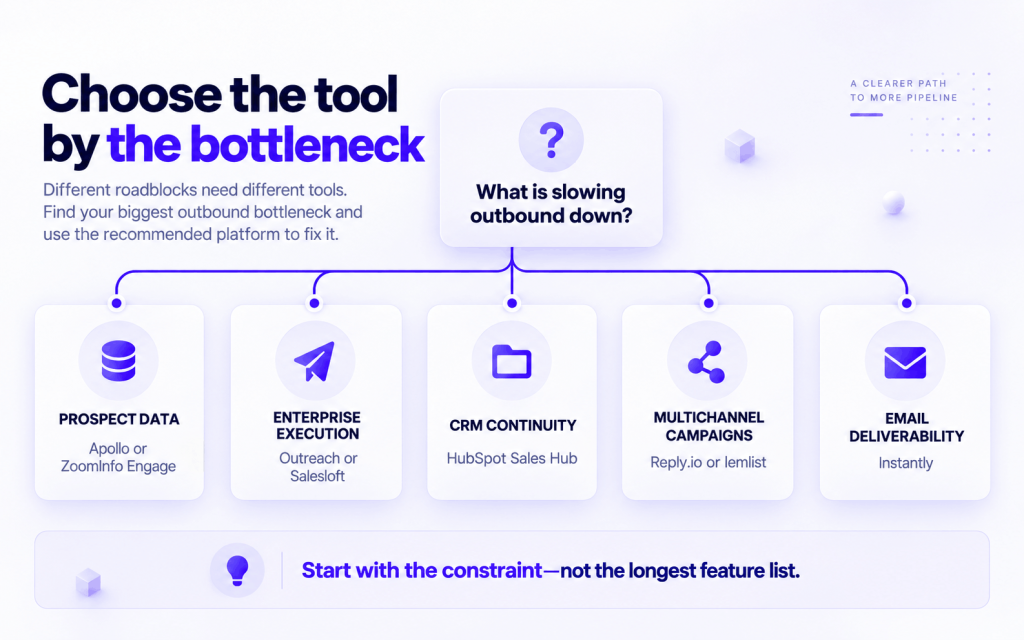
Start by identifying the part of your existing process that isn’t working properly.
- When prospect data is your first major bottleneck, choose either Apollo or ZoomInfo Engage.
- When you have a large team that needs to execute and govern consistently, choose either Outreach or Salesloft.
- When CRM continuity matters more than integrating one more platform, choose HubSpot Sales Hub.
- When coordinating personalized multichannel outreach matters as much as maintaining an accurate message for all reps, choose Reply.io or lemlist.
- When monthly cold email volume and delivery success rates matter most, use Instantly.
Prior to entering into a formal agreement for services from any of these companies run a pilot test using real account information. The goal is to measure valid contact rates, positive reply rates, meeting bookings, user (rep) engagement/adoption and CRM sync accuracy. Validating open rates alone will never provide evidence that the outbound marketing efforts being used will create new “useful” pipeline.
What happens after outbound books the meeting?
The outbound platform allows the AE to create the dialog with the prospect. However, it does not provide the AE with tools to assist in preparing for the buyer prior to the call, practicing how to handle a difficult objection by the buyer or creating a clear next step after completing the call.
This is exactly what Salesman AI will do. It is a rep-first AI sales copilot designed for account executives. Once you have booked the meeting, Salesman AI provides AI-powered meeting preparation and sales role-plays based on the opportunity, buyer, and meeting details. It also helps the rep continue selling after the meeting with AI-powered follow-up capabilities.
The outbound platform generates your pipeline. Salesman AI helps the AE move that pipeline from booked to closed. For a wider view of how these systems connect, read our guide to AI sales automation.
Frequently asked questions
What is the best outbound sales software for a small team?
When you have a small team that will use outbound sales software as a one-stop shop for contact information and sequencing, Apollo may be your best bet. However, if your team already uses HubSpot CRM, then HubSpot would likely be the better choice. If you are in a cold-email-led motion, Instantly is likely your best option.
What features do I need my outbound sales software to have?
You should look for a platform with:
- Reliable data
- Sequence management
- Personalization options
- CRM integration
- Activity tracking
- Useful analytics
Only add dialing, social steps, or delivery infrastructure options if they fit the motion of your business.
Will outbound sales software replace my CRM?
No. Your outbound software will execute the prospecting and outreach portion of your sales cycle. Your CRM will continue to act as the system of record for your contacts, activities, and opportunities. Some platforms integrate these two systems, but their operational functions remain different.
How can I determine how well my outbound sales software performed?
You will want to track:
- Valid contacts
- Positive response rate
- Meetings booked
- Opportunities created
- Cost per opportunity
- Rep adoption
Then follow those opportunities with the right deal tracking software rather than measuring performance only by how many messages were sent. That distinction matters because activity alone does not prove that pipeline is progressing.
Build a connected path from prospect to revenue
Create an end-to-end (from prospect to revenue) pathway for AEs through the sales process.
Your ideal outbound sales software will be the one which eliminates your most pressing operational constraints.
Data, deliverability, sequencing, and enterprise-wide governance are better served by different types of tools.
Once you have all of the tools in place to get the meetings scheduled, then you need to make sure each conversation counts.
To do this, start with the first meeting and give each AE everything they need, including context, practice, and follow-through, so the opportunity can advance.
Start with your next meeting and turn booked pipeline into a more connected path to revenue.