Contents
You finish a good sales call with pages of notes, open questions for further discussion and a meeting scheduled to follow. You then open a blank email and type, “Thanks for your time today. It was great talking to you.”
This template is simply too vague to help move the deal forward.
The ideal sales follow up email should make it easier to continue the conversation.
It should also show that you understand the buyer's needs, confirm what has been decided and clarify the next action.
This guide gives you a simple structure and 12 pre-written templates you can adapt without making every email sound like an automated response.
TL;DR: what to include in a sales-call follow-up
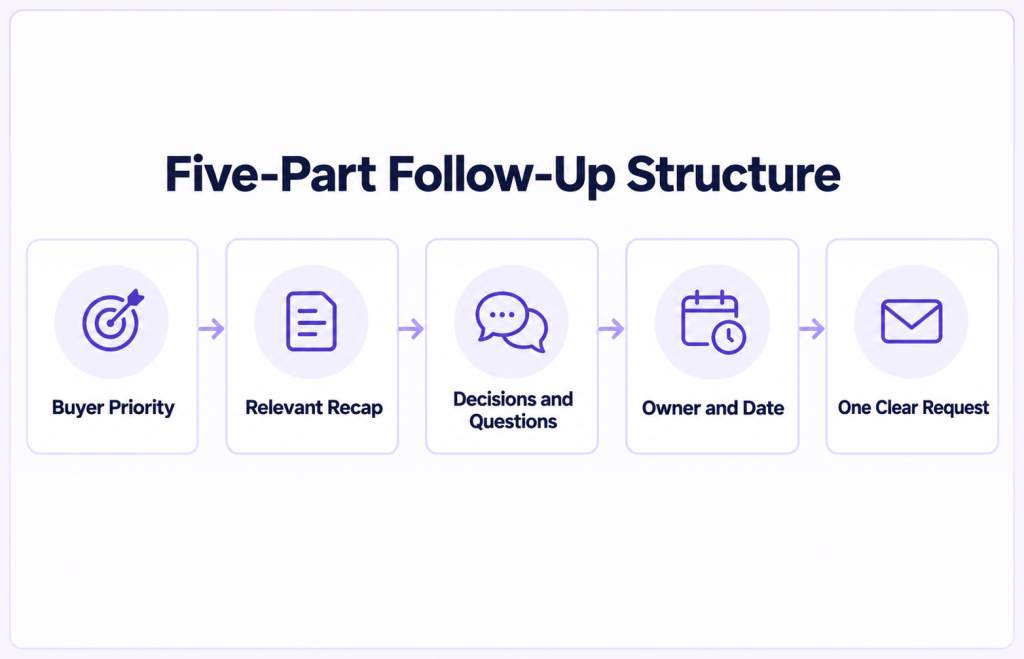
Use this five-part structure to send a good follow-up:
- Start with the buyer’s most important priority.
- Restate the issue, problem or outcome in their words.
- Confirm your agreements and what they are still unsure about.
- State who will do what and by when.
- Close with a single call to action.
A useful follow-up moves the buying process forward. A meeting summary only records what happened.
You do not need to include every point from the call to prove that you listened. The buyer needs to see the details that affect the decision, the people involved and the next action. Anything else can remain in your notes unless it helps the buyer prepare for the next conversation.
Why most sales follow-up emails feel generic
Emails often begin in generic input fields. When an AE relies on memory, the email may include a general description of the call but miss the specific details that could help continue the conversation.
Compare these two examples:
We discussed how you have been challenged with reporting on issues related to our platform.
You told me that managers waste time every Monday morning because the CRM is updated only after your manager has reviewed the sales pipeline for the forecast call. Your goal is to identify any “stale” opportunity numbers that the team should not commit to.
Although the second example is longer, it makes the previous conversation easier for the prospect to recall. It includes the current method, its consequences and where the buyer wants to go.
HubSpot’s sales-call recap guidance also recommends restating the buyer’s main challenge or objective and including only the advice or resources relevant to that conversation.
Your follow-up does not need to be lengthy. It needs to preserve the right evidence from the call.
That evidence may be a phrase the buyer used to describe the problem, a deadline they cannot miss or a concern raised by another stakeholder. Specific details make the message feel personal because they came from the conversation. They also give the buyer something concrete to correct if your understanding is incomplete.
A simple format for a sales follow up email
1. Use a specific subject line
Don’t use “Follow-up” as the entire subject line. Reference a specific topic or action instead:
- Pipeline review next steps
- Questions from implementation and Thursday’s workshop
- Pricing options for the eight-person team
- Security-review documents and owners
- Forecasting project recap and next step
Use the subject line to help the customer locate the conversation later.
A practical subject line should still make sense when the buyer searches for it several weeks later. Use the project, decision or promised action as the anchor. Avoid artificial urgency unless the buyer has already confirmed a genuine deadline.
2. Begin with what matters to the buyer
Thank the customer for sharing their concerns or information, but do not let that take over the opening. Begin by referencing the issue they are facing and the decision or priority in front of them.
For example:
Thank you for explaining how your team creates its Monday forecast. It appears the main challenge is that opportunities are updated only after your manager has reviewed the sales pipeline.
This shows that you were listening and establishes a direction for the rest of the email.
3. Recap selectively
Do not copy the entire transcript. Include only the information that will allow the sale to continue:
- The issue confirmed by the buyer
- Its impact on their business or operations
- What the buyer wants to happen
- Constraints or requirements
- Key stakeholders involved in the process
- Questions that remain unanswered
- Decisions already made
If you were unable to confirm something, label it as an open question rather than presenting it as a known fact.
This distinction is important because a recap can easily turn an AE's interpretation into an apparent buyer commitment. Separate what the buyer confirmed from what still needs validation. That keeps the email accurate and gives the next meeting a useful purpose.
4. Make the next step concrete
“Let’s stay in touch” isn’t a next step. A concrete next step should include an action, who owns it and when it needs to happen.
For example:
I will send the security documents by Wednesday. Could you confirm whether Priya from IT can join our technical review this Friday at 11:00 a.m.?
5. Ask for one response
Several unrelated requests will create resistance. Put all action items into a short checklist and indicate which item needs immediate attention.
Multiple separate requests create friction. If the customer needs to do several things, make the first required response unmistakable.
You can still record secondary actions, but do not give every item equal weight. A buyer should be able to scan the closing lines and understand what you need from them now, what you will handle and what can wait until later.
Sales follow up email template after a discovery call
Subject: Recap and next step for [priority]
Hi [Name],
Thanks for explaining how your team currently handles [process]. The main issue I heard is [specific problem], which is creating [consequence].
Your priority is to achieve [desired outcome] while keeping [constraint or requirement] in place.
For our next conversation, I will prepare [relevant demonstration, answer or document]. Could you confirm whether [stakeholder] should join us on [date/time]?
Best, [Your name]
Why this works
The message connects the current state to the desired outcome and uses the next meeting to resolve a real question. It does not turn discovery into an immediate product pitch.
Follow-up email after a product demo
Subject: Demo recap: [buyer outcome]
Hi [Name],
Based on today's demo, the two workflows most relevant to your team are:
- [Workflow] for [buyer requirement]
- [Workflow] for [buyer requirement]
You asked about [open question]. I will confirm the answer with [internal owner] and send it by [date].
The agreed next step is [action] on [date/time], with [stakeholders]. Please let me know if I missed anyone who should be involved.
Best, [Your name]
Why this works
It recaps the demo around buyer requirements instead of listing every feature shown.
Follow-up email when the buyer requests pricing
Subject: Pricing options for [team/use case]
Hi [Name],
You asked for pricing based on [number of users, usage or scope]. I have attached the options we discussed.
The main difference is [brief decision-relevant distinction]. Based on your requirement for [capability], [option] appears to be the closer fit, subject to confirming [open item].
Could you review this with [stakeholder] before our call on [date]?
Best, [Your name]
Why this works
The AE provides context without pretending to make the buyer's decision.
Follow-up email after an objection
Subject: Follow-up on [specific concern]
Hi [Name],
You raised an important concern about [objection]. From what I understood, the risk is [buyer's explanation of the risk].
I have included [evidence, documentation or answer] that addresses [specific part]. The remaining question is [unresolved point].
Would it help to include [relevant expert or stakeholder] in a 20-minute review on [date]?
Best, [Your name]
Why this works
It treats the objection as a requirement to resolve. It does not dismiss the concern or overload the buyer with unrelated proof.
Follow-up email when the next step was agreed
Subject: Confirming [next step] on [date]
Hi [Name],
Confirming the next step we agreed today:
- Action: [specific action]
- Owner: [name]
- Date: [date/time]
- Purpose: [decision or question to resolve]
I will send [your deliverable] by [date]. Please reply if any of these details need to change.
Best, [Your name]
Why this works
The format removes ambiguity and gives the buyer an easy way to correct the agreement.
Follow-up email when no next step was confirmed
Subject: Choosing the right next step for [priority]
Hi [Name],
We covered [problem or priority], but we did not confirm what should happen next.
The most useful next step may be [recommended action] because it would help us answer [open question]. Would [date/time] work, or would you prefer to pause until [buyer event]?
Either answer is helpful. I want to make sure the timing reflects your process.
Best, [Your name]
Why this works
The email acknowledges the gap directly and gives the buyer a clear choice without manufacturing urgency.
Follow-up email asking for a stakeholder introduction
Subject: Including [role] in the next conversation
Hi [Name],
You mentioned that [stakeholder/role] will evaluate [requirement]. It would be useful to understand their criteria before we finalise [demo, proposal or pilot].
Would you be comfortable introducing us before [date]? I can send a short note explaining why their input is needed.
Best, [Your name]
Why this works
It explains the value of the introduction and avoids making the champion feel bypassed. For more guidance, see the guide to multithreading in sales.
Follow-up email after a technical review
Subject: Technical review: decisions and open items
Hi [Name],
Thank you for bringing [technical stakeholders] into today's review.
Confirmed:
- [Requirement or decision]
- [Requirement or decision]
Still open:
- [Question], owned by [name], due [date]
- [Question], owned by [name], due [date]
Once these items are resolved, the team can decide [next decision]. I will send my update by [date].
Best, [Your name]
Why this works
Technical reviews often contain several details. Separating confirmed and open items keeps the email scannable.
Follow-up email after sending a proposal
Subject: Proposal for [desired outcome]
Hi [Name],
I have attached the proposal based on the scope we confirmed: [short scope]. It reflects [important requirement] and [important constraint].
The section that may need the most discussion is [section] because [reason]. Could you and [stakeholder] review it before [date]?
Our next call is scheduled for [date/time] to address questions and confirm whether the proposal can move to [next stage].
Best, [Your name]
Why this works
It tells the buyer where to focus and connects the document to a decision.
Gentle follow-up when the buyer has not replied
Subject: Checking the timing for [priority]
Hi [Name],
I wanted to check whether [priority/project] is still active for [timeframe]. When we last spoke, the remaining question was [specific issue].
If that is still relevant, I can [useful action]. If priorities have changed, let me know and I will update my side.
Best, [Your name]
Why this works
The message gives the buyer a reason to respond and makes “not now” an acceptable answer.
Follow-up email when the timeline has changed
Subject: Updating the plan for [project]
Hi [Name],
You mentioned that [event or dependency] has moved the decision from [old timing] to [new timing].
To keep the evaluation useful, I suggest we [appropriate action] on [date]. That would allow us to resolve [open question] without forcing the broader decision early.
Does that match your revised timeline?
Best, [Your name]
Why this works
It respects the new timeline while preserving a relevant next action.
Break-up email for an inactive opportunity
Subject: Should I close the loop on [project]?
Hi [Name],
I have not heard back since our conversation about [priority]. At that point, the team wanted to address [problem] before [timeframe].
Should I close the loop for now, or is there a better time to revisit it? If the project is still active, tell me what has changed and I will adjust the next step.
Best, [Your name]
Why this works
The email is direct and gives the buyer control. It also helps the AE distinguish a delayed deal from an inactive one.
How soon should you follow up after a sales call?
Send a follow-up while both sides can still recall the conversation. The exact timing should reflect what you promised the buyer.
- If the buyer wants material on the same day, send it on the same day.
- If you need internal confirmation, acknowledge the question and provide a realistic timeframe for your response.
- If the buyer wants you to wait until a particular event occurs, honour that request.
- If you did not discuss a timeframe, send a brief summary by the end of the first business day.
Follow the timing agreed during the call instead of relying on a generic sequence.
Speed matters most when the follow-up contains something the buyer needs for an internal conversation or a decision already in progress. In other situations, accuracy matters more than sending an immediate but incomplete response. If an answer requires help from another team, acknowledge the request first and give the buyer a realistic delivery date.
How to personalise the email without spending 30 minutes
To personalise without researching every hobby or writing every line from scratch, look at the information already shared during the call.
Identify these items before writing:
- The buyer's number-one priority
- One consequence they mentioned
- The result they want from the purchase
- Unresolved questions
- The agreed next step
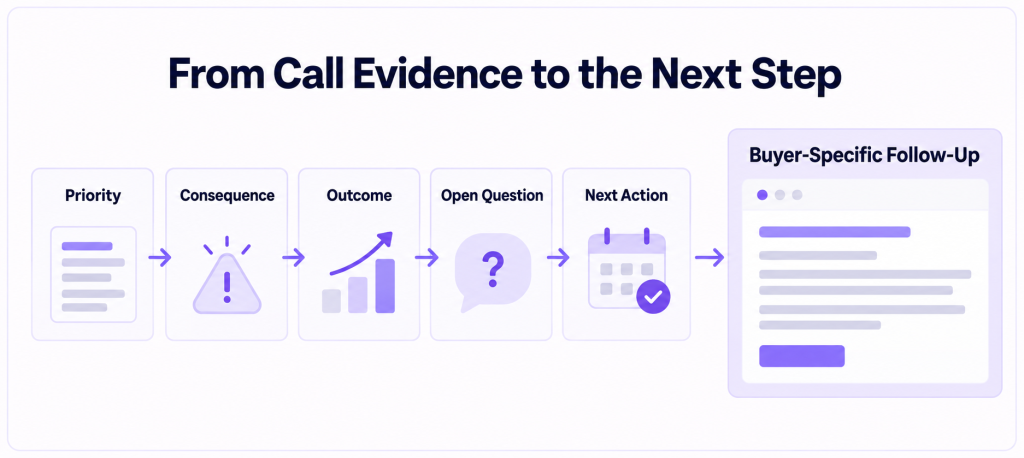
Salesman AI's AI sales assistant allows an AE to use meeting and opportunity context instead of starting with a blank prompt. Once the call has ended, the FOCUS report surfaces evidence about the call's priorities, blockers, green flags and next steps. With that evidence, the AE can use AI Helper to draft a follow-up based on what the buyer actually stated during the call.
Review your draft before sending it. Verify the spelling of names, dates, commitments, quoted prices and attachments. The AE is still accountable for the final message; AI can organise the supporting evidence.
The final review should also check whether the tone matches the relationship. A first discovery call may need more context, while an active evaluation may only require decisions, owners and deadlines. Personalisation comes from relevance, not from adding an informal line that has nothing to do with the buyer's work.
Sales follow-up mistakes to avoid
Sending the same recap to every stakeholder
Different groups care about different issues. The common facts can remain consistent, but you may need to adjust the request, level of detail and emphasis for each group.
Including unconfirmed buyer information in the summary
Do not turn an unproven assumption into something the buyer supposedly confirmed. Use “we still need to confirm” when there is not enough evidence.
Hiding the next action inside a lengthy paragraph
Move the call to action near the end and make it easy to find. If you need to include owners, dates or several actions, use a bulleted list.
Sending attachments without explaining them
Tell the buyer what the attachment contains, why the document matters and which section they should review.
Repeating follow-ups without a valid reason
“Just checking in” makes the buyer reconstruct the context. Instead, refer to the priority, open question or timeframe already established.
Final checklist before you send the email
Read the message once from the buyer's point of view. They should not need to reopen the calendar invitation, search for an attachment or interpret a vague promise before they can respond.
- Does the subject line name the topic or next action?
- Does the opening reflect the buyer's priority?
- Are confirmed facts separated from assumptions?
- Is it clear which decisions and questions still need to be resolved?
- Does every commitment have the correct owner and timeline?
- Is there one obvious response the buyer should provide?
- Are names, dates, prices, links and attachments accurate?
- Can the buyer understand the email in less than one minute?
Frequently asked questions
What should I say in a follow-up email after a sales call?
State the buyer's priority and confirm the agreements and decisions made during the call. Identify the remaining unanswered questions, then clarify who will handle the next action and by what date. Close with one actionable request.
How long should a sales follow-up email be?
Use the shortest email that still includes enough detail for the buyer to move forward. Many follow-ups are between 100 and 200 words. A technical review may require a longer list of decisions and open issues.
Should I send meeting notes or a personalised email?
Send a personalised email that lists the buyer's decisions and the agreed next steps. Meeting notes can be attached or linked when they add useful detail and make the next steps clearer.
What happens if the buyer didn’t agree to a next step?
Acknowledge that no next step was agreed. Suggest an action that addresses a specific open issue from the call, then ask whether the timing fits the buyer's current process.
Do not present your suggestion as though both sides already accepted it. Giving the buyer a clear choice is more useful than adding a meeting to the calendar without genuine commitment.
Can AI help me write my sales follow-up email?
Yes, if the AI has access to accurate call and opportunity history. The AE is still responsible for checking factual accuracy, tone and every request in the final message.
AI is most useful when it can work from the buyer's actual language, confirmed decisions and open questions. A generic prompt with no call context may produce a polished message that still misses what matters to the deal.
Why should I create the follow-up immediately after the call?
A well-written sales follow up email keeps both parties aligned on the priorities discussed during the call. It protects valuable details and turns a good conversation into a commitment to the next steps.
If your call context is split across notes and transcripts, start by bringing that information together. With Salesman AI, post-call analysis and AI Helper use the same buyer and opportunity context. You can write a relevant follow-up without reconstructing the conversation from scratch.