Contents
One person who responds to a deal quickly and is enthusiastic about the product does not always have the authority to purchase it.
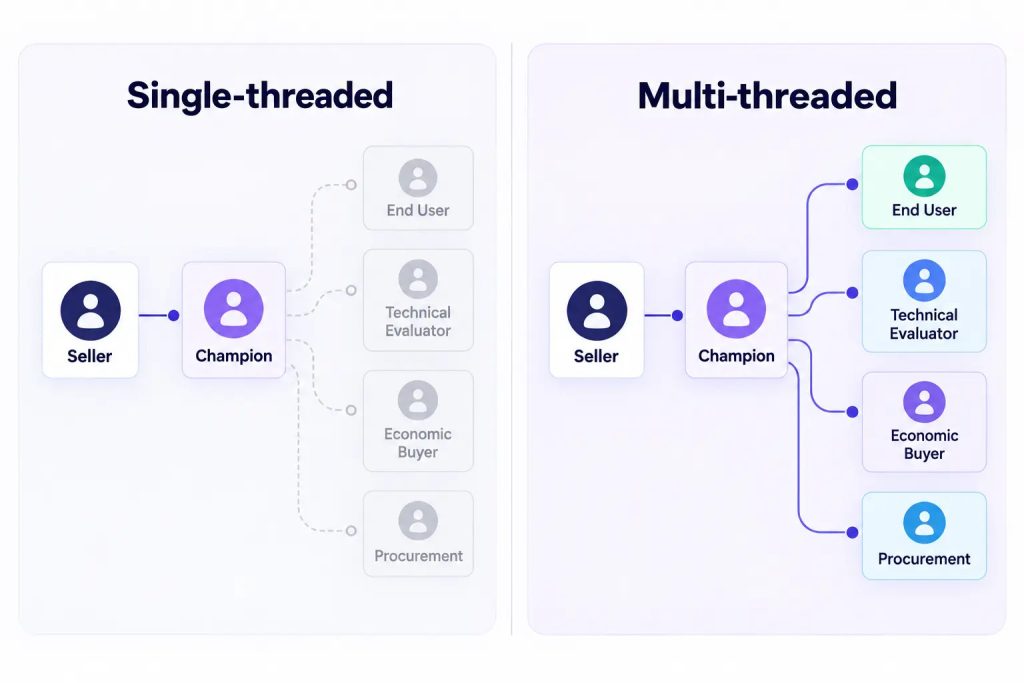
When all of your efforts are concentrated on developing a relationship with just one person involved in a particular buying process, you are creating a single-threaded opportunity. That opportunity may come to an end if that individual's influence is diminished or they leave their company.
Multithreading in sales provides a framework for establishing multiple relationships with individuals who each contribute to the collective decision-making process.
It is not intended as a way to acquire additional contacts and circumvent your champion. It is designed to assist in eliminating hidden obstacles within the buying group.
TL;DR: how to multi-thread a sales deal

Identify who is currently engaged in your project and map them out.
Determine which roles are needed but have not been assigned yet.
Find out what beliefs (or opinions) need to be addressed by each person.
Create a reason for your champion to present you to their team.
Plan on having a separate conversation with each of the people identified.
Provide an update to your champion concerning developments that occur with other parties.
Discuss with the whole group how decisions will be made.
What is multithreading in sales?
Multithreading in sales is a B2B strategy that involves creating collaborative, working relationships with multiple people within a single customer’s account.
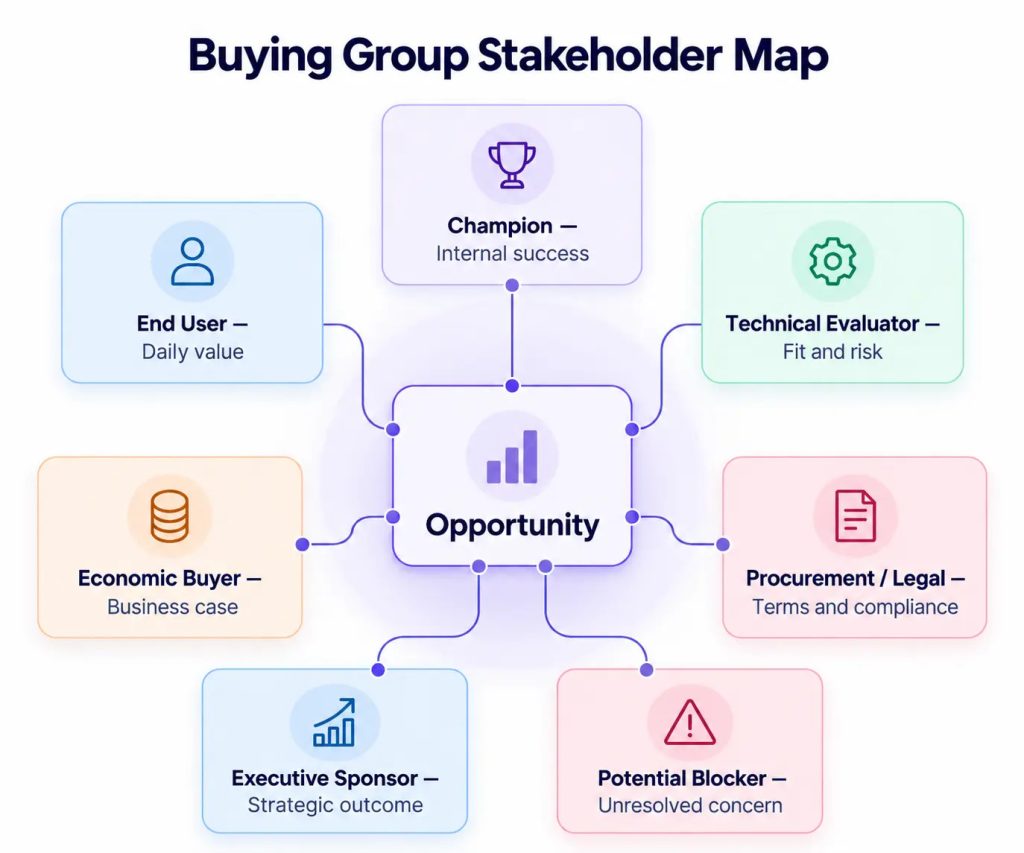
The relationships can include the champion, end user, technical evaluator, economic buyer, executive sponsor, procurement contact or even a potential blocker.
A multi-threaded sales approach allows the sales representative to see different parts of the opportunity. It doesn’t mean calling numerous employees randomly. Each new thread in this methodology should either add clarity to the current buying process or advance the buying process.
Single-threaded vs multi-threaded sales
| Area | Single-threaded deal | Multi-threaded deal |
|---|---|---|
| Relationships | One primary buyer contact | All relevant relationships within the buyer’s team |
| Deal context | Details are generally passed through a single individual | Details are confirmed across multiple roles |
| Stakeholder concerns | These individuals often appear at an advanced stage of the buying process | Their concerns can be identified earlier in the process |
| Champion workload | The champion works alone while selling internally | The seller helps the champion create alignment with internal stakeholders |
| Contact risk | If this contact leaves the organization, it may be difficult for the seller to continue selling | Continuity is maintained through other working relationships |
| Decision process | Assumed or only partly understood by the approver or evaluator | Validated among approvers and evaluators |
| Messaging | One general value proposition | A relevant message for each stakeholder |
Single-threading can be perfectly fine in many cases. However, it is risky to treat a complex purchase as if it were one person’s decision.
Why multi-threaded deals are stronger
You gain a better understanding of the actual decision
Your champion may understand the problem but have limited knowledge about security. The technical evaluator will likely know how to implement the solution but may lack budgetary information. Talking to both groups provides greater clarity about the project.
Objections are identified before closing
Objections that arise near the end of the buying process may seem unexpected because a new party became involved. Earlier input allows corrections to be made when assumptions are still weak.
The champion does not carry the project alone
Regardless of how well your champion represents the product, it is still their job to turn it into a financial, technical or executive case. Multithreading provides stakeholders with the most relevant data possible to support their specific interests.
The opportunity can survive changes in people
There will be times when key members of the project move on from the company. Establishing multiple relationships provides protection if one member leaves.
Signs your deal is too single-threaded
Your opportunity will likely require additional support if:
- All meetings rely upon the same contact.
- Stakeholders are referenced in communications, but they are never formally introduced to you.
- Your champion states “the team loves this” with no supporting data.
- No confirmation of the business case exists from the economic buyer.
- All technical, security and legal concerns continue to be passed down through intermediaries.
- You do not know who could prevent the sale.
- The closing assumptions exist before the approval process has started.
- When you reach out to your primary contact, all communication ceases and the entire sales effort ends.
- No members of other departments, besides the initial sponsoring department, understand what the project entails.
Several warning signs appearing together indicate that the strategy needs to change.
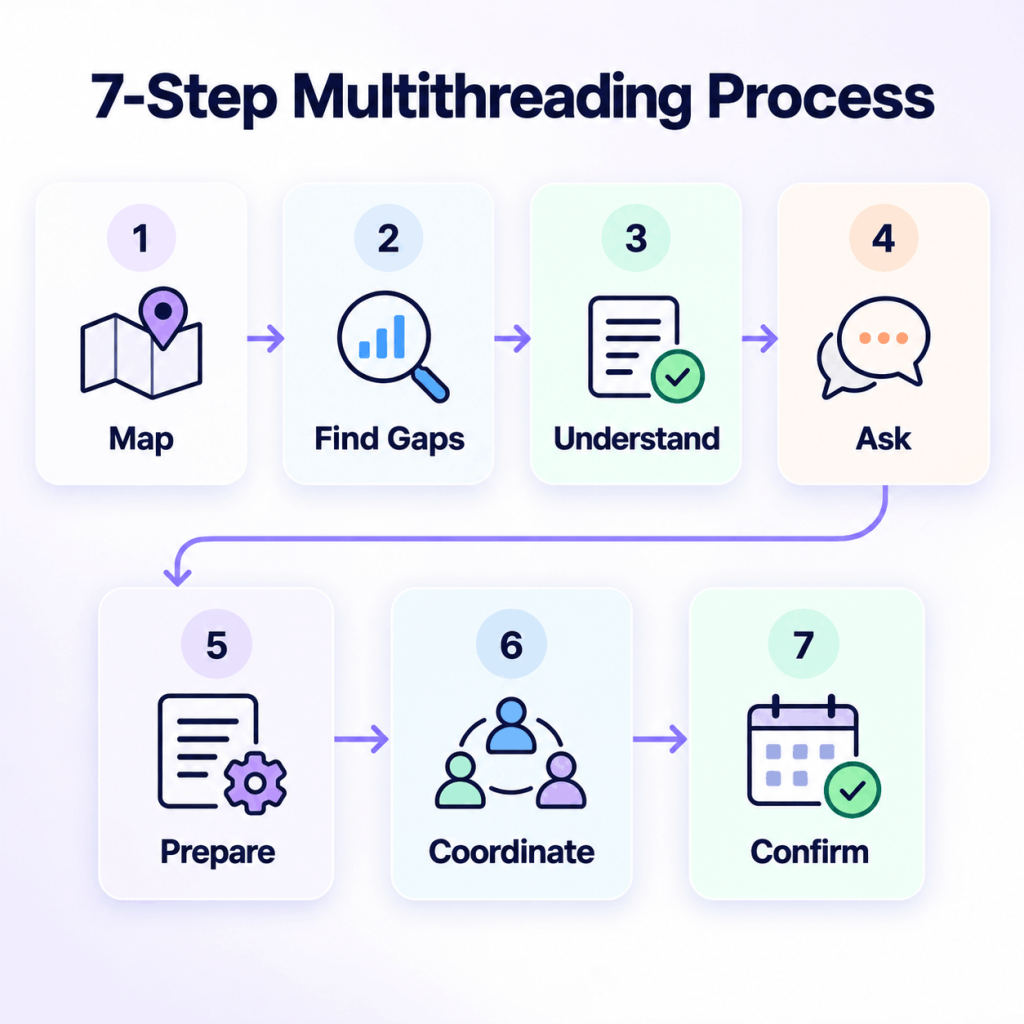
The seven-step multithreading sales process
1. Map the buying group
It is better to consider the different stakeholder roles that can exist in a purchase decision-making process rather than the job titles these stakeholders may have in their respective organizations.
The role of each stakeholder remains relatively constant from one organization to another, whereas the job title may differ depending on the size and type of the organization.
| Stakeholder role | What they normally care about | Evidence needed |
|---|---|---|
| Champion | Internal success and credibility | Advocacy and introductions to the correct individuals within the organization |
| End user | Effort, workflow and usability | Current pain points and practical requirements of the product or service |
| Technical evaluator | Implementation, security and architecture | Steps for obtaining technical approval and the criteria used by the evaluator |
| Economic buyer | Cost, business impact and risk | Budget position and the criteria used when approving a purchase |
| Executive sponsor | Company-wide strategic objectives and organizational value | Evidence that the project aligns with overall company objectives |
| Procurement or legal | Process, commercial terms and compliance | Review sequence, owners, time frame and potential blockers |
One person may hold several roles, while one role may involve several people.
2. Identify the missing decision roles
Think about how your current relationships match the buyer’s decision-making process. It doesn't have to be the highest-ranking person who needs to be contacted next.
For example, if technical requirements must meet safety and security standards before approval from the chief financial officer, the security issues should take priority over contacting the CFO.
Ask:
- Who will benefit from the results of this project?
- Whose approval do you require to implement this product or service?
- Who will review your company's implementation or assess the associated security risks?
- Who controls the budget for this purchase?
- Who can stop the decision to purchase this product or service?
- How was your last major purchase approved?
These are better questions to ask than, “Do you make all final decisions?”
3. Understand what each stakeholder needs
Multithreading fails when all stakeholders receive the same pitch. Each person has a different objective when entering the buying process.
The end user needs to know how their current workflow will be affected by the proposed solution. A technical evaluator needs factual information about how the software will be implemented.
Meanwhile, an economic buyer needs to evaluate the potential cost, risk, timing and overall impact of the proposed software on the business. Record at least three items for each key role identified above:
- What are they accountable for when making this purchasing decision?
- What do they need to believe in order to support that decision?
- What kind of data or proof would help them believe it?
4. Give your champion a reason to introduce you
Instead of simply asking for an introduction, explain why the conversation matters. This gives your champion a chance to express concerns about involving another person in the process.
Instead of:
Hi, can you introduce me to your VP?
Try:
You said Maya will have to agree on our business case. Would it be helpful if we shared a 20-minute view of the expected operational impact and the assumptions that still need to be validated?
This allows your champion to tell you whether the proposed conversation makes sense. You can also use this as a template for other requests for stakeholder input:
Since [stakeholder] has ownership or influence over [part of the decision], it might be useful to discuss [specific issue] before [decision milestone]. Would it make sense to speak with them briefly?
5. Prepare a different conversation for each role
Provide a new stakeholder with sufficient information to consider their part in the decision-making process.
End users
Talk about the end-to-end workflow, identify where daily work creates friction, describe how usability could improve and specify the expected level of adoption or implementation.
Technical evaluators
Provide all relevant technical documentation. Ensure there is a clear separation between items you know are supported and items that need further clarification.
Economic buyers
Show the economic buyer how the proposed change will affect the business, what risks may be associated with it, and the expected costs and timelines. Only provide a feature tour if they request one.
Procurement and legal
Define and document the scope, terms, dependencies, owners and review dates. A process question is not necessarily a product objection.
6. Keep your champion at the center
Multithreading can become harmful when your champion feels bypassed. Your champion is an inside person who can give you direction and let you know whether certain areas should be avoided because of their political implications.
When you meet with another stakeholder:
- First, agree on why you’re meeting.
- Ask what the stakeholder currently knows about your area of interest.
- Determine whether anything you have discussed may be politically sensitive or off-limits.
- If possible, allow your champion to introduce you.
- Verify together what a successful outcome looks like.
- After speaking with the stakeholder, inform your champion of any changes.
The goal is to keep the different relationships connected, not to create separate conversations that your champion cannot see.
7. Confirm how the group will decide
Having additional relationships does not mean that you have finished. The buying group still needs an effective decision-making process.
Verify:
- Who recommends the solution among the stakeholders?
- Who has to approve the purchase?
- Which technical or commercial tasks still need to be completed?
- What information still needs to be developed?
- Who is responsible for each task?
- When does the group expect to reach a decision?
A multi-threaded deal is much more than a bigger deal with more people involved in the purchasing decision. It is also a deal with clearly defined relationships, evidence and responsibilities within the buying group.
A practical multi-threading example
An AE is selling a content-production platform to a global training team. The champion is an enthusiastic learning manager. However, IT must first approve security, procurement must approve the contract, and the VP of Learning has to provide final approval for the budget.
The AE and champion establish three purposeful conversations:
- An end-user workflow review with the content manager.
- A technical evaluation with IT covering integration, security and implementation questions.
- A business-case discussion with the VP connecting production delays to team capacity.
The AE keeps the champion involved. New concerns are raised earlier, and each one receives a responsible owner. The deal improves because the decision process becomes visible, not simply because the CRM now contains four contacts.
Common multithreading mistakes
Collecting contact information rather than creating relationships
Entering names in the CRM does not generate a multi-threaded deal. A relationship should reveal a need, issue, function or responsibility of some sort.
Your deal-tracking process should show what each relationship contributes, not merely store more names.
Reaching out to senior leaders without relevance
Access to executives is only effective when the discussion is meaningful. A generic escalation may damage the champion's credibility.
Sending the same message to everyone
The same benefit will not be equally significant to an end user, technical evaluator and purchasing manager. Tailor your data and evidence accordingly.
The Challenger Sales Model can also help AEs shape stakeholder-relevant commercial conversations.
Waiting until negotiations to map stakeholders
Inadequate early discovery of key stakeholders creates excessive technical, legal and approval-related work that must then be completed within an unreasonable closing deadline. Begin developing a map of roles early in the discovery process.
Assuming meeting attendance means support
Just because someone attends a meeting does not mean they are aligned. Look for concerns that were resolved and commitments that were made regarding the project.
How to measure multithreading success
Do not only count how many contacts are connected to an opportunity. Instead, use evidence-based indicators that show the strength of your relationships:
- Required decision-making roles have been identified.
- Direct working relationships with key decision-makers have been established.
- Specific goals for each stakeholder have been documented.
- The champion is making or supporting introductions.
- Technical and commercial issues have been assigned to responsible parties.
- Buyer-initiated actions on the opportunity have been completed.
- The decision process and dates have been confirmed.
- Stakeholder support has been validated rather than assumed.
A contact count can still be useful, but it should never replace evidence of relationship quality or buyer momentum.
How Salesman AI supports multi-threaded sales
Salesman AI maintains relevant buyer, meeting and opportunity details together for each active deal.
Before a meeting, AI Meeting Preparation allows the AE to review priorities, previous discussions and likely buyer concerns. The AE can then practise a buyer-specific conversation using AI Sales Role Play.
After a supported meeting, Salesman AI creates a FOCUS report that organizes stakeholder information, commitments, Green Flags, Blockers and next steps. Using AI Helper, the AE may ask:
- Which decision-making roles have appeared in this deal?
- Who has yet to be included as a stakeholder?
- What did the technical evaluator want us to verify or confirm?
- Did the economic buyer agree with our business case?
- Is any stakeholder concern still unresolved?
Salesman AI supports the AE in identifying and preparing around available evidence. It does not independently contact stakeholders or make decisions in place of the AE.
Multi-threading checklist for AEs
The champion's involvement and motivation have been identified.
End users are represented in the analysis.
A technical evaluator has been identified.
An economic buyer has been identified or can be accessed.
Procurement, legal and security steps are mapped where applicable.
Potential blockers are understood.
Each introduction request has a clear purpose.
The message changes based on the stakeholder’s role.
The champion remains aware of activity related to the deal and continues to be involved.
Stakeholder support is based on facts, not assumptions.
Actions, owners and dates have been documented for the decision process.
Each new relationship improves the understanding of the agreement.
Frequently asked questions
What does multithreading in sales mean?
Multithreading in sales means building appropriate working relationships with multiple people involved in a buyer's purchasing decision instead of relying solely upon a single contact.
What is a multi-threaded deal?
A multi-threaded deal involves several people who contribute to a buying decision. The seller understands the roles, priorities, concerns and commitments of the individuals involved in that decision.
When should I initiate sales multithreading?
Begin mapping the buying group at the start of the discovery phase. Initiate new relationships when the decision process, impact, approval requirements or other factors extend beyond the original contact.
How many contacts can a multi-threaded sales deal include?
There is no specific quantity. A small transaction could involve two people, while an enterprise transaction could involve numerous roles. The relevance and quality of each relationship matter more than the raw contact count.
What if the champion refuses to introduce me to another stakeholder?
Ask why before pushing for the introduction. Understanding the champion’s concern allows you to address it and provide more clarity about why you want to meet the other stakeholder.
Can I contact an executive directly without my champion?
Yes, but sometimes this can be risky. Only use direct outreach when you have a clear reason, such as establishing a formal relationship or obtaining additional information, and a plan for keeping your champion informed.
Build your buying group, not just a longer contact list
Multithreading in sales works when every relationship creates a clearer understanding of the decision and helps move it forward.
Identify the key players who will ultimately decide or influence the outcome. Make sure that every conversation has a reason. Most importantly, strengthen your champion instead of making them feel replaced.
Use Salesman AI to prepare for your next stakeholder meeting.