Contents
A sales call can go well without moving the deal forward.
The buyer asks relevant questions, appears interested and agrees to another meeting. Your meeting assistant produces a clean transcript, a positive summary and a list of action items. Two weeks later, however, the opportunity has not moved.
The problem may not be the meeting itself. It may be the gap between recording what happened and understanding what it means for the deal.
A pricing question does not always signal buying intent. A positive response does not confirm commitment. Five stakeholders can attend the same meeting and still disagree about what they need, why they need it or whether the problem is urgent.
This is where AI sales call analytics should offer more than transcription. The goal is not simply to document a meeting. It is to help you understand what buyers are signalling, what remains unresolved and what needs to happen next.
What is sales call analytics?
Sales call analytics is the process of examining sales conversations to understand buyer behaviour, evaluate call effectiveness, identify areas for improvement and determine what could help an opportunity progress.
Traditional analysis focuses largely on measurable activity, including:
- Call duration
- Talk-to-listen ratio
- Number of questions asked
- Topics discussed
- Call outcome
These measurements are useful. A sales manager may notice that an account executive dominates discovery calls or rarely asks about the customer's decision process.
But those measurements do not necessarily show whether the buyer is closer to making a decision.
Modern AI call analytics can examine what was said alongside those activity measurements. Depending on the platform, it may identify objections, commitments, competitor mentions, stakeholder concerns and changes in urgency.
Consider these two statements:
“This looks interesting. Send us the pricing.”
“If implementation is approved this month, we would like to start next quarter.”
Both sound positive. The second statement, however, contains a timeline, a dependency and a possible next step. A useful analysis must preserve that distinction instead of placing both statements under positive sentiment.
Why more call data does not guarantee better deal visibility
Most B2B sales teams do not lack customer information. They have recordings, transcripts, CRM notes, emails, calendar events and follow-up documents.
Yet an AE still has to search through old conversations before an important meeting. Who raised the security concern? Which stakeholder mentioned a competitor? Why was implementation postponed? What did the team promise to send?
The information exists, but it is rarely presented as one connected account of the deal.
Information is captured in separate places
Discovery establishes the initial problem. A demonstration reveals technical requirements. Pricing introduces budget constraints. These discussions may happen weeks apart and involve different people.
For example, a buyer could mention limited implementation resources during discovery and later ask whether onboarding can be completed within two weeks. The connection between those statements matters more than either statement in isolation.
CRM stages compress complicated buying processes
Two opportunities can occupy the same pipeline stage while facing completely different obstacles.
One may be waiting for a signature. The other may still lack agreement between finance and operations. Both appear late-stage in the CRM, but they require different actions from the AE.
Sales call intelligence should reveal the evidence behind the status. It should not simply repeat the stage already entered in the CRM.
Summaries preserve events, not always their significance
A summary may accurately report that a customer asked about integrations. It may not explain whether the question was routine or whether a specific integration is a condition of purchase.
That meaning often becomes clear only when the question is viewed alongside earlier objections, stakeholder priorities and later commitments.
From transcription to intelligence: four levels of analysis
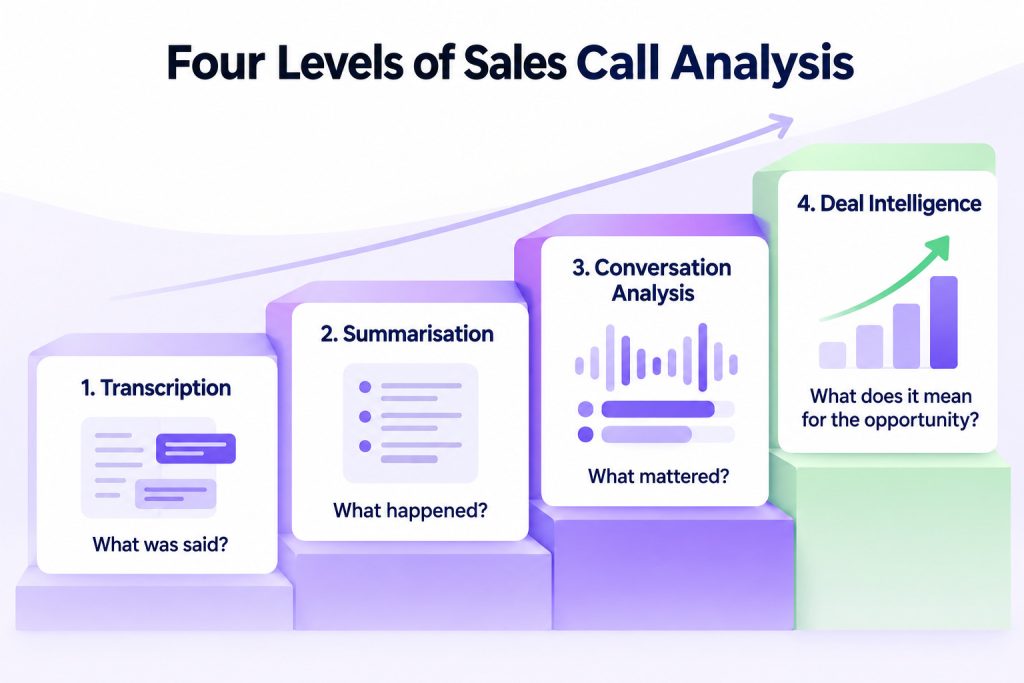
AI sales tools do not all interpret conversations in the same way. Their capabilities can be separated into four layers.
| Level | What it does | Question it answers |
|---|---|---|
| Transcription | Converts speech into searchable text | What was said? |
| Summarisation | Condenses the meeting into key points and actions | What happened? |
| Sales conversation analysis | Examines questions, objections, engagement and buyer statements | What mattered during this call? |
| Deal intelligence | Connects evidence across conversations, stakeholders and time | What does this mean for the opportunity? |
Each layer is valuable. Transcription makes a conversation searchable. Summarisation saves review time. Sales conversation analysis highlights important moments. Deal intelligence places those moments in a wider buying process.
Suppose a buyer raises budget concerns in the first meeting, expresses interest in a feature during the second and requests an ROI calculation in the third. Separately, these are three observations. Together, they suggest that the interest may be genuine, but the financial case remains unresolved.
Seven sales call transcript analysis metrics worth following
Sales call metrics often begin with talk time, question count and meeting duration. These can support coaching, but AEs also need measures that illuminate how the buying process is changing.
The following dimensions are useful indicators. They should not be treated as a universal predictive score.
1. Buyer engagement and participation
Engagement is not simply the amount of time a buyer speaks. A buyer who explains internal constraints and the decision process may reveal more than someone who agrees enthusiastically throughout the call.
Look for questions tied to requirements, examples of existing problems and a willingness to involve other stakeholders. Active evaluation is more meaningful than passive participation.
2. Objection frequency and resolution
Counting objections can reveal patterns, but not all objections carry equal weight. One unresolved security requirement may matter more than five minor usability questions.
Separate concerns that have been answered from those that remain open. When implementation complexity returns across several meetings, reassurance may not have resolved the underlying concern.
3. Stakeholder alignment
A VP may care about revenue growth. A sales manager may prioritise adoption. RevOps may want integration confidence, while finance expects a credible return on investment.
Those priorities can coexist, but the buying group still needs a shared reason to act. Review agreements, disagreements, missing decision-makers and unresolved requirements. Do not invent a precise alignment score where the evidence does not support one.
4. Next-step clarity
“Let's reconnect next week” sounds encouraging but commits nobody to anything.
“RevOps will review the requirements by Thursday, and we will decide on the pilot on Friday” contains an owner, an action, a deadline and a decision.
A useful next step is specific enough to be verified later.
5. Commitment fulfilment
A champion agrees to introduce finance, but the introduction does not happen. During the next meeting, they say finance is busy. By the third meeting, priorities are being reassessed.
None of these statements proves that the deal is lost. Together, they show that an important dependency remains unresolved. Track what buyers do after agreeing to an action, not only what they promise during a call.
6. Changes in urgency
“We need this before next quarter” may later become “We are reassessing our priorities.” The change between those statements is more useful than either phrase on its own.
It suggests that the original timeline should be revisited, without assuming the buyer has lost all interest.
7. Deal momentum across conversations
More meetings do not automatically equal progress. Ask what materially changed:
- Was an objection resolved?
- Were decision criteria confirmed?
- Did a decision-maker become involved?
- Was the technical evaluation completed?
- Did the buyer agree to a timeline?
Deal momentum should be based on observable changes, not a mysterious composite score.
Traditional measurements still help explain sales call performance. Context-driven measurements answer a different question: Are these conversations reducing uncertainty and helping the buyer make a decision?
What summaries can miss about signals, objections and commitments
Buyers rarely announce their intentions in perfectly explicit language.
“Could you send the security documentation before we bring in IT?” may be a routine request, a purchasing dependency or an emerging blocker. Its meaning depends on who asked, what happened earlier and whether IT eventually became involved.
Buying signals need supporting evidence
A pricing request may mean the buyer is comparing vendors. An implementation question may mean they are planning a rollout. Neither guarantees a purchase.
Interpret a statement alongside previous requirements and subsequent actions. A signal becomes stronger when behaviour supports it.
Objections can evolve without disappearing
An initial concern about integration complexity may later appear as a documentation request and then as a question about implementation ownership.
The wording changes, but the underlying concern may remain the same. Recognising that continuity stops the AE from treating every version of the objection as a new and unrelated question.
Behaviour can matter more than enthusiasm
A buyer who repeatedly praises the product but avoids committing to next steps may need a different approach from one who sounds measured but consistently completes agreed actions.
Neither pattern is conclusive on its own. AI sales insights are strongest when they remain connected to verifiable evidence.
Why understanding a deal requires more than one conversation
A B2B purchase is a series of discussions between people with different responsibilities.
The VP wants higher win rates. The manager cares about coaching and adoption. RevOps worries about implementation. Finance asks for measurable returns.
Every meeting can end positively while the group remains unaligned. Individual summaries may be accurate but collectively incomplete. A concern raised by finance may never reach the technical team. A requirement established during discovery may be forgotten before the proposal is prepared.
Sales call intelligence becomes more valuable when it links those statements to the same buying process. It does not need to pretend there is one definitive explanation. It needs to help the AE examine all the available evidence together.
This also supports a stronger multithreading strategy, because the AE can prepare for what each stakeholder actually cares about instead of repeating the same message to everyone.
Where generic AI call analysis falls short
Large language models can summarise transcripts, extract information and answer questions about the text provided to them. The challenge is often not the model's language capability. It is whether the model can access the right information.
Paste one transcript into an AI assistant and ask, “Why is this deal taking so long?” The model can reason about that meeting. But the actual delay may have appeared three weeks earlier during a conversation with another stakeholder.
Without that history, the answer will be incomplete.
Compare these two requests:
Summarise this call and identify the objections.
Across the last four conversations, which objections remain unresolved, who raised them and which commitments are still outstanding?
The second question requires authorised access to a broader conversation history. That is the value of connected AI workflows: less manual transcript copying and more relevant context available when the AE needs to investigate a deal.
The Model Context Protocol provides an open standard through which AI applications can connect to external tools and data sources. The quality of the answer still depends on the context and permissions exposed by each integration.
What about LLMs, SLMs and specialised extraction?
Large language models can interpret language and produce contextual responses. Smaller language models may suit narrower tasks depending on accuracy, cost, latency and training. Some systems combine structured extraction, retrieval and several model types.
But the model label alone does not solve the context problem.
The more useful questions are:
- Can the system access the relevant history?
- Can it separate buyer statements from seller assumptions?
- Can the AE verify the evidence behind an answer?
- Does it respect the permissions attached to the underlying data?
A more powerful model cannot recover context it was never given.
Example: four positive meetings and one stalled deal
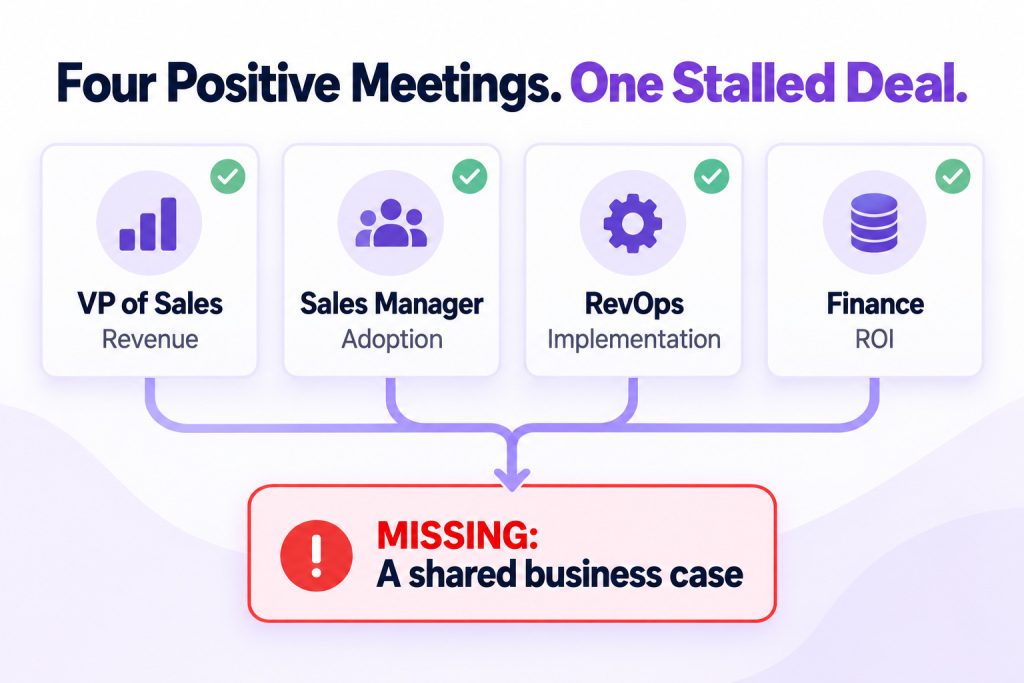
Consider a fictional $75,000 opportunity at a mid-market technology company. Four meetings have taken place. The CRM still shows the opportunity in evaluation, and every summary sounds positive.
| Meeting | What happened | What remains unclear |
|---|---|---|
| VP of Sales | Wants higher win rates and more selling time; requests a demonstration | Whether the problem is urgent enough to fund |
| Sales Manager | Likes reduced preparation time; asks about onboarding and adoption | Whether the team will use the product consistently |
| RevOps | Raises security, integration and data-access questions | Whether technical requirements can be approved |
| Finance | Requests proof that productivity gains justify the investment | Whether there is a credible shared business case |
None of these meetings looks disastrous. Together, however, they reveal the real gap: the stakeholders have not agreed on a business case connecting revenue, adoption, implementation and cost.
The next step may not be another product demonstration. It may be a working session that connects those requirements into one purchasing rationale.
Reporting four good meetings is not the same as understanding why the deal has not advanced.
How Claude and Salesman AI connect conversations to decisions
Account executives often know the answer is somewhere in their call history. Finding it and applying it is the difficult part.
Salesman AI supports meeting preparation, review and follow-up around active sales opportunities. Its MCP connection with Claude lets Claude use the authorised sales context made available through the integration, rather than requiring the AE to copy and explain individual transcripts every time.
Prepare with previous buyer context
Ask:
Brief me on my next Northstar meeting. What did the buyer ask for previously, and which commitments should I follow up on?
This prepares the AE around the actual history of the opportunity rather than a generic meeting checklist.
Investigate a stalled opportunity
Ask:
Across the last four Northstar conversations, which concerns remain unresolved, and what may be preventing progress?
Treat the response as evidence to investigate, not a definitive diagnosis.
Compare stakeholder priorities
Ask:
What does each stakeholder in the Northstar deal care about? Where do their priorities differ, and what should I address next?
The answer can help the AE plan a meeting that addresses the buying group rather than only the most vocal contact.
Draft a follow-up in the buyer's language
Ask:
Draft a follow-up using the priorities the buyer mentioned, the questions we promised to answer and the agreed next steps.
The AE should verify and personalise the message before sending it. For more examples, see these sales follow-up email templates.
Find the deals that need attention
Ask:
Which deals need my attention this week based on what buyers said in recent conversations?
The goal is to prioritise using available buyer evidence. AI supports the AE's judgement; it does not replace it.
What better sales call analytics should help an AE do next
The value of sales call analytics software should not be measured by the number of dashboards it produces.
A dashboard may show a 45-minute meeting, a 55% talk ratio and 12 questions. Those numbers can help with coaching. They do not necessarily explain the next action in the opportunity.
Useful analysis should help an AE answer:
- What changed in the buyer's priorities?
- Which commitments remain outstanding?
- What has the buying group not agreed on?
- Which objection requires attention?
- What would constitute meaningful progress?
Sales call reporting documents activity. Better analytics connects observations to possible actions while keeping the underlying evidence accessible.
If you are comparing platforms, evaluate whether they:
- Produce accurate, searchable transcripts
- Identify buyer statements, objections and commitments
- Analyse multiple conversations when required
- Distinguish evidence from interpretation
- Connect insights to the correct opportunity
- Support preparation and follow-up
- Respect data access and user permissions
Not every recording or transcription product provides the same depth of intelligence. The broader conversation intelligence guide explains how the category works across coaching, customer insights and deal workflows.
The next step is not another summary
Recording is easier than it used to be. Transcription is faster, and AI can summarise a meeting within seconds. These are meaningful improvements, but capturing the conversation is only the beginning.
The harder task is understanding how that conversation connects to a purchasing decision. A customer may be interested but concerned about implementation. A stakeholder may support the product without having authority. A positive meeting may still leave the main blocker unresolved.
The real promise of AI sales call analytics is not a better report after every meeting. It is making the evidence from those meetings useful when the AE needs to make the next decision.
Frequently asked questions
What is sales call analytics?
Sales call analytics examines sales conversations to understand engagement, objections, communication patterns and deal progress. It can combine conventional call measurements with an analysis of what buyers actually said.
What sales call transcript analysis metrics are most useful?
Useful dimensions include buyer engagement, objection resolution, stakeholder alignment, next-step clarity, commitment fulfilment, changes in urgency and momentum across meetings. Talk ratio and question frequency remain useful for coaching.
How does AI call analysis work?
Platforms typically transcribe speech and use language-processing methods to identify topics, questions, objections and commitments. Capabilities differ considerably, particularly when analysing several meetings connected to one opportunity.
What is the difference between sales call analytics and conversation intelligence?
Sales call analytics focuses on measuring and interpreting sales conversations. Conversation intelligence is a broader software category that may include transcription, coaching, buyer insights and connections to deal workflows. Vendors sometimes use the terms interchangeably.
Can AI sales call analytics improve conversion rates?
It may help sellers identify blockers, prepare more effectively and follow up with greater context. Any effect on conversion rates should be measured rather than assumed.
How is AI call analytics different from sales call reporting?
Reporting documents activities and outcomes. Analytics interprets conversation content and patterns to help explain what the information may mean and what the AE should investigate next.
Can Claude analyse sales call transcripts?
Yes, when transcripts are supplied within its supported context and permissions. With an appropriate MCP integration, Claude can also use authorised context exposed by connected tools. The exact capability depends on the integration.