Contents
Somewhere in your territory, a prospect has received a detailed, well-researched email that mentions their latest funding round, their new VP of Sales and a job posting dated last Tuesday.
No member of your competitor's staff wrote this email. An AI SDR did, at 3 a.m., along with hundreds of other emails.
AI SDR tools have gone from "cool demo" to "sales line item." All you're debating now is which one your competition will try next, and what will happen to the meetings it generates.
Below, we've covered 7 AI SDR tools, organized around how they function. Each one was checked against its own site in October 2026. As such, every feature and price below comes directly from the vendors.
Finally, we address the section most lists leave out: what do your AEs need to do once the AI generates a meeting?
TL;DR: the shortlist
- Best for fully autonomous outbound at scale: 11x Outbound
- Best all-in-one with a dialer built in: Artisan (Ava)
- Best to test without a monthly commitment: AiSDR
- Best budget autonomous option: Salesforge Agent Frank
- Best inside an existing sales engagement platform: Reply.io Jason AI SDR
- Best copilot where reps stay in control: Amplemarket Duo
- Best for inbound leads: Qualified Piper
What is an AI SDR?
An AI SDR performs all the tasks of a sales development representative.
Prospects are located and researched, personalized messages are generated, replies are managed, and meetings are scheduled for your account executives. The terms AI BDR and AI sales agent may also appear when referring to this type of technology.
Key to understanding the difference is the word "does." A previous generation of sales technology helped a sales development representative (SDR) do the job more efficiently. A modern AI SDR performs the entire sales sequence itself, with whatever degree of human oversight you want.
This is but one example of the broader use of AI in the sales process. Our AI sales automation guide discusses additional applications.
Three types of AI SDR tools
Most tools are not alike. There are three different types:
- Autonomous outbound agents perform the whole outbound process: list building, research, writing, sending and booking. (11x, Artisan, AiSDR, Agent Frank)
- Agents working within an existing sales platform add AI SDR capabilities to a tool your team may already use, with approval controls. (Reply.io Jason AI SDR, Amplemarket Duo)
- Inbound agents respond to people who have already shown some interest in your company or product, for example, website visitors and people who have filled out one of your forms. (Qualified Piper)
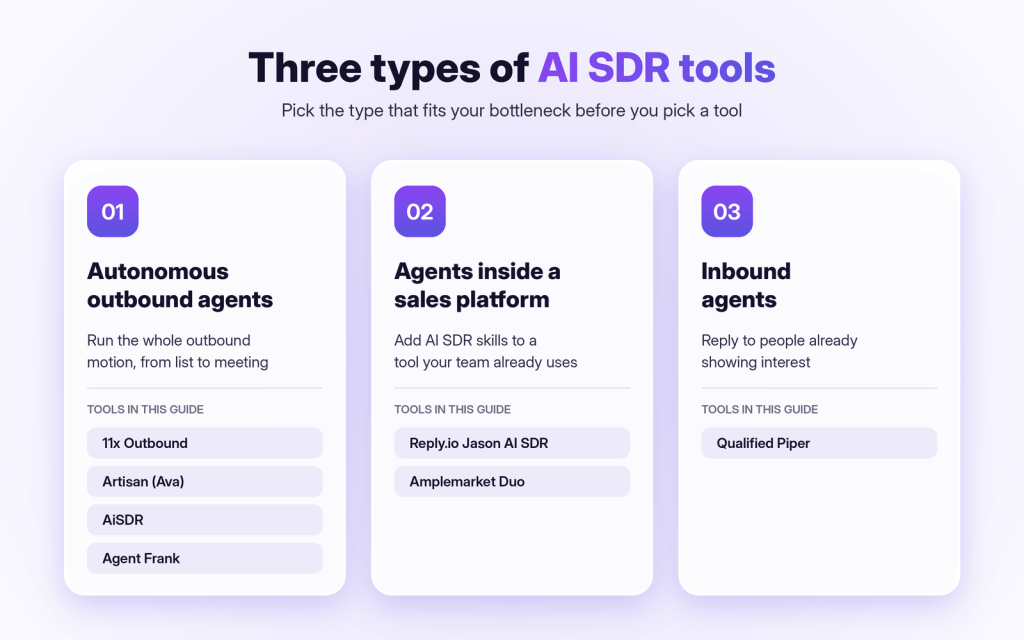
Which type you need is far more important than which tool is the best. A great outbound agent is useless if your biggest leak is a delay in replying to your inbound leads.
If you would prefer to keep humans writing each of your messages, we also wrote a roundup of outbound sales software that covers non-AI SDR tools.
How we evaluated these AI SDR tools
We examined six areas, each based on the vendor's own website:
- Motion: outbound, inbound or both
- Channels: email, LinkedIn, phone and/or website chat
- Control and autonomy: fully autonomous, approval-based or adjustable
- Signals and data: where prospects come from and what buying signals it tracks
- CRM and handoff: how meetings and context reach your reps
- Transparency in pricing: whether you can see pricing before scheduling a sales call
We didn't run paid trials of every tool. Therefore, view vendor-reported results, including the ones we mention, through a skeptical lens.
AI SDR tools compared
| Tool | Type | Channels | Autonomy | Pricing |
|---|---|---|---|---|
| 11x Outbound | Autonomous outbound | Email, LinkedIn, power dialer for rep-led calls | Runs plays end to end | Demo only, no public pricing |
| Artisan (Ava) | Autonomous outbound | Email, social, phone dialer | Adjustable | Usage-based credits, free trial; dialer seat $67/mo |
| AiSDR | Autonomous outbound | Email, LinkedIn, AI calls via Aircall | Runs campaigns; managed service optional | $1.50 per person prospected, or team plans via sales |
| Agent Frank | Autonomous outbound | Email, LinkedIn (phone coming soon) | Auto-Pilot or Co-Pilot | $499/mo |
| Jason AI SDR | Agent in a sales platform | Email, LinkedIn, phone steps | Automatic or approval mode | $500/mo, per Reply.io |
| Amplemarket Duo | Copilot in a sales platform | Email, multichannel sequences, AI voice messages | Review first or autonomous | Not public |
| Qualified Piper | Inbound | Website chat (text, voice, video), email | Engages inbound leads | Not public |
Prices and features as listed on vendor sites, October 2026.
The 7 AI SDR tools, reviewed
1. 11x Outbound: best for fully autonomous outbound at scale

What it does: 11x Outbound (formerly Alice) is an AI SDR designed to find prospects, research them, reach out to them and book appointments.
How it works: You tell the platform who you're trying to sell to and what you're trying to achieve. The platform then decides how to approach them.
It handles prospecting, research, personalization and multichannel outreach on your behalf. Your lists can come from your CRM or from 11x's own database. Additionally, lists update automatically based on activity such as funding rounds, new hires, job changes and website visits.
Key features:
- Email, LinkedIn and a power dialer for rep-led calls
- Live research on every contact, including recent news and 10-K filings
- Smart replies and objection handling
- Multi-language support with a claimed 400M+ contact base
- Two-way CRM integration, with your CRM kept as the system of record
Best for: Mid-market and enterprise organizations looking to run high-volume outbound across multiple languages.
Limitations: There's no publicly available pricing, so expect a sales process. The power dialer supports rep-led calls, but AI voice calling isn't supported.
Verdict: A good choice if you want one platform to manage your entire outbound operation and you're willing to go through an enterprise-style buying process.
2. Artisan (Ava): best all-in-one with a built-in dialer

What it does: Ava is Artisan's version of an AI BDR. According to Artisan, she covers sourcing, enrichment, multichannel outreach, reply management and meeting scheduling in one platform.
How it works: Ava finds prospects using signals like funding, new executive hires, increases in hiring, tech stack, intent and website visits. You can also create your own custom signals in plain language.
Then she sends individual messages. When someone responds, she uses a knowledge base to reply and schedules a meeting on the right rep's calendar.
Key features:
- A claimed 400M+ contact records across B2B and local business databases
- Waterfall enrichment from roughly a dozen data providers
- Email, social and native phone, including parallel dialing and AI voicemail drop
- Deliverability controls such as mailbox ramp-up and inbox placement testing
- Native Salesforce and HubSpot sync, plus audit trails and SSO on Enterprise
Best for: Teams that want outbound and calling in one tool, with escalation rules they control.
Limitations: Usage-based credits make monthly costs harder to forecast than a flat rate. Most claims about Ava's performance come directly from Artisan itself.
Verdict: The most complete feature set here for teams that use their phones as often as their inboxes.
3. AiSDR: best for testing with no monthly commitment

What it does: AiSDR runs outbound campaigns using email, LinkedIn and AI calls, from researching prospects through to booked meetings.
How it works: You can start self-serve without calling a sales rep. Pricing is $1.50 per prospect, billed daily, with no monthly fee. Larger teams move to volume-based team plans with quarterly contracts.
Key features:
- Email through Gmail or Outlook, plus LinkedIn requests, direct messages, InMails and voice notes
- AI calls through the Aircall dialer
- Access to over 300 million native leads, Sales Navigator data and waterfall enrichment across 20 providers
- Buying signals, including job changes and funding
- Two-way HubSpot sync, plus Salesforce sync on team plans
Best for: Startups and small teams that want to test an AI SDR before committing budget.
Limitations: Salesforce integration and some advanced features are only on team plans, which are priced through sales.
Verdict: The lowest-risk way to find out whether an AI SDR will work in your market.
4. Salesforge Agent Frank: best budget autonomous option

What it does: Agent Frank is Salesforge's version of an AI SDR. It finds leads and runs email and LinkedIn outreach all day long.
How it works: Either use Auto-Pilot to let Frank go from finding prospects to booking meetings, or Co-Pilot to review each message before it sends. It connects to the rest of the Salesforge stack for mailboxes, warm-up and lead data.
Key features:
- Two automation modes: Auto-Pilot and Co-Pilot
- Email and LinkedIn sequences
- Unlimited LinkedIn senders, mailboxes, workspaces and seats
- Integration with Salesforge's email infrastructure and lead generation tools
- 24/7 support through Slack and a dedicated account manager
Best for: Small teams and agencies that want their outbound automated at a set cost per month.
Limitations: Phone outreach is currently listed as "coming soon." Most of Salesforge's claims come from its own comparison pages.
Verdict: An easy-to-understand price ($499/month) and a sensible approval mode make this product easy to try.
5. Reply.io Jason AI SDR: best inside an existing sales engagement platform

What it does: Jason is Reply.io's version of an AI SDR. It helps you create an outreach strategy, find and research prospects, write messages, handle responses and schedule meetings.
How it works: First, you define playbooks, offers and a knowledge base. Then Jason runs multichannel sequences with conditional logic, in either automatic mode or approval mode for every response from a prospect.
Key features:
- Email, LinkedIn and phone call steps with auto-generated scripts
- A choice of AI models: Claude, Gemini, Mistral and OpenAI
- Access to over 1 billion contacts, plus intent signals such as hiring and tech use
- Three modes: automatic mode, approval mode and per-message source review
- 50+ languages and mobile apps
Best for: Teams already running Reply.io, or teams that want an AI SDR agent inside their sales engagement platform.
Limitations: Reply.io quotes $500/month for Jason, compared with the cost of a human sales development representative. Be sure to check the pricing page to see what's included in your plan.
Verdict: Works well if you want to add AI SDR capabilities without buying another platform.
6. Amplemarket Duo: best copilot that keeps reps in control

What it does: Duo is Amplemarket's AI sales copilot.
It identifies people showing buying intent, researches accounts, drafts multichannel messages and follows up with potential customers.
How it works: When a rep signs in, they can see the prospects who have shown buying intent. Reps can then review the messages Duo drafts before they send. Alternatively, they can let Duo send follow-ups automatically.
Key features:
- 20+ buying intent signals, including competitor evaluation and LinkedIn activity
- Prospect lists that update daily
- Multichannel sequences, including AI voice messages in the rep's own tone
- Automated follow-up and objection handling
- Integration with CRM, email and calendar
Best for: Teams that want AI to do the lead generation legwork but still control what goes out under each rep's name.
Limitations: Pricing isn't published at this time. Specific integrations weren't named in the launch announcement either.
Verdict: The most rep-centric experience among these tools. It supports SDRs rather than replacing them.
7. Qualified Piper: best for inbound leads

What it does: Piper is essentially Qualified's AI SDR for inbound. It engages people visiting your site and inbound email leads. It now goes by the name PiperX.
How it works: Piper talks to visitors on your site through text or voice, with video yet to launch, and follows up with inbound leads by email. Your sales reps interact with Piper mainly through Slack.
Key features:
- Text and voice conversations, with video planned
- Emails sent as Piper or on your rep's behalf, through your company's existing email service
- Salesforce as the only required integration, plus HubSpot Marketing Hub
- Support for 16+ languages
- Built for sales-led and product-led teams
Best for: Companies with real website traffic, or inbound leads waiting too long for someone to reach out.
Limitations: It isn't designed for outbound prospecting. Pricing isn't public, and the multi-modal features aren't included in the base price; they're sold separately.
Verdict: If your main pipeline issue is speed to lead, start here before trying an outbound strategy.
How to choose an AI SDR tool
Don't start by listing features. Start with your objective (the problem):
| If your situation is… | Start with |
|---|---|
| You want to test an AI SDR before committing budget | AiSDR or Agent Frank |
| You need outbound at volume, across languages | 11x Outbound or Artisan |
| Your team already runs sequences in Reply.io | Jason AI SDR |
| You want reps to approve what goes out | Amplemarket Duo, or any tool's approval mode |
| Inbound leads wait too long for a reply | Qualified Piper |
Ask every vendor these questions before signing an agreement:
- Who reviews each message before it sends, and can I set this per campaign?
- How are our sending domains protected? One bad week could hurt deliverability for months.
- After a prospect agrees to meet, what context reaches the AE?
- How will we measure success? Meetings held plus pipeline created.
The third question is the one most buyers fail to ask.
What happens after the AI SDR books the meeting?
Here's what the AI SDR pitch leaves out: there are gaps in how you prepare for the meeting. Your AE still has to run the meeting, even though the AI scheduled it.
That AE also didn't write the outreach. Therefore, they don't know which pain point the email started with, what signal triggered it or what the buyer replied.
If they show up unprepared to a meeting with someone who has received a dozen "custom" emails, it can quickly turn into a no-decision.
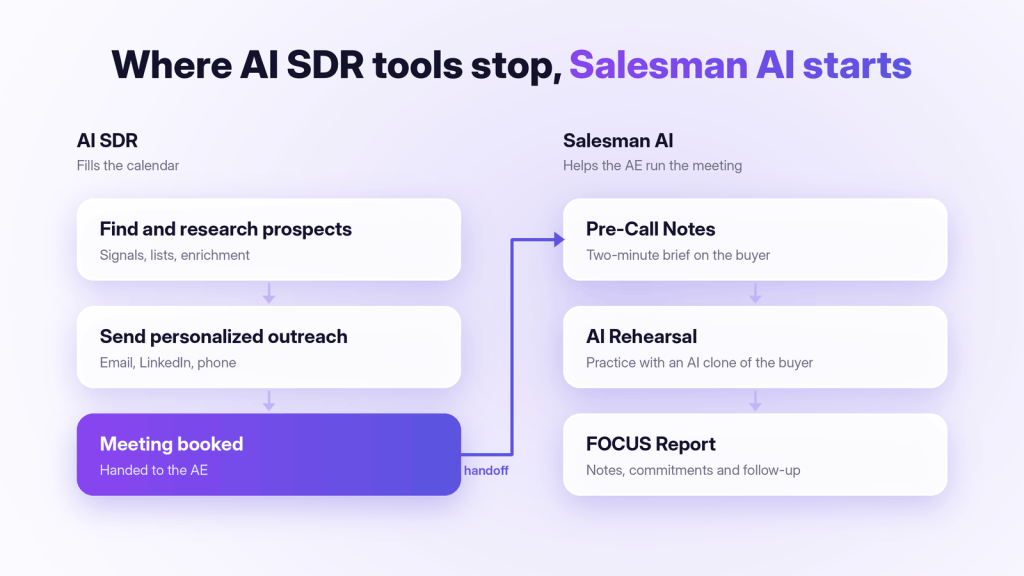
Salesman AI begins exactly where AI SDR tools stop. It's a rep-first AI sales copilot for account executives.
- Pre-Call Notes gives the AE a two-minute brief before the meeting, covering the buyer's likely priorities, likely objections, DISC-based communication cues, top questions to ask and a meeting objective.
- AI Rehearsal lets the AE simulate the discussion with an AI clone of the buyer, based on the opportunity context. Comparing practice tools? See our roundup of AI sales role-play tools.
- FOCUS Report converts the discussion into CRM-ready notes, including buyer commitments, next actions and the follow-up the meeting needs, so the deal moves forward.
So basically, your AI SDR puts people on your calendar, and Salesman AI helps make sure those meetings turn into deals. For a manual version of that prep, see our 10-minute account research checklist.
FAQs
Will AI SDRs replace human SDRs?
For high-volume, repetitive outreach, much of the SDR's work is moving to AI SDRs. However, many tools offer approval modes, and some, such as Amplemarket Duo, are designed to support reps rather than replace them.
Most teams use AI SDRs to cover more ground while people handle the conversations.
How much do AI SDR tools cost?
Cost varies widely. From vendor sites in October 2026: AiSDR costs $1.50 per person prospected with no monthly fee, Agent Frank is $499/month, and Reply.io lists Jason at $500/month.
There's no public pricing for 11x, Amplemarket or Qualified, and Artisan uses usage-based credits.
Can an AI SDR handle inbound leads?
Yes, but it depends on the tool. Qualified Piper is designed for inbound, engaging website visitors and inbound email leads. Most tools here are designed for outbound.
What's the difference between an AI SDR and a sales engagement platform?
A sales engagement platform helps reps run sequences. An AI SDR runs the sequence on its own, from finding prospects to booking meetings. Some platforms, such as Reply.io, now include an AI SDR agent.
How do I measure whether an AI SDR is working?
Measure meetings held, not just booked. Next, track the pipeline those meetings create and how quickly those deals move.
Booked meetings that never show or never progress aren't pipeline. Our guide to pipeline metrics that expose false momentum shows what to track.
Are you competing for the same meeting slots as everyone else?
Your competition is filling their calendars fast. Does your team have a strategy to keep up?
AI SDR tools have been working territories at hours no human can keep. Which type fits your bottleneck: autonomous outbound, an agent inside your current platform, or inbound?
Now look at the other side of the funnel. Meeting after meeting only increases revenue if your AEs go into those meetings prepared.
If the meetings are coming, make sure every one of them counts. Start with your next meeting.